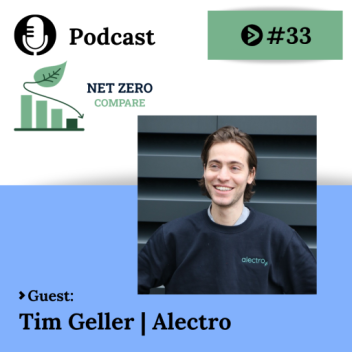
#33: Tim Geller on Sustainability Without a Team: How SMEs Can Approach Emissions, Data, and ROI
In this episode
Executive summary
Tim Geller explains how mid-sized companies approach sustainability despite lacking dedicated teams. Many start informally, using simple tools to measure emissions, establish a baseline, and produce usable reports. Emissions tracking is often inconsistent, with reliance on spreadsheets and changing methodologies, making comparisons difficult. Key challenges evolve: early on, alignment and data collection; later, prioritizing actions based on cost and impact. Scope 3 emissions remain complex due to unclear boundaries, limited supplier data, and methodological flexibility. Companies are encouraged to act despite imperfect data by first identifying major emission hotspots. Strong sustainability efforts are linked to business value through revenue opportunities, efficiency gains, and procurement advantages. Common mistakes include delaying action and lacking management support. The focus should be on starting small, staying consistent, and improving over time. Ultimately, sustainability is most effective when integrated into decision-making, supported by internal engagement, and driven beyond compliance.
Tim Geller, Co-Founder of Alectro, works directly with companies navigating sustainability, emissions tracking, and reporting. His perspective comes from building tools for organizations that often lack dedicated sustainability teams but still face growing expectations around ESG and compliance.
In a conversation hosted by Net Zero Compare, the discussion focused on how companies actually approach emissions in practice, where they struggle, and how sustainability efforts can translate into operational and financial outcomes.
🎥 Watch the Full Conversation: For a deeper understanding of how companies are handling sustainability in practice, including real examples and practical considerations, you can watch the full conversation with Tim Geller below. The discussion adds context to topics such as Scope 3 complexity, data challenges, and how organizations prioritize actions. It also highlights how decision-making evolves over time as companies mature in their reporting journey.
A Practical Starting Point for Companies Without Sustainability Teams
Alectro focuses on companies that fall between having no structure and having a full sustainability department. These are typically organizations with around 100 to 250 employees, where sustainability is not owned by a dedicated role.
In many of these companies, responsibility is informal. Someone takes initiative, often without prior experience, and attempts to move things forward.
This creates a clear need for tools that reduce complexity. The goal is not to build a perfect system from day one, but to enable companies to:
measure emissions quickly
establish a baseline
generate usable outputs for internal stakeholders
The emphasis is on accessibility. Companies should be able to start with limited expertise and still produce a report that is consistent and usable.
How Companies Actually Handle Emissions Today
In practice, emissions tracking is still highly fragmented. Many organizations rely on spreadsheets. These setups can work initially, but tend to break when data changes or when companies attempt to revisit previous years. At the same time, some companies limit what they report, which makes comparisons difficult and reduces transparency.
A key issue is inconsistency. Companies often change methodologies, boundaries, or emission factors over time. This makes it difficult to track progress or compare results across reporting periods. A more effective approach is to:
define clear boundaries from the beginning
select a methodology
apply it consistently over time
For smaller organizations in particular, there is little external enforcement. This makes internal discipline and transparency more important than attempting to optimize the numbers.
For companies looking to better understand how to approach emissions tracking, reporting methodologies, and common pitfalls in more detail, Alectro provides additional practical guidance in its Resource Centre.
Where Sustainability Efforts Break Down
The challenges companies face depend on where they are in their reporting journey.
In the first year, the main barrier is internal alignment. Organizations need to agree to start measuring emissions, which can be difficult when outcomes are uncertain. There is often hesitation due to lack of familiarity. Once the process begins, the focus shifts to data:
collecting the necessary inputs
ensuring data quality
organizing information across teams
In later years, the challenge becomes prioritization. Companies begin to ask which actions are worth investing in and which will have the greatest impact. A practical way to approach this is to:
list potential actions
estimate their cost
compare them based on cost per unit of emissions reduction
This allows organizations to make decisions based on both environmental and financial impact.
Why Scope 3 Remains Difficult
Scope 3 emissions are complex because they extend beyond direct control.
The first challenge is defining boundaries. Emissions can theoretically extend across an entire value chain, including product use and end-of-life processes. Companies must decide where their responsibility begins and ends.
The second challenge is methodological flexibility. The Greenhouse Gas Protocol allows multiple interpretations, which can lead to inconsistencies in how emissions are categorized.
The third challenge is data availability. Accurate activity data from suppliers is difficult to obtain, especially in the early stages. As a result:
Scope 3 measurement is iterative
supplier engagement becomes necessary over time
reliance on spend-based estimates is common early on
However, relying only on spend-based methods can distort results as companies grow. Transitioning toward more precise data is necessary for long-term accuracy.
Data Quality vs. Taking Action
Many companies delay action while waiting for better data. This often slows progress. A more effective approach is to focus on identifying emission hotspots, even with imperfect data. Once hotspots are identified:
companies can prioritize high-impact areas
improvements can be tracked using activity metrics
data quality can be refined over time
The objective is not to achieve perfect precision immediately. The objective is to enable decision-making and reduction efforts.
In practice, measuring everything at a basic level first, then improving specific areas, is more effective than trying to perfect all data upfront.
Building the Business Case for Sustainability
The strongest sustainability initiatives are tied to clear business outcomes. There are several ways companies typically justify investments:
1. Revenue impact
In some cases, sustainability performance influences contract decisions. Companies that meet ESG expectations may have a higher chance of winning business.
2. Operational efficiency
Reducing manual work or improving processes can translate into time savings, which have a measurable cost benefit.
3. Procurement advantages
Engaging suppliers on sustainability can lead to broader market comparisons. This can result in better pricing or improved supplier selection.
Not all benefits are immediate. Some become visible over time, particularly as organizations integrate sustainability into procurement and decision-making processes.
The Role of Regulation vs. Voluntary Action
Regulation plays a significant role in driving adoption, but it also introduces uncertainty. Changes in policy can quickly alter incentives. When reporting requirements are reduced or removed, companies may deprioritize sustainability efforts.
As a result, many organizations still approach sustainability as a compliance exercise rather than a strategic initiative.
However, there is also a growing voluntary driver, particularly in business-to-consumer markets. Companies that position themselves as more sustainable can differentiate their products, especially when price and quality are comparable.
In business-to-business environments, behavior remains more closely tied to regulatory requirements and client expectations.
Common Mistakes Companies Make Early On
One of the most common mistakes is delaying action while evaluating tools. Instead of spending excessive time selecting a platform, companies can:
run a basic initial assessment
establish a baseline
use that data to build internal support
Another issue is a lack of management buy-in. Without it, sustainability efforts often stall. To address this, internal teams need to:
demonstrate clear benefits
connect sustainability to financial or operational outcomes
use examples from competitors or peers
Starting small and showing results tends to be more effective than attempting to design a complete strategy upfront.
What Will Scale in the Next 5 to 10 Years
Looking ahead, one area with potential impact is carbon removal technologies. For many companies, especially smaller ones, some emissions are difficult to eliminate. Affordable removal solutions could provide a way to address these residual emissions.
At present, these technologies are primarily used by organizations with larger budgets. Wider adoption will depend on cost reductions over time.
As early adopters invest, the expectation is that costs will decrease, making these solutions more accessible.
Beyond Measurement: Engaging the Organization
Sustainability is not limited to measurement and reporting. One overlooked aspect is internal engagement. Sharing results across the organization can influence behavior beyond formal processes.
Employees who understand where emissions come from are more likely to adjust their own actions. This creates an indirect impact that extends beyond the company’s measured footprint.
This broader influence can support long-term progress, even if it is not directly captured in reporting metrics.
Conclusion
The conversation with Tim Geller highlights a clear pattern. Most companies are still in the early stages of their sustainability journey, often relying on fragmented systems and limited internal resources.
For these organizations, the priority is not perfection. It is establishing a baseline, maintaining consistency, and focusing on actions that deliver measurable impact. Key takeaways include:
start with what is available rather than waiting for perfect data
define boundaries and apply methods consistently
prioritize actions based on cost and impact
connect sustainability efforts to business outcomes
engage both suppliers and employees over time
Sustainability becomes more effective when it moves beyond compliance and becomes part of how decisions are made across the organization.
Topics
More from Net Zero Compare Podcast
#59: Lisa Wright on Why eVTOL Infrastructure May Matter as Much as the Aircraft
#58: Arjun Gupta on Packaging EPR in the US: How AI Is Changing Compliance, Data Management, and Cost Forecasting
#57: Lubomila Jordanova on Corporate Sustainability: From Carbon Accounting to Business Value

#56: Hesham Gamal Gaafar on Digital Twins in Smart Cities and Infrastructure: Where the Real Value Comes From
#55: Bhuva Shakti on What Makes a Climate Company Investable, and Where AI Actually Helps