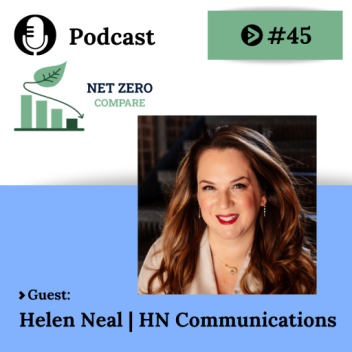
#45: Helen Neal on How Companies Can Communicate Sustainability Progress Without Greenwashing
In this episode
Executive summary
Helen Neal, founder of HN Communications and creator of Zena, explains why sustainability communication has become a governance issue, not just a marketing task. She argues that greenwashing often results from weak internal processes rather than intentional deception, especially when sustainability, legal, marketing, and corporate affairs teams work separately. The discussion covers how companies can reduce risk by defining claim scope, keeping evidence, clarifying methodologies, involving teams earlier, and reviewing content before publication. Neal also highlights greenhushing, where companies avoid communicating legitimate progress due to fear of criticism. The podcast emphasizes that credible sustainability communication should be accurate, evidence-based, transparent about limitations, and adapted to different regulatory markets.
Companies face a difficult balance when communicating sustainability progress. Saying too much without sufficient evidence can create greenwashing risk. Saying too little can leave investors, customers, employees, and other stakeholders without information they increasingly expect.
Helen Neal works at the intersection of sustainability communications, regulation, and corporate governance. She is the founder of HN Communications and the creator of Zena, an AI-based pre-publication governance platform designed to help corporate teams review sustainability content before it becomes public.
In a conversation hosted by Net Zero Compare, Neal discussed why sustainability communications have become more difficult, where greenwashing often originates, and how organizations can build more reliable internal review processes.
Her central argument was straightforward: credible sustainability communication depends on more than careful wording. Companies need evidence, defined responsibilities, cross-functional cooperation, and a review process that begins before content reaches the public.
🎥 Watch the Full Conversation: Watch the full Net Zero Compare interview with Helen Neal for a more detailed discussion of greenwashing, greenhushing, regulatory complexity, and the role of AI in reviewing sustainability claims. The conversation also examines how sustainability, legal, marketing, and corporate affairs teams can work together more effectively. Watching the full discussion provides additional context and practical examples that cannot be captured fully in a written summary.
From Regulatory Affairs to Sustainability Communications
Neal began her career in British politics, working in Parliament with a focus on defense, international relations, policy, and regulation. She later moved into corporate roles at companies including Virgin Atlantic and Nissan, where her work involved helping heavily regulated businesses navigate political and policy developments across multiple markets.
Because aviation and automotive companies face significant scrutiny related to emissions and pollution, sustainability gradually became a larger part of her work.
Neal founded HN Communications approximately a decade ago. Although it began as a broader communications agency, clients increasingly approached the company for help with sustainability, regulatory issues, and corporate affairs.
Over time, the connection between regulation and sustainability communication became increasingly clear. Companies were not only trying to understand what environmental action they should take. They were also trying to determine what they could credibly and safely say about it. That challenge ultimately contributed to the development of Zena.
Why Sustainability Communication Has Become More Difficult
Several years ago, companies often competed to announce ambitious climate commitments. Public targets and long-term pledges attracted attention and could strengthen corporate reputation. The problem is that commitments eventually need to be supported by results.
As target dates approach, companies face more pressure to demonstrate progress, explain their methodology, and show how they intend to deliver on earlier promises. At the same time, political attitudes toward sustainability have become more divided in some markets.
According to Neal, many companies have not necessarily stopped investing in sustainability. Instead, they have changed how they describe those investments. The language has shifted away from purely values-based arguments and toward concepts such as:
Business resilience
Long-term planning
Supply chain security
Risk management
Operational continuity
Commercial performance
This does not necessarily mean that climate or environmental objectives have disappeared. It means that companies are increasingly explaining sustainability through its business implications.
Regulatory scrutiny has added another layer of complexity. Companies operating internationally may need to consider different consumer protection rules, reporting obligations, advertising standards, and expectations regarding evidence. The result is a more cautious communications environment.
Greenwashing Is Often a Process Failure
Greenwashing is commonly associated with deliberate deception. Neal argued that, in practice, companies often expose themselves to greenwashing risk unintentionally. The underlying problem is frequently a broken internal process.
A large organization may have separate sustainability, legal, marketing, communications, product, procurement, and corporate affairs teams. Each department may contribute to public sustainability claims, but they may not collaborate at the right stage.
The sustainability team may understand the data but not control the final campaign. Marketing may be responsible for creating a clear and engaging message but may not have full access to the methodology behind it. Legal teams may only review the material shortly before publication, when substantial changes are more difficult. This structure can produce claims that present the company or product positively but leave out important limitations, evidence, or context.
Sustainability information should therefore be treated with a level of rigor similar to financial information. A company should be able to explain where the data came from, what the claim covers, how it was calculated, and what limitations apply. The risk is not limited to factually false statements. A claim can also mislead through:
Vague or undefined wording
Missing context
Selective use of data
Unsupported comparisons
Unclear boundaries
Images or presentation that create an exaggerated impression
Failure to disclose relevant limitations
A brief public statement may sit on top of a much larger body of internal evidence. If that evidence does not exist, or cannot be retrieved, the claim is vulnerable.
The Other Risk: Greenhushing
As scrutiny increases, some companies choose to communicate less. This is commonly described as greenhushing. Greenhushing may reduce the immediate risk of criticism, but remaining silent is not always a practical solution. Larger organizations may still have reporting obligations, while investors and commercial partners may expect access to sustainability information.
Silence can also prevent companies from explaining legitimate progress supported by years of investment. Neal argued that businesses need greater confidence in how to communicate, rather than simply avoiding the subject. This requires internal knowledge of what constitutes a credible claim, what evidence is necessary, and what information should be disclosed.
Responsible communication does not mean presenting every initiative as a success. It means explaining what has been achieved, what remains incomplete, and what evidence supports the company’s position.
The Critical Stage Before Publication
Companies often invest heavily in collecting sustainability data, calculating emissions, developing targets, and producing reports. However, risk can intensify when technical information is translated into public-facing language.
A data set may be accurate, but the final headline, campaign, product label, press release, or social media post can still create a misleading impression. Neal described this pre-publication stage as a critical point in the process. Before approving a sustainability claim, companies should ask:
Is the claim supported by current data?
Are its boundaries clearly defined?
Does it apply to the whole product, company, or operation, or only one part?
Is the methodology available and understandable?
Has relevant evidence been independently verified?
Can the organization provide real-world examples?
Does the statement explain progress rather than only an end goal?
Are important limitations or setbacks being omitted?
These questions apply across several formats, including sustainability reports, product pages, advertising campaigns, investor communications, websites, and social media.
The objective is not merely to remove risky language. A strong review process should help the company communicate clearly while preserving the factual meaning of the underlying information.
What Zena Is Designed to Do
Zena was created as a pre-publication governance tool for teams preparing sustainability content. Users can submit draft material, including reports, press releases, campaign copy, or internal papers. The platform then reviews the content against relevant regulatory and best-practice considerations and identifies areas that may require more evidence, explanation, or qualification.
Rather than simply labeling a claim as acceptable or unacceptable, the platform is intended to guide the user through questions such as:
Is additional data required?
Should the scope of the claim be narrowed?
Is a third-party verifier identified?
Is the language too broad?
Does the content need a concrete example?
Are the company’s actions and progress sufficiently explained?
Neal said an unexpected use case has been early-stage drafting. Some users do not wait until a document is finished. They use the platform while developing reports, board papers, and other content to test whether they are approaching the subject appropriately. This turns the review process into a form of internal training. Staff can gradually improve their understanding of what makes sustainability communication credible.
Navigating Different Markets and Regulatory Frameworks
International companies face an additional challenge because environmental claims are governed by different frameworks in different jurisdictions. The interview covered examples including the UK Competition and Markets Authority’s Green Claims Code, the US Federal Trade Commission’s Green Guides, the EU Corporate Sustainability Reporting Directive, and the EU rules on empowering consumers for the green transition.
The proposed EU Green Claims Directive was also discussed. Neal noted that its legislative progress had been put on hold, illustrating a broader difficulty for companies: the rules themselves can continue to evolve. The frameworks are not identical, but they share several recurring principles. Environmental claims should generally be:
Accurate
Clear
Appropriately qualified
Supported by credible evidence
Transparent about their scope
Presented without omitting important information
For multinational organizations, a statement developed for one market may require different wording, evidence, or disclosures elsewhere. Translation adds further complexity because regulatory meaning and consumer interpretation may change between languages. Companies should therefore avoid assuming that one approved global statement can be used unchanged in every jurisdiction.
What Evidence Should Support a Sustainability Claim?
The type of evidence required depends on the claim, but Neal identified several recurring components.
Clearly defined scope
The company should specify what the claim covers. It may apply to one product, one facility, one market, one stage of the value chain, or a defined period. A broad statement can create the impression that it applies to the entire business when the evidence only relates to a limited area.
A credible baseline
Progress claims require a starting point. Companies should be able to explain the baseline year, the data included, and whether calculation methods have changed.
A clear methodology
The company should document how the result was calculated. This becomes particularly important for emissions, product footprints, recycled content, avoided emissions, and circularity claims.
Relevant independent verification
Third-party verification can strengthen credibility and may be necessary in certain contexts. It does not replace accurate internal data, but it provides additional assurance that the methodology and result have been reviewed independently.
Interim targets and delivery plans
Long-term climate targets should be supported by nearer-term milestones. Organizations should explain what actions are expected, when they will occur, and how progress will be measured.
Life-cycle information
Claims related to recyclability, circularity, or product impact should consider where the stated benefit applies within the product’s life cycle. For example, a product may contain recycled material but still present challenges related to manufacturing, transportation, use, repair, or disposal. Focusing on only one positive feature can distort the overall impression.
Real-world evidence
Case studies can help explain how a policy or target works in practice. However, they should not become promotional stories that omit difficulties. Neal recommended acknowledging what did not work, what the company learned, and what it changed. This can make a sustainability account more credible than a story that presents uninterrupted success.
Sustainability and Marketing Should Work Together Earlier
Cross-functional cooperation is more effective when it begins at the start of a project. Bringing the sustainability team into a campaign shortly before publication can create conflict. At that point, the strategy, design, budget, and core message may already be fixed.
When sustainability specialists work with marketing from the beginning, they can help identify credible themes, appropriate evidence, and relevant environmental or social connections. Neal cited the Polish beer brand “Żubr” as an example. Its connection to the European bison created a natural basis for a biodiversity-focused campaign developed with WWF.
The relevance of the connection mattered. Not every sustainability topic fits every product or brand. Companies should avoid attaching themselves to an issue simply because it is prominent. A credible campaign should reflect a genuine relationship between the brand, its operations, its impact, and the issue it is discussing.
Practical First Steps for Companies
Organizations without a mature sustainability communications process should not begin with a promotional campaign. The first step is to understand what the business is already doing. Sustainability extends beyond carbon emissions. Depending on the organization, it may include:
Energy and emissions
Water management
Biodiversity
Resource use
Waste and circularity
Supply chain resilience
Labor practices
Community impact
Product safety and accessibility
Broader social responsibility
Some companies may already be carrying out relevant work without labeling it as sustainability.
The next step is to define objectives and establish a system for monitoring progress. Companies need to know what they are trying to achieve, what data they will collect, and who is accountable.
Neal recommended taking action before communicating extensively. A company should establish a plan, begin implementation, collect evidence, and demonstrate some progress before promoting its ambitions publicly. When the organization is ready to communicate, it should:
Gather the supporting data and documentation.
Identify both positive results and unresolved problems.
Involve sustainability, marketing, legal, and other relevant teams.
Define who approves different types of claims.
Review content against the rules in each target market.
Retain the evidence supporting the final published statement.
Reassess claims when data, regulations, or business activities change.
Leadership support is also essential. Sustainability is unlikely to become embedded when responsibility sits with one isolated department. Neal said the strongest results occur when the board and senior leadership support the work and when different business functions have sustainability-related responsibilities and performance indicators.
Regulation Should Not Eliminate Meaningful Communication
Companies need to take regulatory risk seriously, but avoiding penalties should not become the sole purpose of sustainability communication.
An excessive focus on compliance can produce content that is technically detailed but difficult to understand. Reports may contain extensive data without explaining why the information matters or what is changing within the organization.
The alternative is not to weaken the evidence. It is to combine evidence with clear and honest storytelling. Businesses should be able to explain:
What they are trying to change
Why the issue is relevant to their operations
What action they have taken
What results they have achieved
What has not worked
What they intend to do next
That approach provides more value than either exaggerated promotion or complete silence.
Conclusion
Sustainability communication has become a governance issue as much as a marketing issue. Companies need reliable data, but data alone does not guarantee a credible public claim. The information must be translated carefully, reviewed by the right teams, and presented with clear boundaries, supporting evidence, and relevant context.
Organizations should involve sustainability specialists earlier, treat environmental information with rigor, and establish accountability across departments. They should also resist the temptation to communicate only successes. Honest discussion of limitations and incomplete progress can strengthen credibility.
Regulatory expectations will continue to evolve, particularly for companies operating across multiple markets. However, the underlying practical principles are relatively consistent: understand the claim, define its scope, retain the evidence, disclose relevant limitations, and make sure the public message reflects the underlying facts.
For sustainability and business leaders, the goal should not be to choose between promotion and silence. It should be to build a process that allows the organization to communicate meaningful progress responsibly.
More from Net Zero Compare Podcast
#54: Patrick Sherwin on What Makes Clean Energy Technology Work in the Real World

#53: Josh Harrison on Why Climate Adaptation Requires Connected Solutions for Forests, Buildings, and Cities
#52: Albert Slap on Why Property Climate Risk Requires More Than a Hazard Score
#51: Wayne Visser on How Businesses Can Separate Climate Technology Progress From Hype

#50: Frédéric Pouyot on Why Systems Thinking Is the Missing Piece of Sustainable Infrastructure