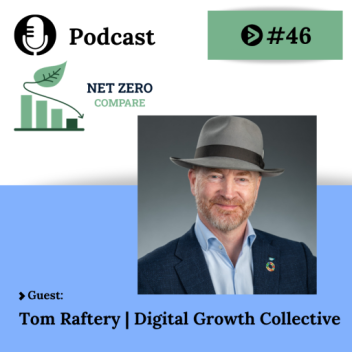
#46: Tom Raftery on Why Sustainability Is Becoming a Core Business System, Not a Separate ESG Function
In this episode
Executive summary
Tom Raftery argues that sustainability is becoming part of everyday business management, linked to cost, risk, resilience, and efficiency. Clean energy is increasingly an economic decision, helping companies reduce exposure to volatile fossil fuel prices and improve energy security. Supply chain visibility is essential for measuring emissions, managing risk, and improving procurement decisions. Scope 3 reporting requires supplier cooperation, starting with the suppliers responsible for the largest share of emissions. AI can support complex supplier analysis, but only when companies have reliable data. The main message: start by measuring emissions, engage priority suppliers, and integrate environmental data into financial and operational systems.
Sustainability is increasingly connected to the systems companies already use to manage procurement, finance, energy, suppliers, and operational risk.
Tom Raftery has spent many years working at the intersection of technology, sustainability, energy, supply chains, and digital transformation. His experience includes serving as a Global Vice President at SAP, advising organizations, speaking internationally, and developing an independent media platform focused on the energy transition, climate innovation, and supply chain resilience.
In a conversation hosted by Net Zero Compare, Raftery discussed how the economics of clean energy are changing, why supply chain data is becoming more important, where artificial intelligence can provide practical value, and why emissions reporting will need to become part of core business operations.
🎥 Watch the Full Conversation: Watch the full Net Zero Compare interview with Tom Raftery for a more detailed discussion of clean energy, supply chain resilience, Scope 3 emissions, procurement, and enterprise technology. The recording provides additional context around the examples covered in this article, including power purchase agreements, supplier engagement, electric vehicles, and the growing role of emissions data in financial decision-making. The full conversation also explores where companies may be overestimating technology and where practical opportunities already exist.
Sustainability Language Is Changing, but the Work Is Continuing
Raftery described a noticeable change in how companies communicate about sustainability. In some markets, particularly amid political pressure on ESG, companies have become more cautious about publicly describing their work as sustainability-focused. Instead, they increasingly use terms such as resilience, efficiency, security, and risk management.
This does not necessarily mean that companies have stopped investing in sustainability. In many cases, the underlying work continues, but it is presented through a different business lens. The shift matters because sustainability is now linked to issues that companies already consider operationally important:
Energy security
Supply chain continuity
Cost control
Customer retention
Access to capital
Insurance costs
Regulatory compliance
Supplier performance
For decision makers, the practical question is becoming less about whether an initiative should be labeled “sustainable” and more about whether it reduces risk, improves efficiency, or strengthens the business.
Clean Energy Is Increasingly an Economic Decision
One of the clearest changes identified in the conversation is the declining cost of renewable energy and energy storage. Raftery pointed to the long-term reduction in the cost of solar power, supported by increased production, technological learning, and economies of scale. As more solar capacity has been installed, the industry has gained experience, manufacturing has expanded, and costs have continued to fall.
Wind power and battery storage have followed a similar direction, although at different rates. This changes the way organizations should assess energy investments. Renewable energy is not only a decarbonization option. In many markets, it can also offer:
Lower energy costs
Faster deployment than large conventional power projects
Reduced exposure to fossil fuel price volatility
More predictable long-term costs
Greater energy independence
Raftery contrasted the time and cost required to develop large nuclear or fossil fuel projects with the shorter development timelines available for many solar and wind installations.
His central point was not that every energy system should follow the same path. It was that organizations should assess available technologies based on deployment time, total cost, security of supply, and emissions impact rather than relying on outdated assumptions about which energy sources are affordable.
Power Purchase Agreements Can Improve Energy Resilience
Recent disruptions in global energy markets have shown how exposed businesses can be to geopolitical events and fossil fuel price fluctuations. Raftery argued that renewable energy can strengthen resilience because solar and wind resources are produced locally and are not dependent on international fuel transport routes. He highlighted power purchase agreements, or PPAs, as one practical option.
Under a PPA, an energy provider may develop and operate a renewable energy installation and sell the electricity to a company under a long-term agreement. Depending on the structure, the customer may avoid a large upfront capital investment while receiving more predictable electricity prices over a period that can extend for decades. For businesses with significant energy consumption, this can provide two forms of security:
Greater certainty over the availability of energy
Greater certainty over its long-term price
PPAs will not be suitable for every organization or location. Companies still need to evaluate contract terms, grid conditions, expected production, storage requirements, and regulatory factors. However, they illustrate how sustainability and resilience can reinforce each other when a project reduces both emissions and exposure to energy market volatility.
Sustainability Is Moving Beyond Compliance
For many organizations, regulatory requirements are the initial reason to measure emissions or improve sustainability reporting. Raftery noted, however, that compliance is only one part of the business case. Companies are also facing pressure from customers, employees, investors, banks, insurers, boards, and procurement teams.
Customers may prefer suppliers that can provide credible sustainability information. Employees may be more attracted to organizations with a clear environmental position. Banks and insurers increasingly need information about the emissions connected with the businesses they finance or cover. This makes emissions data relevant to commercial decisions.
A company that cannot provide reliable information may be viewed as a higher-risk customer, borrower, supplier, or insured party. Where primary data is unavailable, organizations may need to rely on industry averages, which provide less certainty about actual performance. The result is that sustainability reporting can affect:
Customer acquisition and retention
Employee recruitment and retention
Cost of capital
Insurance pricing
Supplier eligibility
Procurement decisions
Corporate reputation
Sustainability therefore becomes a risk and cost-management issue, not only a communications or compliance exercise.
The Green Premium May Decline as Technologies Scale
Sustainable products and services are sometimes more expensive than conventional alternatives. This difference is often described as a green premium. Raftery argued that this premium may decline as technologies mature, production expands, and processes become more efficient.
Many sustainability initiatives are based on reducing waste, using fewer inputs, lowering energy consumption, or improving resource productivity. In principle, these improvements should reduce costs over time. The challenge is that newer technologies may initially lack scale. Companies may face higher equipment costs, limited supplier availability, or immature infrastructure. As adoption increases, those conditions can change.
This does not mean that every sustainable product will automatically become cheaper. Costs depend on the product, industry, geography, production method, and supply chain. However, organizations should not assume that lower-emission alternatives will always carry a permanent cost disadvantage. In some cases, their operational efficiency and lower energy requirements may eventually make them the less expensive option.
Supply Chain Resilience Depends on Visibility
A resilient supply chain is one that can continue operating through disruptions with fewer delays, shortages, and unexpected costs. That requires more than maintaining extra inventory or identifying alternative suppliers.
Raftery emphasized the importance of visibility. Companies need to understand who their suppliers are, where materials originate, how suppliers operate, and what risks exist across the value chain. This information is also central to sustainability.
Without supplier data, a company cannot accurately assess much of its environmental impact. It may also struggle to identify exposure to high-emission materials, unstable energy sources, regulatory risks, or operational bottlenecks. Data visibility supports several objectives at once:
Emissions reporting
Supplier risk assessment
Regulatory compliance
Cost reduction
Procurement planning
Product-level reporting
Business continuity
This is one of the clearest links between sustainability and resilience. Both depend on reliable information about operations beyond the company’s direct control.
Scope 3 Reporting Requires Supplier Cooperation
Scope 3 emissions remain difficult because the relevant information often belongs to suppliers, logistics providers, customers, and other parties in the value chain. A supplier’s Scope 1 and Scope 2 emissions may become part of its customer’s Scope 3 inventory.
The first challenge is determining whether suppliers measure these emissions at all. The second is persuading them to share the information in a useful and consistent format.
Where primary data is unavailable, companies often use industry averages. These estimates can provide a starting point, but they do not offer the same level of accuracy or supplier-specific insight. Raftery recommended a gradual approach rather than waiting for perfect data. One practical method is to apply the 80/20 principle:
Identify the smaller group of suppliers responsible for the majority of estimated emissions.
Focus initial engagement and data collection efforts on those suppliers.
Continue using estimates for lower-impact suppliers while improving coverage over time.
This allows organizations to begin reporting and making decisions before every data gap has been resolved. It also avoids a common mistake: postponing action because the company does not yet have a complete or perfect dataset.
Supplier Engagement Can Create Mutual Value
Companies cannot solve Scope 3 reporting alone. They need suppliers to participate. For large organizations, this may involve direct engagement, technical support, contractual requirements, or consultancy-led supplier programs.
Smaller companies may need a more targeted approach. They can begin by explaining why the information is required, how missing data affects the commercial relationship, and what reporting expectations may apply in the future. This does not need to begin with an immediate ultimatum.
A company might inform a supplier that emissions data will become an increasingly important procurement requirement, ask what systems the supplier already has in place, and agree on a timeline for improvement.
Suppliers may also benefit from the process. Once they can measure and report their own emissions, they can provide that information to other customers, improve their competitiveness, and respond more efficiently to future reporting requests. Over time, this can lead to closer and longer-lasting supplier relationships.
Technology Is Foundational, but It Cannot Fix Poor Data
Digital systems make it possible to collect, exchange, analyze, and report supply chain information at scale. They can help companies:
Connect with supplier systems
Collect operational data
Visualize emissions and performance
Identify inefficiencies
Automate parts of reporting
Compare suppliers
Track progress over time
However, technology is only useful when it has access to reliable information. Raftery cautioned against assuming that a new platform or artificial intelligence system can compensate for missing data, weak processes, or unclear objectives.
A company should first define the problem it is trying to solve. It should then determine what information is needed, where that information resides, and whether it is sufficiently accurate. Only after those foundations are in place can technology produce dependable results.
The technical implementation may also be easier than the organizational change. Companies still need employees and suppliers to adopt new processes, share information, and use systems consistently. Change management therefore remains an essential part of sustainability technology projects.
AI Can Support More Informed Procurement
Raftery identified procurement as one of the most practical uses of artificial intelligence in sustainability. Large organizations may work with thousands or tens of thousands of suppliers. Procurement teams already evaluate factors such as:
Price
Quality
Delivery performance
Reliability
Geographic exposure
Contract terms
Emissions performance adds another variable.
The challenge is not simply ranking suppliers by emissions. Procurement teams need to consider several factors at the same time. The lowest-emission supplier may not be the least expensive, most reliable, or best positioned to meet production requirements. AI can support this type of multivariable analysis.
When supplied with reliable procurement, emissions, cost, and performance data, an AI system may help identify supplier combinations that reduce Scope 3 emissions without ignoring commercial requirements. This is a defined business use case with measurable objectives.
It is different from adding AI features to a platform without a clear operational purpose. Raftery noted that AI remains a relatively young area in its current generative form and should be implemented with care. The quality of the output still depends on the quality of the data, the design of the system, and the decisions made by the people using it.
Emissions Data Should Be Embedded in Enterprise Systems
For larger organizations, sustainability data cannot remain isolated in spreadsheets or separate ESG systems indefinitely. Raftery argued that companies need a digital backbone capable of connecting emissions information with financial and operational transactions.
An enterprise resource planning system can help organizations understand both the financial cost and the emissions associated with purchasing, production, logistics, and other business activities. This creates a more complete basis for decision-making.
For example, procurement teams could evaluate a supplier based not only on price and delivery performance, but also on the emissions attached to the purchased product or service. Raftery’s broader argument was that emissions should eventually be accounted for with a level of rigor similar to financial costs.
That may also change where sustainability responsibilities sit within organizations. As reporting becomes more formal and connected to financial risk, sustainability functions may work more closely with finance teams and chief financial officers.
Smaller companies do not need to implement large enterprise systems to follow the same principle. They still need a consistent method for connecting emissions data with their actual operations and financial decisions.
Practical First Steps for Smaller Companies
Small and medium-sized companies often lack dedicated sustainability departments, large consulting budgets, or complex enterprise platforms. Raftery recommended starting with carbon accounting.
The first objective should be to develop a basic understanding of the organization’s emissions, identify the largest sources, and prepare for customer or regulatory reporting requests. A practical sequence may include:
Select a carbon accounting solution appropriate for the company’s size and industry.
Calculate an initial emissions baseline.
Identify the most significant Scope 1, Scope 2, and Scope 3 categories.
Prioritize the suppliers or activities responsible for the largest share of emissions.
Improve primary data collection gradually.
Track relevant regulatory and customer reporting requirements.
Use the findings to guide reduction efforts and purchasing decisions.
Companies can compare carbon accounting and sustainability solutions on Net Zero Compare, including tools designed for small, medium-sized, and large organizations. The objective is not to create a perfect system immediately. It is to establish a credible starting point and improve it over time.
Regulation Will Continue to Influence Business Requirements
Raftery concluded by emphasizing the need to follow regulatory developments, particularly in Europe. New and evolving rules can affect emissions reporting, product information, supply chain due diligence, carbon-related import requirements, and the data companies must provide to customers. Even organizations that are not directly covered by a regulation may be affected indirectly.
A large customer may ask smaller suppliers for emissions or sourcing information because it needs that data for its own compliance. Banks and insurers may introduce additional requirements. Procurement contracts may include new sustainability conditions. This means companies should not evaluate regulation only by asking whether a law applies directly to them. They should also consider whether it applies to their customers, lenders, insurers, investors, or business partners.
Conclusion
Tom Raftery’s central message is that sustainability is becoming part of ordinary business management. Clean energy can support cost stability and energy security. Supply chain visibility can improve both resilience and emissions reporting. Better supplier data can support procurement, financing, insurance, and compliance decisions. AI can help analyze complex supplier information, but only when companies have reliable data and clearly defined objectives. The most important practical step is to begin building the necessary foundation.
Companies do not need to wait for perfect data, implement every available technology, or create a large sustainability department. They can start by measuring emissions, identifying their largest sources, engaging priority suppliers, and connecting environmental information with financial and operational decisions.
As reporting expectations continue to develop, organizations that treat emissions data as part of their core business systems will be better prepared than those that continue to manage sustainability as a separate reporting exercise.
Topics
More from Net Zero Compare Podcast

#59: Lisa Wright on Why eVTOL Infrastructure May Matter as Much as the Aircraft

#58: Arjun Gupta on Packaging EPR in the US: How AI Is Changing Compliance, Data Management, and Cost Forecasting

#57: Lubomila Jordanova on Corporate Sustainability: From Carbon Accounting to Business Value

#56: Hesham Gamal Gaafar on Digital Twins in Smart Cities and Infrastructure: Where the Real Value Comes From
#55: Bhuva Shakti on What Makes a Climate Company Investable, and Where AI Actually Helps