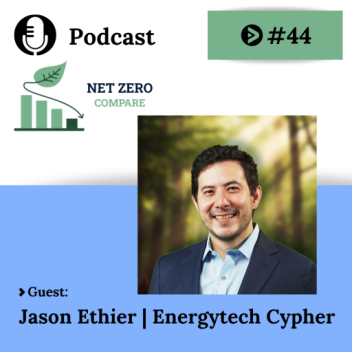
#44: Jason Ethier on Climate Tech Needs More Than Innovation. It Needs Deployment, Timing, and the Right People
In this episode
Executive summary
In this Net Zero Compare conversation, Jason Ethier, founder of Energytech Cypher, explains why climate and energy innovation depends on far more than new technology. He argues that the real challenge is deploying solutions at scale in markets shaped by regulation, infrastructure limits, cost pressure, risk aversion, and reliability requirements. The discussion covers why energy technologies are harder to commercialize than software, how capital often fails to reach real deployment, and what investors look for in early-stage companies. Ethier also highlights the importance of strong teams, differentiated intellectual property, operational discipline, and clear storytelling. Drawing on lessons from Greentown Labs and Houston’s energy ecosystem, he shows why successful climate tech companies need the right timing, partners, financing, and execution to move from prototype to real-world impact.
The energy transition is producing no shortage of new technologies, startups, and investment headlines. But according to Jason Ethier, founder of Energytech Cypher, the real challenge is not generating ideas. It is getting technologies deployed at scale in environments where reliability, regulation, cost, and infrastructure constraints all matter simultaneously.
In a conversation hosted by Net Zero Compare, Ethier discussed the realities of scaling climate and energy technologies, how capital is actually flowing through the market, and why many startups struggle long before commercialization becomes possible. He also shared lessons from his time helping build Greentown Labs and working within the broader Houston energy ecosystem.
🎥 Watch the Full Conversation: This conversation with Jason Ethier explores the practical side of climate and energy innovation, including commercialization, infrastructure investment, grid limitations, and the realities of scaling physical technologies. The discussion also covers venture capital dynamics, startup execution challenges, and why Houston has become a major hub for energy transition activity. Readers interested in how climate technologies move from prototypes to real-world deployment may find additional nuance and examples in the full recording.
Why Energy Deployment Is Harder Than Software
Ethier explained that energy technologies operate in a very different environment from software startups. Building a power plant, industrial system, or grid-connected infrastructure project can take years, involve multiple regulatory approvals, and require substantial upfront capital. Buyers are naturally risk-averse because the systems being deployed are considered mission-critical.
According to Ethier, companies often face an overwhelming number of possible technical solutions while simultaneously needing certainty around reliability, availability, and long-term operating performance. Even technologies that appear promising on paper may struggle to gain traction if they cannot clearly demonstrate economic value.
He emphasized that creativity alone is not enough. In his view, innovation only matters if customers are willing to pay for it and if the technology delivers measurable operational value. In energy markets, that means being more reliable, more resilient, lower cost, and more sustainable at the same time.
Energytech Cypher and the Search Problem in Climate Tech
Ethier described Energytech Cypher as an attempt to reduce fragmentation across energy and climate ecosystems. The company combines data systems, relationship-building, and industry events to help companies identify technologies that fit specific operational needs.
One of the problems he highlighted is that organizations often spend large amounts of time simply trying to evaluate which technologies are relevant to their use cases. Traditional search systems are not designed to handle the complexity of industrial energy requirements, infrastructure constraints, or specialized deployment scenarios.
To address this, Energytech Cypher tracks technologies and companies across more than 100 data sources while using modern search and language-processing tools to improve discovery and matching processes.
At the same time, Ethier stressed that digital tools alone are insufficient. Conferences and in-person meetings still play a major role in the industry because large energy deals often require coordination among multiple decision-makers.
He pointed to events such as CERAWeek and Houston Energy and Climate Week as examples of environments where financing discussions, customer alignment, and strategic partnerships can happen more efficiently because the relevant stakeholders are physically present in one location.
Why Capital Is Not Always Reaching Deployment
One of the central themes of the discussion was the difference between headline investment numbers and actual infrastructure deployment. Ethier noted that while climate investment figures often appear large in media coverage, infrastructure and venture activity can shift rapidly depending on geopolitical conditions, supply chain concerns, and broader market uncertainty.
He referenced recent declines in infrastructure investment activity tied to global instability and investor caution following geopolitical tensions and uncertainty around future economic conditions. According to Ethier, many investors are delaying decisions while reassessing risk exposure.
At the same time, he identified several areas that continue attracting attention:
Geothermal energy
Nuclear and fusion technologies
Sustainable aviation fuel
Grid-related infrastructure
AI-driven power demand solutions
Ethier also pointed out that fusion funding is increasingly coming from private high-net-worth individuals rather than traditional venture capital or government-backed funding structures.
A major factor behind current investment activity is the growing demand for electricity driven by AI infrastructure and large-scale data centers. According to Ethier, power demand growth projections have changed significantly compared to previous decades, increasing pressure on grid systems and accelerating interest in reliable baseload power generation technologies.
What Investors Actually Look For
Ethier also discussed a common misunderstanding among early-stage founders: the assumption that venture capital firms operate as a uniform group. In reality, he explained, most investors operate according to very specific theses tied to the commitments they have made to their limited partners. That means many startups fail to secure funding not because their technology is poor, but because they are approaching investors whose mandates do not align with the business.
He encouraged founders to spend more time understanding what investors are truly interested in rather than relying solely on public databases or generalized assumptions about climate investment trends.
At the same time, Ethier argued that founders should not take rejection personally. Misalignment is common, and persistence is part of the process.
Lessons From Greentown Labs
Drawing from his experience helping build Greentown Labs, Ethier identified several recurring patterns among companies that were able to scale successfully. One of the strongest predictors was differentiated intellectual property developed through universities, research institutions, or government-funded programs. Many successful companies entering commercialization had already benefited from years of academic research and non-dilutive grant funding before venture capital entered the picture.
Programs such as SBIR, NSF, and Department of Energy funding were described as particularly important because they allow startups to advance technical development before facing the pressures of commercial scaling.
Beyond the technology itself, Ethier repeatedly emphasized the importance of storytelling and leadership. In his experience, early-stage investors often evaluate founders and teams more heavily than the initial business model because business strategies frequently evolve during commercialization.
He noted that some technically impressive companies struggled because leadership teams could not clearly communicate why they were uniquely positioned to solve the problem or why the opportunity mattered.
Scaling Climate Companies Requires Operational Discipline
Ethier also spoke extensively about the operational challenges of scaling physical technology businesses. Unlike software startups, climate and energy companies often need to build supply chains, manufacturing systems, regulatory processes, deployment capabilities, and customer support operations simultaneously. This creates organizational complexity very early in a company’s lifecycle.
According to Ethier, one common mistake is expanding teams too quickly without carefully considering how decision-making structures evolve as organizations grow. He argued that many startups underestimate the operational discipline required to scale effectively.
He emphasized the value of experienced operators who can execute quickly, manage risk, and build organizational structures appropriate for later-stage growth.
Why Houston Matters in the Energy Transition
Ethier described Houston as one of the most important locations for energy transition companies, not necessarily because of university-driven innovation, but because of proximity to decision-makers, industrial operators, and deployment expertise.
Many energy companies headquartered elsewhere still maintain major operational and investment leadership teams in Houston. As a result, startups seeking partnerships, pilot projects, or commercial relationships often benefit from being physically present in the ecosystem.
He also highlighted the concentration of engineering and project-management talent in the region, particularly individuals with experience delivering complex industrial infrastructure safely and at scale. According to Ethier, this operational mindset differentiates Houston from ecosystems that are more heavily focused on rapid experimentation or software-style scaling models.
Grid Infrastructure May Become the Biggest Bottleneck
Looking ahead, Ethier believes one of the largest opportunities and constraints will involve grid modernization and power delivery infrastructure. Traditional grids were designed around centralized generation and predictable consumption patterns. That model is changing rapidly as distributed generation, EV charging, AI infrastructure, and large data centers place new demands on transmission systems.
He explained that many utilities and grid operators are struggling with permitting queues, funding constraints, and infrastructure limitations that were never designed for current levels of power demand.
This is creating growing interest in behind-the-meter generation, distributed power systems, and technologies capable of supporting large energy loads independently of the traditional grid.
Final Thoughts
Jason Ethier’s perspective reflects a broader reality within climate and energy technology markets: technical innovation alone is not enough. Deployment depends on infrastructure, financing, regulation, organizational execution, and the ability to create measurable value in highly risk-sensitive industries.
The conversation also highlighted a recurring theme across the energy transition ecosystem. Many of the biggest challenges are no longer purely technical. They involve coordination, trust, capital alignment, and the operational realities of scaling physical systems in the real world.
For companies operating in climate tech, sustainability, or energy infrastructure, understanding those constraints may become just as important as developing the next generation of technologies.
More from Net Zero Compare Podcast

#55: Bhuva Shakti on What Makes a Climate Company Investable, and Where AI Actually Helps

#54: Patrick Sherwin on What Makes Clean Energy Technology Work in the Real World

#53: Josh Harrison on Why Climate Adaptation Requires Connected Solutions for Forests, Buildings, and Cities
#52: Albert Slap on Why Property Climate Risk Requires More Than a Hazard Score
#51: Wayne Visser on How Businesses Can Separate Climate Technology Progress From Hype