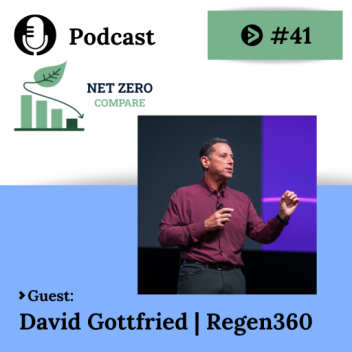
#41: David Gottfried on From LEED to Regeneration: David Gottfried on Why Sustainability Alone Is No Longer Enough
In this episode
Executive summary
David Gottfried, co-founder of the U.S. Green Building Council and founder of the World Green Building Council, argues that sustainability alone is no longer sufficient to address today’s environmental challenges. While sustainability focuses on reducing harm, regeneration aims to restore damaged ecosystems and build long-term resilience. Reflecting on the evolution of LEED and green building standards, Gottfried highlights the importance of measurable performance, operational verification, and third-party certification. He emphasizes the growing role of embodied carbon in construction materials such as concrete and steel, as well as emerging solutions like carbon mineralization that can store CO₂ in building products. The discussion also explores how procurement policies, financing, regulation, and disclosure requirements can accelerate low-carbon innovation. Ultimately, Gottfried advocates for a regenerative approach that combines environmental restoration, circularity, transparency, and long-term value creation, positioning sustainability as a driver of resilience, competitiveness, and future economic growth.
For more than three decades, David Gottfried has been closely connected to the evolution of green building and sustainability standards. He helped launch the U.S. Green Building Council, contributed to the development of LEED certification, and later founded the World Green Building Council, which expanded the movement internationally.
Today, through Regen360, Gottfried is focused on a broader concept: regeneration. In a conversation hosted by Net Zero Compare, he discussed why sustainability alone may no longer be sufficient, how the built environment must evolve, and what companies should understand about long-term value creation, embodied carbon, procurement, regulation, and systems thinking.
🎥 Watch the Full Conversation: This conversation with David Gottfried explores the evolution of green building standards, the practical realities of decarbonizing the built environment, and the growing importance of regenerative thinking. The discussion also covers embodied carbon, procurement policy, carbon mineralization, disclosure pressures, and why long-term environmental performance increasingly intersects with business value. For readers interested in the broader context behind LEED, regenerative systems, and the future direction of sustainable infrastructure, the full interview provides additional nuance and examples beyond the topics summarized below.
Sustainability Versus Regeneration
One of the central themes of the discussion was Gottfried’s distinction between sustainability and regeneration. According to him, sustainability traditionally focuses on maintaining existing systems and reducing harm, often aiming for “net zero” outcomes. Regeneration, by contrast, attempts to restore systems that have already been damaged.
Gottfried argued that many environmental systems have already crossed thresholds that cannot be solved simply through maintaining current conditions. He pointed to warming oceans, melting glaciers, damaged aquifers, and ecosystem degradation as examples where restoration, rather than stabilization alone, is now necessary.
This distinction also changes how organizations think about value creation. Instead of limiting sustainability to reporting or compliance exercises, regeneration introduces broader questions about long-term environmental repair, systems resilience, and the relationship between economic activity and ecological health.
How Green Building Standards Evolved
Gottfried traced the origins of modern green building standards back to the early 1990s. Before certification systems existed, one of the primary challenges was simply defining what “green building” actually meant.
Early work through ASTM eventually evolved into the creation of the U.S. Green Building Council in 1993. LEED later emerged as a point-based rating framework designed to establish measurable performance thresholds for buildings.
The categories that shaped those standards remain familiar today:
Energy efficiency
Renewable energy integration
Water efficiency
Indoor air quality and occupant health
Waste reduction and recycling
Sustainable transportation access
Materials selection and embodied carbon
Landscaping and site performance
Gottfried emphasized that these frameworks became important because they replaced vague environmental claims with measurable criteria and third-party verification.
Over time, green building certification evolved from a niche market differentiator into a large global industry. According to Gottfried, green building now represents trillions of dollars in economic activity worldwide.
Why Outcomes Matter More Than Certifications
The conversation also addressed criticism that sustainability certifications can become “box-checking” exercises. Gottfried acknowledged this risk and stressed that actual operational performance matters more than design-stage intentions alone.
He highlighted the importance of measuring real utility consumption, operational energy use, water use, and waste generation rather than relying exclusively on modeled estimates. Programs such as Energy Star benchmarking were discussed as examples of systems that compare buildings against similar asset classes using operational data.
For organizations, this reinforces a broader trend already emerging in ESG and sustainability reporting: regulators, investors, tenants, and procurement teams increasingly expect verifiable performance data rather than high-level commitments alone.
Building a Global Green Building Movement
When Gottfried founded the World Green Building Council in the late 1990s, the goal was to create an international coalition capable of adapting sustainability frameworks to different economic and policy environments.
One of the key lessons he described was the importance of broad stakeholder participation. Financial institutions, developers, contractors, architects, utilities, scientists, universities, tenants, and regulators all needed representation because each group influenced building performance differently.
He compared the process to an orchestra, where each participant contributes a different instrument but must still operate within a coordinated system. That coordination also created tension, particularly when balancing commercial interests against environmental performance standards.
The discussion highlighted an important challenge still visible today: climate and sustainability transitions require coordination across multiple industries simultaneously, not isolated technological improvements.
Regeneration as an Operating System
At Regen360, Gottfried now approaches regeneration as something broader than environmental compliance. He described it as an “operating system” that changes how businesses define value, relationships, transparency, and responsibility. These ideas are also explored in the upcoming book Regen 360: An Operating System for a Regenerative Earth, scheduled for release in October 2026 during the Greenbuild Conference in New York City.
A recurring concept throughout the discussion was the idea of treating Earth as “home” rather than as an external resource system. This perspective influenced several themes he discussed:
Circular systems that eliminate waste
Biomimicry and nature-inspired design
Materials reuse and disassembly
Broader stakeholder responsibility
Transparency across operations and supply chains
Gottfried also introduced the idea of “soul worth” alongside financial net worth and self-worth. While philosophical in tone, the concept reflected a broader argument that future economic systems may increasingly reward activities that improve environmental and human health rather than simply maximizing short-term extraction.
Embodied Carbon Is Becoming Central
One of the most practical parts of the discussion focused on embodied carbon, particularly in construction materials such as concrete, steel, and aluminum. Gottfried argued that operational energy improvements alone are no longer sufficient because embodied emissions are becoming one of the largest remaining carbon sources globally. He explained embodied carbon as the cumulative emissions associated with:
Raw material extraction
Transportation
Manufacturing
Processing
Installation
Concrete and steel were identified as especially important due to their large contribution to global emissions.
This has major implications for Scope 3 reporting and procurement strategies. Companies increasingly need to evaluate supply chain emissions and lifecycle impacts, not just operational energy use.
Carbon Mineralization and Construction Materials
The conversation also explored carbon mineralization technologies through Gottfried’s involvement with Blue Planet Systems. These approaches capture CO2 from industrial flue gas streams and convert it into calcium carbonate materials that can be used in concrete and other building products.
According to Gottfried, this process could allow construction materials themselves to become long-term carbon reservoirs rather than emission sources. Potential applications include:
Concrete aggregate
Fillers for building materials
Drywall products
Flooring systems
Ceiling tiles
He stressed that many of these technologies already exist but struggle with scaling due to insufficient financing and procurement support.
Why Procurement and Policy Matter
Gottfried repeatedly returned to the issue of deployment speed. In his view, many low-carbon technologies already exist, but capital deployment and procurement systems are moving too slowly relative to climate timelines. He pointed to several mechanisms that could accelerate adoption:
Tax credits
Green bonds
Government-backed financing
Advanced market commitments
Performance-based procurement standards
Carbon pricing mechanisms
Building performance laws
Examples included New York City’s Local Law 97 and incentive programs that rewarded higher building performance through tax reductions.
The broader message was that regulation and financial incentives must work together. In practice, many organizations are already seeing this dynamic emerge through disclosure requirements, procurement mandates, and investor scrutiny around climate risk.
Moving Beyond Compliance
For companies dealing with ESG reporting and decarbonization requirements, Gottfried argued that sustainability should not be approached purely as a compliance obligation. He suggested that organizations pursuing higher environmental performance often strengthen:
Brand value
Customer loyalty
Employee retention
Long-term asset value
Investor confidence
The guest also argued that businesses increasingly face exposure related to climate disclosure, operational transparency, and long-term environmental liabilities. As a result, organizations that delay adaptation may eventually face higher financial and regulatory risk.
Importantly, Gottfried framed sustainability investments less as “green premiums” and more as quality investments with lifecycle value over long time horizons.
Hope, Leadership, and Long-Term Systems Change
Unlike many sustainability discussions focused primarily on risk, Gottfried repeatedly returned to the idea of hope. He defined “H.O.P.E.” as “Health On Planet Earth” and described hope as both a practical and emotional driver for systems change.
Throughout the conversation, he emphasized the importance of maintaining optimism, encouraging innovation, and supporting younger generations entering the sustainability field. He also reflected on the early skepticism he encountered when launching green building initiatives in the 1990s, noting that many transformative ideas initially appear unrealistic or commercially uncertain.
For organizations navigating climate-related transitions today, that perspective may be particularly relevant. Many of the technologies, procurement models, and reporting systems now considered mainstream were once viewed as niche or impractical.
Conclusion
David Gottfried’s perspective combines historical experience with a broader systems-oriented view of sustainability and regeneration. His core argument is that sustainability alone may no longer be sufficient if the goal is to restore ecological systems, reduce long-term climate risk, and build resilient economic models.
The conversation also highlighted several practical themes relevant for businesses today:
Embodied carbon is becoming increasingly important
Procurement and financing systems strongly influence deployment speed
Operational verification matters more than symbolic commitments
Low-carbon materials and carbon mineralization are gaining relevance
ESG and climate disclosure pressures will likely continue increasing
Long-term lifecycle value may increasingly outweigh lowest-cost approaches
At the same time, Gottfried emphasized that innovation, systems thinking, and public awareness still have the potential to accelerate meaningful change. For companies operating in construction, infrastructure, manufacturing, finance, or sustainability strategy, the discussion offered a reminder that environmental performance is increasingly becoming tied to resilience, competitiveness, and long-term value creation.
Topics
More from Net Zero Compare Podcast

#60: Brandon Lapsys on Why Recycling Projects Depend on End Markets, Operational Discipline, and Better Waste Data

#59: Lisa Wright on Why eVTOL Infrastructure May Matter as Much as the Aircraft

#58: Arjun Gupta on Packaging EPR in the US: How AI Is Changing Compliance, Data Management, and Cost Forecasting

#57: Lubomila Jordanova on Corporate Sustainability: From Carbon Accounting to Business Value

#56: Hesham Gamal Gaafar on Digital Twins in Smart Cities and Infrastructure: Where the Real Value Comes From