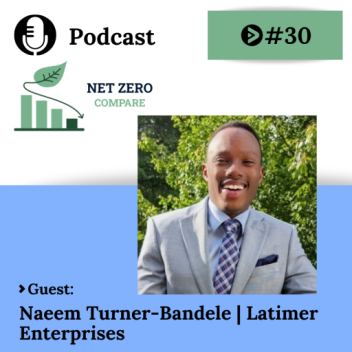
#30: Naeem Turner-Bandele on What Power System Planning Often Misses: Reliability, Workforce, and Real Grid Constraints
In this episode
Executive summary
The podcast discussion between Karol Kaczmarek and Dr. Naeem Turner-Bandele highlights key realities often overlooked in energy transition debates. While discussions about climate targets and renewable capacity dominate policy conversations, electricity systems operate within strict physical and operational constraints. Dr. Turner-Bandele explains that power grids depend on three interconnected layers: generation, transmission, and distribution, all of which must maintain stable voltage, frequency, and load balance to avoid outages. Integrating renewable energy introduces additional complexity because wind and solar generation are variable and difficult to predict. Grid operators must constantly manage fluctuations, curtail excess generation, and prepare for sudden output drops. Energy storage can help manage short-term variability, but current battery technologies generally provide only several hours of storage and cannot fully address longer periods of low renewable generation. The conversation also highlights transmission infrastructure as a major bottleneck. Expanding grids is technically feasible, but regulatory approval, financing, and public acceptance often delay projects. Another frequently overlooked constraint is workforce availability. The energy transition requires highly specialized engineers and technicians, and shortages in these roles may slow infrastructure deployment. Emerging solutions such as microgrids and digital twins could improve resilience and grid management, but long-term energy planning must remain grounded in real-world technical and human constraints.
Electricity systems are often discussed through the lens of climate targets, renewable capacity, and technology deployment. But behind those discussions lies a complex physical infrastructure that must operate reliably every second of the day.
In a recent conversation hosted by Net Zero Compare, Karol Kaczmarek spoke with Naeem Turner-Bandele, Ph.D., MBA, Founder and CEO of Latimer Enterprises. Dr. Turner-Bandele works at the intersection of grid operations, power system modeling, and energy policy, focusing on how electricity systems actually function under real-world constraints.
The discussion explored several issues that often receive less attention in energy debates: the physical limits of power grids, the complexity of integrating variable renewable energy, the importance of transmission infrastructure, and a challenge that policymakers frequently overlook: the availability of skilled engineers needed to build and operate future electricity systems.
🎥 Watch the Full Conversation: The full discussion between Karol Kaczmarek and Dr. Naeem Turner-Bandele is available below. In the interview, Dr. Turner-Bandele explains how power systems operate, where common misunderstandings occur in energy policy, and what organizations should consider when making long-term electricity decisions. The video provides additional context and technical explanations that complement the insights summarized in this article.
Understanding the Difference Between Energy and Electricity Systems
Public discussions often treat “energy” as a single concept. In practice, electricity systems are distinct from other energy uses and operate according to strict physical constraints.
Dr. Turner-Bandele explains that modern electricity systems consist of three interconnected layers:
Generation – Power plants convert different energy sources into electricity.
Transmission – High-voltage lines transport electricity across long distances.
Distribution – Local networks reduce voltage and deliver electricity to homes and businesses.
Each layer must operate within specific engineering limits. Transmission lines can only carry a certain amount of current, voltage must remain within safe ranges, and system frequency must remain stable to avoid outages.
This complexity means that electricity policy cannot rely on broad energy targets alone. Technical realities determine what is feasible on the grid at any given moment.
Why Renewable Integration Creates Operational Challenges
Wind and solar power provide important economic and environmental benefits. In many regions, they are now among the lowest-cost generation sources.
However, Dr. Turner-Bandele emphasizes that these resources introduce operational challenges due to variability and uncertainty.
Wind speeds fluctuate throughout the day. Solar output depends on sunlight intensity and weather conditions. These characteristics mean electricity generation from these sources cannot always be predicted or controlled with the same precision as conventional power plants.
Grid operators must therefore manage several challenges simultaneously:
Maintaining stable voltage and frequency on the grid
Managing periods of excess generation that require curtailment
Planning for times when renewable output drops unexpectedly
This balancing process becomes more complex as renewable penetration increases. The challenge is not whether renewable energy can be integrated, but how to manage the operational implications effectively.
Energy Storage: Useful but Not a Universal Solution
Energy storage is frequently presented as the primary solution to renewable variability. Dr. Turner-Bandele cautions that this narrative oversimplifies the role of storage technologies.
Current large-scale battery systems, particularly lithium-ion installations, typically provide between eight and ten hours of energy storage. While this can help manage short-term fluctuations on the grid, it does not fully address longer periods of low renewable generation.
For storage to smooth variability over multiple days or weeks, significantly longer-duration technologies would be required.
Despite these limitations, storage remains valuable in several applications:
Managing short-duration fluctuations
Supporting grid frequency and voltage stability
Complementing renewable generation during peak periods
Storage, therefore, plays an important supporting role, but it is not a standalone solution for grid reliability challenges.
Transmission: A Critical but Often Overlooked Constraint
Transmission infrastructure rarely receives the same attention as renewable generation or storage technologies. Yet it is one of the most significant bottlenecks in electricity system development.
Transmission lines serve two essential functions:
Delivering electricity from generation sites to population centers
Connecting different regions to balance supply and demand
In many countries, existing transmission networks are aging and operating beyond their original design lifetimes. At the same time, expanding renewable generation often requires new transmission capacity to connect remote wind and solar resources to urban demand centers.
According to Dr. Turner-Bandele, the main barriers to transmission expansion are not technological. Engineers know how to design and build these systems.
The real challenges lie in:
Policy approval processes
Financing large infrastructure projects
Public acceptance of new transmission lines
Without addressing these issues, even the most ambitious energy transition strategies may face significant implementation barriers.
The Limits of Power System Modeling
Power system models are widely used to simulate grid behavior and evaluate new energy projects. These tools translate the physical grid into mathematical representations that allow engineers to simulate different scenarios.
However, models necessarily simplify reality.
One important distinction exists between AC power flow models, which capture more real-world electrical constraints, and DC approximations, which simplify calculations but ignore some operational details.
These simplifications can lead to inaccurate expectations about how projects will perform in real grid conditions. Developers sometimes rely on simplified models that overlook operational constraints used by grid operators during interconnection studies and daily operations.
Another common modeling assumption treats generation sources as fully predictable. In reality, generation output can vary due to weather, equipment outages, or resource availability.
These uncertainties must be considered when evaluating how electricity systems will operate under real-world conditions.
The Workforce Challenge in Energy Policy
One of the most overlooked constraints in energy planning has little to do with technology.
Dr. Turner-Bandele highlights that many energy policies assume that the necessary workforce will always be available to build, operate, and maintain new infrastructure.
In practice, the power sector requires highly specialized engineers and technicians. Utilities already face shortages of electrical engineers and experienced grid operators in many regions.
Policy design rarely incorporates workforce development at the scale needed to support long-term system expansion. Without sufficiently skilled professionals, infrastructure projects can face delays regardless of funding or regulatory approval.
For organizations planning energy projects or infrastructure investments, workforce availability may become an increasingly important factor in project timelines.
Technologies That May Scale in the Next Decade
Despite the challenges discussed, Dr. Turner-Bandele points to several developments that could expand over the next 10 to 20 years.
Two areas stand out in particular.
Microgrids
Microgrids allow institutions such as universities, military bases, or communities to operate independently from the main grid when necessary. They provide resilience during outages and can integrate local renewable generation.
While microgrids were primarily experimental a decade ago, utilities are now deploying them in operational environments.
Digital Twins
Digital twin technology creates virtual representations of physical grid assets using sensor data, local computing, and cloud-based analytics.
By modeling the real-time behavior of equipment such as batteries, solar plants, or transmission infrastructure, digital twins can help operators predict failures, optimize performance, and improve planning decisions.
These tools remain in early deployment stages but could significantly improve grid monitoring and asset management in the coming decade.
A Key Question for Energy Decision Makers
Organizations planning energy investments often focus on technology choices, regulatory compliance, or cost projections.
Dr. Turner-Bandele argues that a more fundamental question should often come first.
Before launching major energy projects, decision makers should ask whether the workforce exists to build and operate the systems being proposed.
Engineers, grid planners, and skilled technicians remain central to every part of the electricity system. Without sufficient human expertise, even well-funded projects may face implementation challenges.
For utilities, policymakers, and large energy buyers, this workforce question may become increasingly important as electricity demand grows and infrastructure expansion accelerates.
Conclusion
Electricity systems operate within strict physical and operational constraints. Integrating renewable energy, expanding transmission infrastructure, and improving grid resilience all require careful planning that respects these limits.
The conversation with Dr. Naeem Turner-Bandele highlights several realities that organizations should keep in mind when developing energy strategies:
Grid reliability remains the primary responsibility of electricity systems
Renewable integration introduces variability that must be managed operationally
Energy storage supports the grid but does not eliminate system constraints
Transmission infrastructure remains a major bottleneck in many regions
Power system models are useful, but must be interpreted carefully
Workforce availability may become one of the most critical factors in future energy planning
For companies, utilities, and policymakers navigating energy transitions, understanding these constraints can help ensure that strategies remain grounded in how electricity systems actually operate.
Topics
More from Net Zero Compare Podcast
#59: Lisa Wright on Why eVTOL Infrastructure May Matter as Much as the Aircraft

#58: Arjun Gupta on Packaging EPR in the US: How AI Is Changing Compliance, Data Management, and Cost Forecasting

#57: Lubomila Jordanova on Corporate Sustainability: From Carbon Accounting to Business Value

#56: Hesham Gamal Gaafar on Digital Twins in Smart Cities and Infrastructure: Where the Real Value Comes From
#55: Bhuva Shakti on What Makes a Climate Company Investable, and Where AI Actually Helps