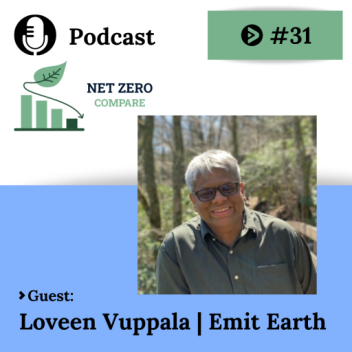
#31: Loveen Vuppala on Scope 3 as Procurement Intelligence: Moving Carbon Data from Reporting to Decision-Making
In this episode
Executive summary
Scope 3 emissions often account for 70 to 90% of a company’s total footprint, yet they are still widely treated as a reporting requirement rather than a strategic tool. In a Net Zero Compare conversation, Loveen Vuppala, Founder of Emit Earth, explains that carbon data should be used as operational intelligence, not just for compliance. Drawing on her experience in supply chain operations, Vuppala highlights that emissions data can reveal supplier risk, energy cost exposure, and regulatory vulnerability. However, this insight is often siloed within sustainability teams instead of being integrated into procurement decisions. She argues that procurement is the key lever for decarbonization, since it controls supplier selection and contract terms. Moving forward, sourcing decisions will increasingly factor in carbon intensity alongside price and quality. A major challenge is the reliance on industry averages rather than supplier-specific data. Vuppala suggests companies focus on directional accuracy and improve data quality over time. Engagement with suppliers also improves when emissions are framed as a shared value opportunity rather than a compliance burden. With growing regulatory pressure, integrating carbon data into procurement can help companies reduce risk, control costs, and strengthen supply chain resilience.
For most large organizations, Scope 3 emissions represent the majority of their carbon footprint. In many cases, 70 to 90 percent of total emissions sit upstream in the supply chain. Yet despite their materiality, Scope 3 metrics are often treated as a reporting obligation rather than a strategic input into sourcing decisions.
In a recent Net Zero Compare conversation hosted by Karol Kaczmarek, Loveen Vuppala, Founder of Emit Earth, explained why carbon data should not remain confined to sustainability reports. Instead, she argues that Scope 3 data contains operational signals about supplier risk, energy cost exposure, and regulatory vulnerability. The discussion focused on how procurement teams can use emissions data as forward-looking intelligence rather than backward-looking compliance.
🎥 Watch the Full Interview: The complete conversation with Loveen Vuppala is available below. In the recording, we explore how procurement, sustainability, and finance teams can collaborate more effectively on Scope 3 data. The discussion provides additional context around regulatory pressure, supplier engagement, and real-world examples of emissions-informed sourcing decisions. For professionals working in procurement, ESG, or supply chain management, the full interview offers practical nuance beyond the written summary.
The Core Insight: Carbon Data Is Operational Data
Vuppala’s professional background spans two decades in supply chain operations and data infrastructure at companies including Flipkart and Apple. Through that experience, she observed a consistent pattern: the data that reveals operational risk, cost inflation, and resource utilization also reveals carbon footprint.
The issue, in her view, is not the absence of emissions data. Many companies already collect it. The gap lies in how that data is used.
Sustainability teams often gather Scope 3 information to meet disclosure requirements. However, that data rarely flows back to procurement teams in a format that supports sourcing decisions. Emit Earth was founded on the premise that this same data can inform supplier risk assessment, energy cost volatility exposure, and regulatory readiness.
In other words, Scope 3 data is not just an environmental metric. It is operational intelligence.
Why Procurement Is Central to Decarbonization
If the majority of emissions sit in the supply base, procurement becomes the primary leverage point.
Sustainability teams can issue supplier surveys and establish targets. Finance teams can assess material risk. But procurement controls purchase orders and contract awards. That authority shapes supplier behavior.
According to Vuppala, future procurement organizations will not negotiate solely on price, quality, and delivery. Decarbonization roadmaps will increasingly become part of sourcing discussions, especially as customers, investors, and regulators demand greater transparency.
The key challenge is incentive alignment. Procurement teams must see how carbon intelligence improves cost modeling, supplier resilience, and long-term competitiveness. Without that connection, emissions reporting remains a separate function with limited impact.
The Data Challenge: Industry Averages Versus Supplier-Specific Insight
A major limitation in current Scope 3 practices is the reliance on spend-based calculations and industry averages.
Many sourcing decisions are made using generalized emissions factors rather than supplier-specific data. While these approaches may satisfy reporting thresholds, they do not provide meaningful differentiation between suppliers operating under very different energy systems or production practices.
Vuppala emphasizes that organizations should prioritize directional accuracy over perfection. Companies do not need laboratory-grade precision to identify whether a supplier operates in a fossil fuel-intensive region or a grid that is rapidly decarbonizing.
The practical approach is to begin with available logistics, energy, and sourcing data, construct initial Scope 1 and Scope 2 baselines at the supplier level, and allocate emissions using production or spend metrics. From there, companies can build stronger data pipelines and increase precision over time.
Supplier Engagement: Reframing the Conversation
Supplier engagement remains one of the most persistent barriers.
Mid-sized suppliers are often overwhelmed by sustainability questionnaires from multiple customers. Without clear business benefits, participation feels like administrative overhead.
Vuppala argues that engagement improves when the discussion shifts from compliance auditing to shared value creation. If suppliers understand that emissions transparency can reduce their energy costs, improve regulatory positioning, and strengthen long-term contracts, participation becomes more meaningful.
Rather than positioning Scope 3 as a policing mechanism, companies can frame it as collaborative benchmarking and performance improvement.
Addressing Common Objections
During the conversation, Vuppala outlined several recurring objections from companies:
The initiative is too resource-intensive or expensive.
Her response centers on the cost of inaction, including lost customers, exposure to carbon border taxes, or regulatory penalties.Suppliers will not engage.
Engagement improves when benefits are clearly articulated rather than framed as a compliance burden.Data quality is insufficient.
Waiting for perfect precision can delay action. Directionally correct data is enough to identify material risk exposure.Scope 3 is a sustainability issue, not a procurement issue.
As regulatory requirements tighten and customers demand product carbon footprints, procurement inevitably becomes accountable.
These objections reflect structural silos more than technical limitations.
Regulatory Pressure as a Catalyst
Regulatory developments are accelerating change.
Frameworks such as the Corporate Sustainability Reporting Directive and IFRS climate disclosure standards require emissions data to be treated with the same rigor as financial data. In addition, mechanisms like the Carbon Border Adjustment Mechanism directly link carbon intensity to import costs.
Under these conditions, spend-based estimates may no longer be sufficient. Supplier-specific data becomes necessary to manage financial exposure.
Vuppala views regulation as a forcing function. Companies that integrate emissions intelligence into procurement strategy can identify cost savings, mitigate risk, and differentiate competitively. Those who treat disclosure as a minimum compliance exercise may struggle with operational and financial consequences.
Real-World Applications
The conversation included practical examples of emissions-informed procurement decisions.
In one case, a pharmaceutical company assessed the carbon footprint of cold storage facilities. By analyzing energy consumption, refrigerant emissions, and logistics impacts, the company developed a roadmap for energy cost reduction and regulatory compliance. Procurement gained data to evaluate alternative refrigeration technologies and renewable energy contracts.
In another example, a manufacturing company sourcing components from two regions identified significant differences in grid emissions and projected energy cost trajectories. By quantifying the carbon delta and modeling forward-looking carbon pricing exposure, procurement could assess total landed cost over a multi-year horizon rather than focusing solely on the immediate price.
These examples illustrate how carbon data can inform cost modeling, supplier selection, and contract strategy.
What Mature Procurement Could Look Like by 2030
Looking ahead, Vuppala describes a procurement function where carbon intensity is weighted alongside price, quality, and delivery in RFP evaluations.
Supplier scorecards track decarbonization progress. Contracts include emissions reduction targets and incentives. Sourcing models incorporate projected carbon costs into total cost of ownership calculations.
Rather than annual reporting cycles, emissions data flows more continuously. Procurement systems embed carbon intelligence into scenario modeling. Category managers view decarbonization not as an obligation but as a factor in supplier resilience and long-term viability.
Technology, in her view, is not the primary barrier. Cross-functional alignment and a leadership mindset are more decisive.
Conclusion
Scope 3 emissions are often discussed in the context of disclosure and compliance. The conversation with Loveen Vuppala highlights a different perspective.
Carbon data can function as procurement intelligence. It can signal supplier risk, energy cost exposure, regulatory vulnerability, and competitive positioning.
For sustainability leaders and procurement professionals, the practical takeaway is clear: start with available data, prioritize directional insight, collaborate across functions, and integrate emissions into sourcing decisions.
Organizations that make this shift will not only meet reporting obligations. They will strengthen supply chain resilience and improve decision-making in a regulatory environment that increasingly links carbon intensity to financial performance.
Topics
More from Net Zero Compare Podcast
#59: Lisa Wright on Why eVTOL Infrastructure May Matter as Much as the Aircraft
#58: Arjun Gupta on Packaging EPR in the US: How AI Is Changing Compliance, Data Management, and Cost Forecasting

#57: Lubomila Jordanova on Corporate Sustainability: From Carbon Accounting to Business Value

#56: Hesham Gamal Gaafar on Digital Twins in Smart Cities and Infrastructure: Where the Real Value Comes From
#55: Bhuva Shakti on What Makes a Climate Company Investable, and Where AI Actually Helps