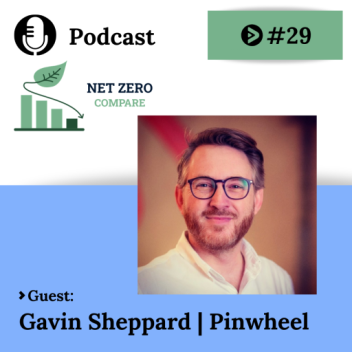
#29: Gavin Sheppard on Beyond Counting Carbon: How Enterprises Should Think About Emissions, Risk, and Value
In this episode
Executive summary
The conversation with Gavin Sheppard (CEO of Pinwheel) highlights how companies should move beyond simply measuring carbon emissions and focus on how they use that data to drive real climate action and business value. He argues that many organizations spend too much time chasing perfectly accurate emissions data, which can delay action and lead to “analysis paralysis.” Instead, companies should use reasonable estimates to begin making decisions and improving over time. A major challenge is Scope 3 emissions, which depend on suppliers and complex supply chains, making coordination and governance as important as data collection. Sheppard also warns against making absolute claims like carbon neutrality when emissions and offsets rely on models and assumptions. With regulations such as CSRD increasing reporting pressure, sustainability is becoming expected across supply chains. Ultimately, Sheppard emphasizes that sustainability should be treated as a strategic business opportunity, not just a compliance exercise. Companies should focus on progress, clear governance, and investments that create value for both the environment and the business.
Gavin Sheppard, CEO of Pinwheel, works with large enterprises on beyond value chain mitigation and climate investment strategy. His focus is not on carbon accounting software, but on what companies do after they have emissions data.
In a recent conversation hosted by Net Zero Compare, Sheppard discussed the real state of emissions reporting, the risks of chasing perfect data, and how companies can avoid turning sustainability into a compliance exercise. At a time when regulations such as CSRD are expanding reporting requirements, his perspective is particularly relevant for sustainability leaders and decision makers.
🎥Watch the Full Conversation: This article summarizes the key themes from our discussion with Gavin Sheppard. For additional nuance and context, readers can watch the full recorded interview on our YouTube channel. In the conversation, we explore emissions data quality, Scope 3 challenges, regulatory pressure, and how companies can structure climate investments responsibly. The full discussion provides deeper insight into the tradeoffs and practical decisions companies face when building credible climate strategies.
Beyond Value Chain Mitigation as a Business Strategy
Pinwheel focuses on what companies can do outside their direct supply chains to create environmental impact. This includes designing beyond value chain mitigation strategies for carbon and nature, sourcing high-quality projects, conducting due diligence, and monitoring performance over time.
Sheppard argues that much of the traditional offset market has failed to create meaningful value for either businesses or the planet. In his view, too much capital has been deployed into low-quality projects that deliver limited impact.
His starting point is customer logic. If a company is spending capital on climate action, it should ask two questions:
Does this create value for the business?
Does this create measurable value for the environment?
If the answer to either is unclear, the strategy likely needs revision.
The Problem With Chasing Perfect Data
One of the strongest themes in the discussion is that many organizations overemphasize data perfection.
Sheppard notes that the quality of emissions data depends on its purpose. If a physical goods company needs granular Scope 3 data to redesign its supply chain, accuracy is critical. However, for other businesses, the marginal benefit of highly precise data may not justify the cost.
He gave an example of a company that spent thousands calculating emissions that ultimately translated into a relatively small carbon responsibility. In such cases, the return on investment from extreme data precision is questionable.
The risk is analysis paralysis. Companies delay action because their datasets are incomplete or based on assumptions. In practice, emissions accounting always involves models and estimates. The issue is not the existence of assumptions. The issue is when assumptions are presented as absolute facts.
Scope 3: Where Plans Meet Reality
Scope 3 emissions are often where corporate ambition collides with operational complexity. Because Scope 3 sits outside direct control, it depends on third-party data and supply chain coordination.
Aligning multiple suppliers who may use different methodologies creates friction. Even well-designed plans can break down when real data is requested from the supply chain.
For many organizations, Scope 3 becomes less a technical exercise and more a coordination challenge. Governance, alignment, and expectations management become as important as data collection.
Estimates, Models, and Absolute Claims
The conversation also addressed the controversy around forest protection and avoided emissions projects.
Many climate projects rely on models to estimate avoided emissions or sequestration. This is often unavoidable. Models are not inherently flawed. They are frequently the only viable method for estimating future scenarios.
The problem arises when companies use model-based data to make absolute claims such as carbon neutrality. Asserting exact precision in both emissions and offset volumes is unrealistic.
For companies, this means distinguishing between directional use of data and definitive claims. If data is used to inform investment decisions and risk management, estimates may be acceptable. If data is used to support absolute marketing statements, the bar is significantly higher.
Regulatory Pressure Is Expanding the Reporting Culture
Although Pinwheel works primarily with large enterprises, the regulatory environment affects companies of all sizes.
Even companies not directly subject to sustainability regulations are increasingly asked to provide data because they sit in regulated supply chains.
Regulations such as the Corporate Sustainability Reporting Directive, combined with voluntary frameworks like science-based target initiatives, are creating a business environment where sustainability reporting becomes expected rather than optional.
This shift is not only about compliance. It is creating broader cultural expectations within procurement processes and investor relations.
Internal Systems Versus External Platforms
When asked whether mid-sized companies should build internal systems or rely on external platforms, Sheppard emphasized a fundamental question: what will you do with the data once you have it?
Organizations can easily create large spreadsheets without a defined plan for how the data will inform decisions.
In some cases, creating internal systems may be cost-effective. In others, external tools or consultants may be justified. The key is clarity of purpose before investing resources.
What a Well-Run Setup Looks Like After 12 to 18 Months
A mature emissions reporting setup does not mean perfect data. It should include:
Clear governance and defined ownership
Functional accountability across departments
Appropriate granularity of emissions understanding
A targeted transition plan within the value chain
A defined budget for beyond value chain mitigation
Progress, not perfection, is the objective. Starting early allows organizations to refine systems over time.
Practical Advice for Companies Starting Out
For companies at the beginning of their reporting journey, the first recommendation is simple: avoid doing nothing.
If emissions data collection takes time, companies can begin with proxy approaches. For example, allocating a percentage of profits or revenue toward climate and nature investments can serve as an interim measure.
Over time, as datasets improve, companies can refine their allocation models. Waiting for perfect data before taking any action is often riskier than starting with reasonable assumptions and adjusting over time.
Do Not Forget the Business and the Brand
In closing, Sheppard stressed that a sustainability strategy should not be reduced to counting exercises.
Climate action interacts with brand positioning, customer expectations, employee engagement, and long-term business value. If sustainability is treated purely as compliance, it becomes a cost. If it is treated as a strategic lever aligned with brand and stakeholder values, it can create measurable business benefits.
The mindset shift matters. Sustainability can be either a reporting burden or a strategic opportunity.
Conclusion
The discussion highlights a recurring theme in corporate sustainability: clarity of purpose is more important than perfection of data.
Organizations should define why they are collecting emissions data, how it will influence decisions, and what claims they intend to make. From there, governance, proportional accuracy, and strategic investment can follow.
As regulatory pressure increases and stakeholder scrutiny intensifies, companies that combine pragmatism with integrity will be better positioned than those waiting for flawless datasets. Progress, backed by transparent communication and thoughtful deployment of capital, is more defensible than inaction.
Topics
More from Net Zero Compare Podcast

#59: Lisa Wright on Why eVTOL Infrastructure May Matter as Much as the Aircraft

#58: Arjun Gupta on Packaging EPR in the US: How AI Is Changing Compliance, Data Management, and Cost Forecasting

#57: Lubomila Jordanova on Corporate Sustainability: From Carbon Accounting to Business Value

#56: Hesham Gamal Gaafar on Digital Twins in Smart Cities and Infrastructure: Where the Real Value Comes From
#55: Bhuva Shakti on What Makes a Climate Company Investable, and Where AI Actually Helps