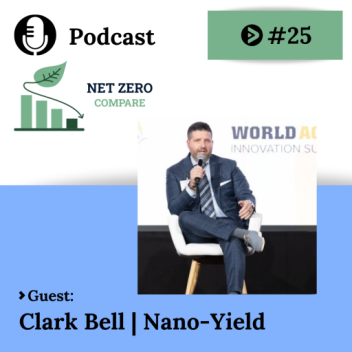
#25: Clark T. Bell on Improving Agricultural Efficiency Without Increasing Inputs: Lessons From Nano-Yield
In this episode
Executive summary
Clark T. Bell, CEO of Nano-Yield, joined Net Zero Compare to discuss how nanotechnology can improve agricultural efficiency. Nano-Yield focuses on enhancing the delivery and absorption of existing fertilizers and crop inputs rather than creating new chemicals. By using nanoscale silicate particles, the company improves nutrient uptake, reducing waste, such as the roughly 40% of nitrogen that typically fails to reach plants. Field data show that farmers can reduce fertilizer use by about 20% while maintaining or increasing yields, lowering costs, and supporting soil health. Adoption depends on measurable results and regulatory compliance, which varies by region. Bell emphasized that efficiency-driven solutions align economic incentives with sustainability goals, helping reduce Scope 3 emissions while remaining practical for growers.
Clark T. Bell, CEO and Founder of Nano-Yield, joined Net Zero Compare for a detailed discussion on how efficiency-focused agricultural technologies are being applied in practice. Nano-Yield operates at the intersection of nanotechnology and agriculture, with a specific focus on improving how fertilizers, nutrients, and crop protection products are delivered and absorbed.
The timing of this conversation matters. Farmers are facing sustained pressure from rising input costs, volatile commodity markets, and increasing scrutiny around environmental performance. For companies tracking agricultural emissions, particularly Scope 3, understanding where real efficiency gains are possible is becoming a practical necessity, not a marketing exercise. The conversation was hosted by Net Zero Compare and focused on what works, what scales, and what holds up under economic and regulatory constraints.
🎥Watch the Full Conversation: The full interview with Clark T. Bell, CEO and Founder of Nano-Yield, is available on YouTube as part of the Net Zero Compare podcast series. In the recording, Bell expands on field data, adoption challenges, and regulatory realities that are difficult to capture fully in written form. Watching the conversation provides additional nuance around how these technologies perform across different crops, regions, and market conditions. The video is especially useful for viewers who want deeper context on the practical trade-offs discussed.
The Core Problem: Inefficient Delivery of Agricultural Inputs
Nano-Yield was founded to address a specific and persistent issue in agriculture: a large share of applied inputs never reaches the crop in a usable form. Bell pointed to nitrogen as a clear example, noting that roughly 40 percent of applied nitrogen typically fails to reach the plant, either washing away or breaking down before it can be absorbed.
Rather than developing new fertilizers or chemicals, Nano-Yield positions its technology as a delivery system. The company focuses on improving how existing inputs, such as fertilizers, herbicides, micronutrients, and bio-stimulants, are transported into the plant. The goal is straightforward: increase efficiency so that more of what is applied is actually used by the crop.
What Nanotechnology Means in This Context
Nanotechnology is often used loosely in agriculture, which has contributed to skepticism. In this case, Bell emphasized a precise definition. Nano-Yield works with particles sized between one and 100 nanometers. At that scale, materials exhibit different physical and chemical behaviors that can be leveraged for agricultural use.
Nano-Yield’s particles, derived from silicate materials, are designed to bind with ions and active ingredients in standard agricultural inputs. Because of their size, these particles can carry inputs more effectively into the plant and release them where uptake occurs. The technology does not change the chemical composition of fertilizers or herbicides. Instead, it improves how those products are delivered and absorbed.
Yield, Sustainability, and Economic Trade-Offs
A common concern in sustainable agriculture is that environmental improvements come at the cost of yield. According to Bell, Nano-Yield’s data does not support that assumption. In practice, the technology has been used either to increase yield while keeping input levels constant or to maintain yield while reducing inputs.
Bell explained that growers can reduce fertilizer application rates by roughly 20 percent and still achieve comparable or improved outcomes when Nano-Yield is used as part of the program. In economic terms, this matters. Input costs remain one of the largest expenses for farmers, and small changes in efficiency can significantly affect margins.
The company reports consistent performance across different crops and regions, with adoption now spanning millions of acres globally. The emphasis, however, remains on integrating the technology into existing programs rather than positioning it as a standalone solution.
Measuring Outcomes and Farmer Adoption
Cost and measurable results play a central role in adoption. Nano-Yield’s flagship product is priced at a few dollars per acre, which lowers the barrier to trial. Bell described cases where yield increases of several bushels per acre more than offset the cost of the product, even under conservative pricing assumptions.
Still, adoption is not immediate. Farmers typically want to see results on their own land or through trusted third parties such as universities or independent research groups. Nano-Yield has focused on long-term field trials and partnerships to build that credibility. Bell noted that full adoption often follows one to three growing seasons of demonstrated results.
Soil Health and Long-Term Considerations
Short-term yield gains are easier to quantify than long-term soil improvements, but Bell argued that efficiency directly affects soil outcomes. By improving nutrient uptake, less unused fertilizer remains in the soil, which can reduce chemical buildup over time.
In some cases, farms using the technology reported measurable improvements in soil properties such as cation exchange capacity. While outcomes vary by soil type and crop, the underlying principle remains consistent: more efficient use of inputs tends to leave less residue behind, supporting healthier soil structure over multiple seasons.
Regulatory and Safety Landscape
Regulations around agricultural nanotechnology vary widely by region. In the United States, products like Nano-Yield are regulated at the state level, typically under fertilizer or soil conditioner frameworks. Bell explained that compliance involves submitting labels, meeting reporting requirements, and supporting any performance claims with data.
Some jurisdictions require university-backed research to substantiate specific claims, such as carrier or adjuvant functionality. International expansion introduces additional complexity. In Brazil, for example, regulators require multi-year field data before approval. Bell characterized regulatory compliance as a long-term process that requires both capital and patience.
The European Union has identified nanotechnology as one of several promising tools for agriculture, but Nano-Yield has not yet entered the EU market due to its regulatory timelines and the company’s current focus on the Americas and parts of Asia.
Lessons From Operating a Farm
In addition to leading Nano-Yield, Bell is President of BioGrass Sod Farms, a commercial sod operation. Applying Nano-Yield technology within his own farming business influenced how products are developed and evaluated.
Running a farm reinforced the importance of affordability, visible results, and operational simplicity. It also shaped how Nano-Yield approaches product development, starting with clearly defined problems that have economic relevance for growers. This dual perspective helped align the company’s technology roadmap with real-world farming constraints.
Where Efficiency Fits Into Emissions and Reporting
For organizations tracking agricultural emissions, particularly Scope 3, Bell sees efficiency as a practical lever rather than a reporting abstraction. Reduced fertilizer use lowers emissions not only at the field level but also upstream, including manufacturing and transportation.
While Nano-Yield is not positioned as a reporting tool, its impact on input efficiency can indirectly support emissions reduction strategies. Bell emphasized that efficiency-driven technologies are more likely to be adopted because they align environmental outcomes with economic incentives.
Conclusion
The conversation with Clark T. Bell highlighted a recurring theme: efficiency is becoming the defining metric in agricultural sustainability. Technologies that reduce waste, lower costs, and maintain or improve yields are more likely to scale than those driven primarily by environmental narratives.
For sustainability professionals and business decision makers, Nano-Yield’s approach offers a practical example of how incremental efficiency improvements can support broader goals around emissions, soil health, and resource use. As regulatory pressure and economic constraints continue to converge, solutions that perform under both will matter most.
Topics
More from Net Zero Compare Podcast

#59: Lisa Wright on Why eVTOL Infrastructure May Matter as Much as the Aircraft

#58: Arjun Gupta on Packaging EPR in the US: How AI Is Changing Compliance, Data Management, and Cost Forecasting

#57: Lubomila Jordanova on Corporate Sustainability: From Carbon Accounting to Business Value

#56: Hesham Gamal Gaafar on Digital Twins in Smart Cities and Infrastructure: Where the Real Value Comes From
#55: Bhuva Shakti on What Makes a Climate Company Investable, and Where AI Actually Helps