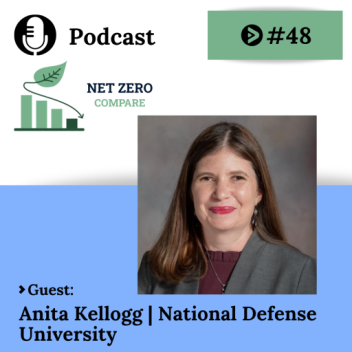
#48: Anita Renda Kellogg on Why Geopolitical Risk Now Belongs in Corporate Sustainability Strategy
In this episode
Executive summary
Sustainability strategy now extends beyond emissions reporting and ESG compliance to include supply chain resilience, energy security, trade policy, critical minerals, and geopolitical risk. Dr. Anita Renda Kellogg explains that clean-energy technologies often depend on highly concentrated mineral-processing networks, creating exposure to trade disputes, export restrictions, and supply disruptions. Companies should map suppliers beyond Tier One, reassess just-in-time models, diversify sourcing, consider friend-shoring, and weigh resilience alongside purchase price. ESG, procurement, finance, legal, and strategy teams should share a common risk view, as poor data and limited supplier visibility can undermine both carbon accounting and business continuity. The central message is that credible decarbonization plans must account for access to materials, suppliers, and infrastructure, as well as stable policy, in an increasingly uncertain world.
Sustainability strategy is no longer only about emissions reporting, ESG disclosure, carbon accounting, or setting decarbonization targets. For many companies, it is also becoming a question of supply chain resilience, energy security, trade policy, critical minerals, and exposure to geopolitical disruption.
That was the focus of Net Zero Compare’s conversation with Dr. Anita Renda Kellogg, Assistant Professor at National Defense University and host of Kellogg’s Global Politics. At the beginning of the discussion, Dr. Kellogg noted that her views are her own and do not represent National Defense University, the U.S. Department of Defense, or the U.S. government.
The conversation explored why sustainability professionals, procurement teams, compliance leaders, and business decision makers need to understand the wider environment in which climate and energy decisions are made. The main takeaway was clear: companies cannot build credible sustainability strategies if they ignore where their materials come from, how concentrated their supply chains are, and how quickly trade and security risks can change.
🎥 Watch the Full Conversation: The full Net Zero Compare interview with Dr. Anita Renda Kellogg is available to watch below. The discussion gives additional context on how energy security, critical minerals, trade tensions, and supply chain risk affect sustainability planning. For readers working in ESG, procurement, compliance, or corporate strategy, the full conversation is useful because it shows how climate and sustainability decisions are increasingly shaped by geopolitical realities. The interview also adds nuance around practical trade-offs, including cost, resilience, supplier visibility, and long-term planning.
Sustainability Is Now Connected to National Security
Many companies still treat sustainability mainly as a compliance or reporting issue. That is understandable, as ESG teams are often focused on emissions accounting, disclosure requirements, regulatory deadlines, supplier questionnaires, and internal targets. These tasks remain important, but they are no longer enough on their own.
The broader operating environment has changed. Sustainability decisions now sit inside a larger context shaped by national security, economic competition, industrial policy, and global supply chain dependencies. A company may choose a lower-carbon technology, but that decision can still depend on materials, processing capacity, or components sourced from politically sensitive or highly concentrated markets.
Dr. Kellogg explained that her work focuses on how economics affects national security, with recent attention on critical minerals and economic coercion. That connection is directly relevant to sustainability because many technologies used in the energy transition depend on inputs that are not evenly distributed across global markets. For business leaders, the issue is not only whether a product supports decarbonization, but also whether the supply chain behind it is reliable, traceable, and resilient.
Critical Minerals Are a Core Business Risk
Critical minerals were one of the central themes of the conversation. These materials are essential for many clean energy technologies, batteries, solar equipment, grid infrastructure, and defense applications. As companies invest in electrification, renewable energy, storage, and more resilient infrastructure, their exposure to critical mineral supply chains often increases.
The challenge is not only where these minerals are mined. Dr. Kellogg emphasized that processing is often the bigger issue. Mining may be more geographically diverse, but processing capacity for many critical minerals is highly concentrated, especially in China. That creates a strategic vulnerability because even when raw materials are extracted in different countries, they may still pass through a limited number of processing hubs before they become usable inputs for manufacturers.
For companies, this creates a practical risk. If one country dominates processing, businesses may have limited alternatives during a supply disruption, trade conflict, export restriction, or geopolitical crisis. This matters for sustainability because clean energy deployment depends on reliable access to these inputs. A decarbonization plan that depends on fragile supply chains can quickly become harder to deliver.
Supply Chain Visibility Needs to Go Beyond Tier One
A recurring point in the discussion was the importance of visibility beyond direct suppliers. Many companies know who they buy from, but fewer understand where those suppliers source key materials. Even fewer have meaningful visibility into third-tier or fourth-tier suppliers, where serious bottlenecks may appear.
This is a major issue for sustainability and procurement teams. A product may look low-carbon at the point of purchase, while still depending on supply chains exposed to geopolitical risk, weak labor standards, high emissions, or concentrated processing capacity. Without deeper visibility, companies may underestimate the risks built into their own procurement choices.
Dr. Kellogg noted that businesses need to understand where the vulnerabilities sit in their supply chains, including several tiers down. This includes assessing whether suppliers are dependent on countries with high geopolitical tension, whether alternative sources exist, and whether a disruption could affect production, pricing, or delivery. For companies building supplier scorecards, ESG dashboards, or climate risk models, the warning is straightforward: tools are useful, but they can create false confidence if the underlying assumptions are incomplete.
Just-in-Time Supply Chains Are Being Reconsidered
For decades, many companies optimized supply chains around efficiency and cost. Just-in-time inventory helped reduce storage costs and improve margins, and it made sense in a relatively stable period of globalization. That model is now being tested by trade tensions, logistics shocks, energy market volatility, sanctions, export controls, and conflict risk.
Dr. Kellogg pointed out that not keeping inventory is cheaper, but disruptions themselves can be very expensive. Companies therefore need to compare the cost of resilience against the cost of interruption. The cheapest supplier may not be the best option if a disruption would stop production, delay customer delivery, or force emergency sourcing at much higher prices.
This does not mean every business should immediately build large stockpiles. It means companies need to make deliberate decisions based on the importance of each input, the likelihood of disruption, and the availability of substitutes. For some materials, stockpiling may make sense. For others, diversification, long-term supplier agreements, alternative materials, or closer relationships with trusted partners may be more practical.
Resilience Comes With Trade-Offs
Businesses often want cheaper inputs, stable supply, lower emissions, low geopolitical exposure, and strong compliance performance at the same time. In practice, these goals can conflict. A lower-cost supplier may carry higher political risk. A more resilient supplier may be more expensive. A cleaner technology may still depend on minerals processed in a concentrated market. A domestic or allied supplier may improve security of supply, while increasing short-term costs.
Dr. Kellogg argued that companies can no longer think about cost only in terms of purchase price. They also need to account for the probability and impact of disruption. That requires a more sophisticated view of risk, especially in sectors where critical inputs are difficult to substitute or where supply chains depend on countries affected by strategic competition.
This is especially relevant for procurement, finance, and sustainability teams. Resilience is not free, but neither is disruption. The business case depends on understanding both. Companies may also need to explain to customers, investors, or internal stakeholders why a more resilient supply chain can cost more in the short term, but reduce exposure over the long term.
Friend-Shoring, Ally-Shoring, and Diversification
One practical response discussed in the conversation was friend-shoring or ally-shoring. If a product or input cannot be sourced domestically, companies may look to allied or lower-risk countries. This can reduce exposure to politically sensitive markets, although it does not eliminate risk entirely.
Relying on one allied country can still create concentration risk. Some countries may also face their own regional security risks, trade restrictions, production constraints, or logistics bottlenecks. Diversification therefore needs to be meaningful, not symbolic. It should consider geography, political risk, processing capacity, supplier reliability, transportation routes, and the availability of alternative sources.
Companies also need to monitor trade policy more closely than in the past. Tariffs, export controls, import bans, sanctions, and non-tariff barriers can all affect supply chains. In some cases, uncertainty itself becomes a business problem. It is difficult to plan investments, pricing, procurement, and inventory levels when rules may change quickly or when companies cannot confidently predict the direction of policy.
Regulation and Industrial Policy Are Market Forces
The conversation also touched on regulation and industrial policy. Governments are increasingly using climate policy, trade policy, subsidies, tariffs, procurement rules, and domestic manufacturing incentives to shape markets. For companies, this means policy is not only a compliance issue. It affects cost structures, market access, competitive positioning, and long-term investment decisions.
Industrial policy can support domestic capacity in strategic sectors, but it can also create uncertainty when incentives change or when political priorities shift. Companies planning sustainability investments need to pay attention not only to current regulation, but also to the stability and durability of policy signals. This matters for electric vehicles, batteries, renewable energy, grid infrastructure, critical minerals, and other sectors linked to decarbonization.
Business leaders should not treat regulation as something that only legal or compliance teams monitor. Policy developments should be integrated into procurement, finance, operations, sustainability, and risk management. A change in tariffs, subsidies, or procurement rules can alter the economics of a sustainability project just as much as a change in technology cost or customer demand.
ESG Teams Need a Broader Risk Lens
Many ESG teams are under pressure to deliver accurate emissions data, prepare disclosures, respond to customer questionnaires, and comply with new reporting requirements. Those tasks are important, but they should not become the full definition of ESG. A stronger approach connects ESG with business risk, resilience, and strategy.
Geopolitical risk should fit into climate risk assessment, supplier due diligence, corporate governance, and long-term planning. If a company depends on high-risk materials or concentrated supply chains, that is relevant not only to procurement, but also to sustainability, compliance, business continuity, and corporate strategy. It can affect whether a company can deliver on climate commitments, meet customer expectations, or maintain access to key markets.
This is especially important for Scope 3 emissions work. Scope 3 reporting often requires companies to understand supplier activity, purchased goods, transportation, product inputs, and upstream impacts. The same mapping that helps with emissions accounting can also reveal supply chain vulnerabilities. In that sense, emissions visibility and geopolitical risk visibility are not separate exercises. They both require better data, deeper supplier engagement, clearer assumptions, and more realistic risk analysis.
Data Quality Is a Strategic Issue
The discussion also highlighted the limits of incomplete data. Companies increasingly rely on dashboards, supplier platforms, risk models, emissions calculators, and AI tools. These systems can be helpful, especially when supply chains are complex. Dr. Kellogg noted that AI software cannot completely solve the visibility problem, but it can help companies gain better insight.
The important caveat is that tools are only as strong as the data and assumptions behind them. If a company does not know where a mineral was processed, where a component was made, or whether a supplier depends on a single-country input, then a dashboard may hide risk instead of revealing it. This can lead to weak decisions even when the reporting interface looks polished.
For sustainability teams, this should sound familiar. The same problem exists in carbon accounting. A clean-looking report can still be unreliable if it depends on poor supplier data, broad estimates, outdated emissions factors, or assumptions that are never tested. Data quality is not only a reporting issue. It is part of strategic decision-making.
Practical Steps for Companies
The conversation pointed to several practical steps companies can take. The first is to map supply chains beyond direct suppliers. The goal is to identify bottlenecks, single-country dependencies, and materials that could become difficult to source under stress. Companies do not need perfect visibility immediately, but they do need to start with the inputs that are most critical to operations, revenue, or compliance obligations.
Second, companies should give geopolitical risk more weight than they may have in the past. The assumptions that worked during a more stable period of globalization may no longer be sufficient. This means assessing where political tension, trade restrictions, sanctions, export controls, or conflict risk could affect supply, pricing, or delivery.
Third, businesses should consider diversification, especially among allies or lower-risk markets. This may include friend-shoring, ally-shoring, domestic sourcing, or long-term agreements with suppliers. In some cases, stockpiling or substitution options may also be appropriate, particularly where disruption risk is high and alternatives are limited.
Finally, companies should improve internal coordination. Sustainability, procurement, compliance, legal, finance, and strategy teams need to work from the same risk picture. They should also engage constructively with regulators where possible. Fighting regulation is rarely a complete strategy. In many cases, businesses benefit from helping policymakers understand practical implementation challenges while preparing for the direction of travel.
The Main Misunderstanding: Short-Term Thinking
One broader takeaway from the conversation is that many companies have been too short-term in how they assess sourcing, resilience, and sustainability. Low-cost sourcing can look attractive today, but create long-term dependency. Concentrated processing can appear efficient until it becomes a strategic bottleneck. A supplier relationship may seem stable until trade policy, conflict, sanctions, or export restrictions change the economics.
This does not mean every company needs to become a geopolitical expert. It does mean companies need to ask better questions. Where do critical inputs come from? Which countries or suppliers create bottlenecks? What happens if a key input is restricted? Can materials be substituted? Are there alternative suppliers? Is the company optimizing for short-term cost while creating long-term exposure?
These are now practical business questions, not abstract policy questions. They affect procurement decisions, emissions strategies, compliance planning, customer commitments, and investment choices. Companies that understand these links will be better prepared than those that treat sustainability, trade, energy, and security as separate topics.
Conclusion
Dr. Anita Renda Kellogg’s conversation with Net Zero Compare offered a useful reminder: sustainability strategy cannot be separated from energy security, supply chains, regulation, trade policy, and geopolitical risk. Companies still need strong emissions data, credible ESG reporting, and realistic decarbonization plans. But those efforts need to be grounded in the real world of materials, manufacturing, infrastructure, policy, and strategic competition.
For sustainability professionals and business decision makers, the practical takeaway is not to abandon cost discipline or overreact to every headline. It is to build more resilient strategies by understanding where critical dependencies exist, where data is weak, and where supply chains may be exposed.
A credible sustainability strategy should answer more than one question. It should not only ask how a company reduces emissions. It should also ask whether the company can access the materials, energy, suppliers, and infrastructure needed to deliver on those goals in a less predictable world.
Topics
More from Net Zero Compare Podcast
#54: Patrick Sherwin on What Makes Clean Energy Technology Work in the Real World

#53: Josh Harrison on Why Climate Adaptation Requires Connected Solutions for Forests, Buildings, and Cities
#52: Albert Slap on Why Property Climate Risk Requires More Than a Hazard Score
#51: Wayne Visser on How Businesses Can Separate Climate Technology Progress From Hype
#50: Frédéric Pouyot on Why Systems Thinking Is the Missing Piece of Sustainable Infrastructure