
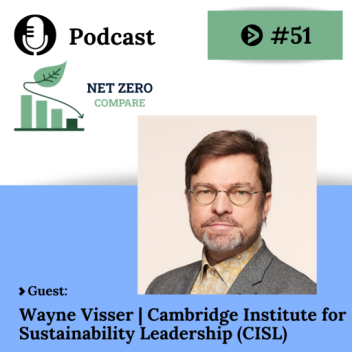
#51: Wayne Visser on How Businesses Can Separate Climate Technology Progress From Hype
In this episode
Executive summary
Wayne Visser discusses how companies can distinguish genuinely transformative climate technologies from hype. He argues that promising solutions should combine meaningful environmental impact with evidence of falling costs, improving performance, and growing adoption. Solar, wind, batteries, EVs, and Earth information systems are already relatively mature, while green hydrogen, low-carbon cement, bioplastics, cultivated meat, and other emerging technologies still face cost or scaling barriers. AI and robotics can create significant value when applied to physical systems such as agriculture, recycling, monitoring, and logistics. Visser emphasizes that every technology has trade-offs, so businesses should assess lifecycle impacts, infrastructure, economics, and real-world results. His advice is to experiment through pilots and partnerships, invest early where technology could transform the core business, and avoid chasing trends without evidence.
Climate technology is attracting growing attention from companies, investors, governments, and sustainability teams. Solar power, battery storage, low-carbon materials, artificial intelligence, robotics, alternative proteins, and environmental monitoring systems are all presented as potential solutions to major climate and resource challenges. The difficulty for business decision-makers is determining which technologies are already delivering measurable value, which are approaching commercial maturity, and which remain dependent on optimistic assumptions.
That question was at the center of a recent Net Zero Compare conversation with Wayne Visser, Professor of Practice in Regenerative Business, Innovation and Technology at Católica Porto Business School, Fellow and Head Program Instructor at the University of Cambridge Institute for Sustainability Leadership, and author of more than 40 books. The discussion focused primarily on his forthcoming book, Technologies of Hope: An Earth-Saving Mission, and on how companies can evaluate emerging technologies without falling into either blind optimism or automatic skepticism.
🎥 Watch the Full Interview: Watch the full Net Zero Compare interview with Wayne Visser for a more detailed discussion of renewable energy, industrial decarbonization, AI, robotics, alternative materials, and technology adoption. The recording provides additional context on where these technologies are already working, where costs and infrastructure remain barriers, and how companies can decide when to lead, test, or wait. It also includes practical examples that are difficult to capture fully in a written summary.
From Sustainability Problems to Scalable Solutions
Visser explained that more than three decades of work in sustainability gradually shifted his attention from documenting problems toward identifying solutions that could operate at the speed and scale required. That change in focus had already shaped his earlier book, Thriving, which explored how systems thinking and innovation could help turn environmental, social, and economic breakdowns into breakthroughs.
Technologies of Hope develops that work further by focusing on environmental technologies. The objective is not to promote every new idea, but to identify solutions with the potential to produce significant change in sectors such as energy, transport, food, agriculture, materials, manufacturing, and digital infrastructure.
For Visser, hope must be tied to evidence and action. A technology should not qualify simply because it offers an appealing vision. It must show the potential to create a meaningful environmental improvement and demonstrate that it is moving toward wider adoption, lower costs, stronger performance, or commercial viability.
What Makes a Technology Transformational?
Visser described two main tests for identifying technologies with genuine potential. The first is whether the technology could create a substantial shift if it were deployed at scale. Incremental efficiency improvements may still be useful, but they are different from technologies capable of changing how a major sector operates.
The second test is whether there is evidence that the technology is moving toward exponential adoption. Relevant indicators include deployment growth, falling unit costs, improving technical performance, rising investment, and stronger demand from the market.
He referred to the work of RethinkX, which studies how new technologies rise while incumbent technologies decline. When these two adoption curves are plotted together, they form an X-shaped pattern. Some technologies move slowly for years before reaching a tipping point, after which adoption accelerates much more quickly than expected.
This is important for companies because a technology can be technically viable long before it becomes commercially attractive. It can also attract significant attention and funding without ever reaching the scale required to challenge existing systems.
How to Distinguish Progress From Hype
One of the clearest warning signs is when a technology is presented as capable of solving almost every problem. Visser argued that technologies still moving through the peak of a hype cycle are often described as universal solutions, while mature technologies tend to have clearer applications, better-understood limitations, and stronger evidence of performance.
Businesses should therefore compare the narrative around a technology with what it is actually delivering. If a solution claims to reduce emissions, companies should examine whether those reductions are occurring in real deployments. They should also look at performance across different markets, sectors, and geographies rather than relying on a single demonstration project.
Cost trends are equally important. A technology that is still more expensive than the incumbent option may still be commercially credible if its costs are falling consistently and its performance is improving. Procurement teams and investors should avoid evaluating technologies through a short-term snapshot and instead consider how pricing, regulation, carbon costs, and supply chain risks may change over the next several years.
The central question is whether the technology solves a real problem and whether there is evidence that it can become competitive.
Renewable Energy Has Moved Beyond the Pilot Stage
Visser identified solar energy, wind power, battery storage, and electric vehicles as technologies where the direction of travel is already clear. Costs have fallen, deployment has accelerated, and commercial adoption is no longer limited to experimental projects.
The transition is still uneven. Grid constraints, permitting delays, infrastructure gaps, local opposition, and political resistance can slow deployment, particularly in markets with deeply established fossil fuel systems. In other regions, especially emerging markets, renewable energy may advance more quickly because there is less legacy infrastructure to replace.
Battery storage is also reducing one of the main concerns surrounding renewable energy: variability. As storage technology improves and becomes cheaper, it becomes more difficult to argue that large amounts of fossil fuel generation must remain permanently available as backup.
The remaining barriers are increasingly linked to systems rather than individual technologies. Renewable deployment requires grid upgrades, transmission capacity, planning, permitting, coordination between technologies, and political support. Installing more generation capacity alone is not enough.
Steel, Cement, Chemicals, and Other Hard-to-Abate Sectors
Some of the most difficult emissions come from sectors where carbon is embedded in industrial processes, heat requirements, raw materials, and global supply chains. Visser highlighted steel, cement, chemicals, plastics, construction materials, and textiles as areas where technical solutions exist but cost and adoption remain significant challenges.
In steel production, electric arc furnaces can use recycled steel and reduce emissions compared with conventional production. Green hydrogen may reduce emissions further by replacing fossil fuels in high-temperature processes. According to Visser, combining these approaches could reduce emissions substantially, but some forms of green steel may still cost several times more than conventional alternatives.
Cement offers another practical example. Reducing the amount of clinker in cement can lower emissions without requiring the construction industry to replace its entire operating model. Limestone calcined clay cement, often referred to as LC3, is one option that can reduce emissions while using familiar production and construction systems.
Bioplastics and other lower-carbon chemicals face a more difficult cost challenge. Fossil fuel-based plastics are produced at very low cost, which makes it hard for biological alternatives to compete even when their carbon footprint is much smaller. Adoption will depend on scale, innovation, policy, customer demand, and whether companies are prepared to pay more for lower-impact materials.
Engineered timber and other biological building materials may offer more immediate opportunities in some applications. Cross-laminated timber can replace part of the steel and concrete used in buildings while reducing embodied carbon. However, adoption still depends on building codes, supply chains, engineering capacity, customer confidence, and project economics.
Earth Information Systems and Better Environmental Data
Visser also discussed Earth information systems, which extend beyond traditional geographic information systems by combining satellite observations, climate modeling, biodiversity monitoring, and environmental intelligence.
These systems are already helping identify deforestation, track methane leaks, assess climate risks, and monitor changes in ecosystems. Improvements in small satellite technology have increased the volume and resolution of available data, while more advanced models are helping organizations understand longer-term climate patterns.
Environmental DNA is another developing field. By analyzing traces of DNA in water, soil, or even air, researchers can identify species and assess biodiversity more efficiently than through some traditional survey methods. While this technology remains earlier in its adoption, it could become valuable for biodiversity reporting, environmental impact assessment, land management, and nature-related risk analysis.
Planetary digital twins represent a more advanced extension of this idea. These models combine large volumes of data to create digital representations of Earth systems, allowing researchers and decision makers to test scenarios and better understand how environmental changes may develop.
For companies, the practical value lies in improving visibility. Better information can support risk management, supply chain monitoring, emissions detection, biodiversity assessment, and regulatory reporting. However, data only creates value when it leads to decisions and measurable action.
AI and Robotics Can Deliver More Than Better Reporting
Many companies currently associate artificial intelligence with sustainability reporting, data collection, or document preparation. Visser argued that these applications may improve efficiency, but they are not the most transformational uses of AI.
More significant opportunities exist where AI improves physical systems. In precision agriculture, AI-enabled machinery can distinguish crops from weeds and apply chemicals only where needed. Visser cited systems that claim to reduce chemical use by more than 80 percent. In waste management, AI-driven robotics can improve sorting accuracy and increase the amount of material that can be recovered and recycled.
Robotics is also creating practical value through autonomous drones and delivery systems. Drones can support reforestation, pollution monitoring, land inspection, and access to areas that are difficult or dangerous for people. These applications are already more commercially relevant than the humanoid robots that attract much of the public attention.
Companies should still be cautious about data quality, transparency, energy use, and poorly designed automation. Better technology does not automatically mean better insight. Weak data, unclear assumptions, and poor human oversight can lead to faster but still incorrect decisions.
Visser advised businesses to apply the same risk management principles they use for other investments. They should identify specific use cases, test the technology, measure results, and decide whether they want to be early adopters or followers.
Every Climate Technology Has Trade-Offs
No industrial technology is impact-free. Renewable energy systems, batteries, electric vehicles, data centers, and digital infrastructure require minerals, water, energy, land, manufacturing capacity, and global supply chains. They also generate waste and may create environmental or human rights concerns.
Visser argued that companies should avoid two unhelpful extremes. The first is presenting clean technologies as if they have no negative impacts. The second is using those impacts as an excuse to avoid replacing systems that are more damaging.
A practical approach begins with comparison. Companies should assess whether the environmental and economic benefits are greater than the negative effects, then determine whether the remaining risks can be reduced or managed. This should include supply chain controls, responsible sourcing, recycling, lifecycle assessment, waste planning, and continued technical improvement.
Technology impacts should also not be treated as fixed. Batteries, solar panels, AI systems, manufacturing processes, and recycling methods continue to improve. The relevant question is not only what the technology looks like today, but whether its efficiency, cost, and environmental performance are moving in the right direction.
A Practical Decision Framework for Companies
Before committing to a climate technology, companies should begin with a small number of practical questions. Does the technology address a major problem that is likely to become more serious? Is it already scaling, or is there credible evidence that it can? Are costs falling? Is the technology delivering measurable results in other markets or sectors?
The company must then build its own business case. The value of a technology may extend beyond the purchase price. It may reduce waste, lower energy use, strengthen supply chain resilience, improve compliance, reduce exposure to future carbon costs, increase employee engagement, or create a competitive advantage.
Organizations should also avoid relying only on evidence from their own sector or country. A technology may already be commercially successful elsewhere, while another may have received substantial funding without gaining meaningful adoption.
Visser used hydrogen-powered passenger vehicles as an example of a technology that has attracted significant investment but has struggled to compete with battery electric vehicles. Hydrogen may still be useful in other applications, but weak adoption in passenger transport should make investors cautious.
The broader lesson is that funding, policy attention, and publicity are not enough. Companies need evidence of performance, adoption, cost reduction, infrastructure availability, and customer demand.
Where Companies Can Move Now
Visser described solar, wind, batteries, and electric vehicles as mature enough for companies to treat seriously today. Earth information systems also offer practical value with relatively limited downside, particularly for monitoring, risk analysis, and environmental data.
Precision fermentation and plant-based proteins may provide significant opportunities in food and agriculture. Cultivated meat has substantial potential but still requires progress in cost, regulation, production capacity, and customer acceptance.
Green hydrogen, lower-carbon cement, green chemicals, and biological plastics may also become important, but they require more patience. These technologies address real problems, yet many remain earlier in their adoption cycle and are not consistently cost-competitive.
AI is becoming difficult for companies to ignore, but it should not be applied indiscriminately. Businesses should focus on tailored systems that solve a clear operational problem rather than adopting general-purpose tools simply because they are popular.
Preparing for Change Without Chasing Every Trend
Visser’s advice to companies is to create space for experimentation. Businesses that wait until a technology becomes unavoidable may face higher costs and lose the opportunity to shape the market. At the same time, experimenting does not mean making a large commitment to every emerging solution.
Companies should set aside resources for research, pilots, partnerships, and controlled testing. They also need a culture that allows teams to learn from unsuccessful experiments rather than punishing every failure.
The level of risk should depend on how central the technology is to the business. If it could transform the company’s core market, there may be a strong case for investing early and trying to lead. If it is less important to the company’s main operations, the organization can wait for stronger evidence and adopt later.
This creates a practical distinction between leadership and unnecessary risk. Companies do not need to pursue every fashionable technology, but they do need the capability to identify important changes before they become unavoidable.
Conclusion
The main lesson from Visser’s work is that climate technology should be evaluated through evidence, not optimism alone. The strongest technologies combine meaningful environmental benefits with improving performance, falling costs, and growing adoption. Their limitations should be acknowledged and managed, but not used to defend systems with larger and better-understood impacts.
For sustainability, procurement, finance, operations, compliance, and leadership teams, the next step is to build a repeatable decision process. That means examining technical readiness, market adoption, lifecycle impacts, infrastructure requirements, cost trends, supplier claims, data quality, and relevance to the company’s core business.
Technology will not replace policy, leadership, or responsible implementation. It can, however, give companies practical tools to reduce emissions, improve resource efficiency, strengthen resilience, and prepare for the structural changes already reshaping energy, industry, food, and environmental management.
Topics
More from Net Zero Compare Podcast

#61: Lisa Drees on Building Trust in Green Hydrogen Supply Chains: Technology Is Only Part of the Answer

#60: Brandon Lapsys on Why Recycling Projects Depend on End Markets, Operational Discipline, and Better Waste Data

#59: Lisa Wright on Why eVTOL Infrastructure May Matter as Much as the Aircraft

#58: Arjun Gupta on Packaging EPR in the US: How AI Is Changing Compliance, Data Management, and Cost Forecasting

#57: Lubomila Jordanova on Corporate Sustainability: From Carbon Accounting to Business Value
