
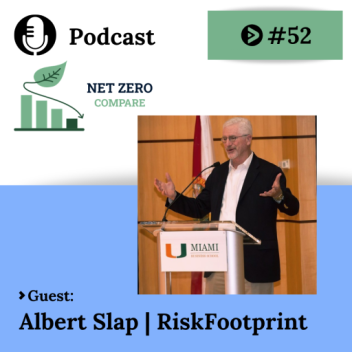
#52: Albert Slap on Why Property Climate Risk Requires More Than a Hazard Score
In this episode
Executive summary
In this Net Zero Compare podcast, Albert Slap, President of RiskFootprint, explains why physical climate risk should be treated as a practical property, financial, and operational issue, not just an ESG reporting concern. Traditional due diligence and flood-zone maps can miss important hazards, while single risk scores may hide severe exposures. Slap argues for property-level assessments that consider building vulnerability, potential damage, financial loss, and downtime. He highlights the ASTM Property Resilience Assessment as a framework for identifying hazards, evaluating vulnerabilities, and selecting cost-effective resilience measures. For large portfolios, companies should screen assets, prioritize strategically important high-risk properties and target investment accordingly. Resilience can reduce repair costs, business interruption, and recovery time, while supporting insurance, financing, and asset value decisions. The key message: climate data becomes valuable only when it leads to practical action at the asset level.
Physical climate risk is becoming a practical concern for property owners, investors, lenders, insurers, and businesses that depend on physical assets. Flooding, wildfire, hurricanes, extreme heat, and other hazards can affect insurance costs, property values, financing, operations, and business continuity.
In a conversation hosted by Net Zero Compare, Albert Slap, President of RiskFootprint, explained why conventional property due diligence can miss important risks and why companies need to connect climate-risk data with practical investment and resilience decisions.
Slap previously worked as an environmental attorney and served as Director of the Colorado River Project at The Nature Conservancy. His current work focuses on assessing natural-hazard exposure at the individual property level.
🎥 Watch the Full Interview: Watch the full Net Zero Compare interview with Albert Slap for a more detailed discussion of property-level risk, insurance, resilience investment, and commercial real estate due diligence. The recording includes practical examples involving flood damage, hotel properties, building retrofits, and portfolio risk assessment. It also provides more context on how companies should interpret climate-risk data and use it in real decisions.
Where Standard Due Diligence Falls Short
Commercial property due diligence often includes an appraisal, title report, environmental site assessment, property condition assessment, and flood-zone check. These reviews remain important, but they do not necessarily provide a complete picture of natural-hazard exposure. A Phase I environmental site assessment, for example, is mainly concerned with contamination, hazardous substances, petroleum products, and underground tanks. It is not a broad climate-risk assessment.
Flood-zone maps can also create a false sense of security. A property outside a regulated flood zone may still face heavy rainfall, surface-water flooding, storm surge, tidal flooding, or rising groundwater. Slap pointed to Hurricane Harvey in Houston, where many homes outside designated flood zones were severely flooded. Many owners did not have flood insurance because they believed the mapped zone represented the full extent of the risk.
The main lesson is simple: completing standard due diligence does not mean every material hazard has been assessed.
Exposure Is Only the First Step
Knowing that a hazard exists in an area does not show how a specific building will respond. Two properties in the same location may have very different levels of vulnerability depending on:
Building age
Construction type
Floor elevation
Roof strength
Drainage
Placement of electrical and mechanical equipment
Flood barriers
Building-code requirements
Previous resilience improvements
Slap described condominium buildings in Florida that experienced different levels of damage during Hurricane Ian because of differences in their floors, walls, and structural design.
The example shows why property-level analysis matters. A regional map may identify the hazard, but a detailed assessment is needed to understand possible damage, loss, and downtime.
Why Risk Scores Can Mislead
A single risk score may be easy to understand, but it can hide the hazard that matters most. A property could receive a relatively favorable overall score while still facing one severe exposure, such as storm surge. If that one hazard can close the building or destroy critical equipment, the overall rating offers little comfort. Decision-makers should therefore ask:
Which hazards were included?
Was one severe risk diluted by several low-risk categories?
How detailed is the geographic data?
Are flood depth, expected loss, or downtime shown?
What historical period and future scenarios were used?
How often is the information updated?
What are the model’s limitations?
Slap argued that maps, hazard-specific data, and expected-loss estimates are usually more useful than a single combined score.
Current Risk and Future Climate Risk
Climate-risk assessments often combine historical hazard data with future projections. Slap recommended treating them separately. Historical models draw on recorded floods, wildfires, hurricanes, earthquakes, tornadoes, and other events. Future climate models introduce more uncertainty because results depend on assumptions, emissions scenarios, geographic resolution, and time horizons.
The relevance of future projections also depends on the decision being made. An investor planning to hold a building for five years may focus mainly on current exposure. A government, infrastructure owner, pension fund, or long-term property investor may need to examine mid-century and late-century conditions. The assessment should match the asset, the holding period, and the consequences of getting the decision wrong.
Moving From Data to Action
Slap highlighted the ASTM Property Resilience Assessment process as a useful framework for turning hazard information into practical decisions. The process has three main stages:
Identify the hazards affecting the property.
Evaluate vulnerability, potential damage, financial loss, and downtime.
Identify feasible resilience measures and assess their costs and benefits.
This goes beyond buying a climate-risk report. It asks what the findings mean for the actual building and what can realistically be done. Possible actions may include:
Installing flood barriers
Relocating electrical or mechanical equipment
Strengthening a roof
Improving drainage
Updating emergency procedures
Changing maintenance schedules
Commissioning further engineering work
Not every assessment will lead to immediate construction. It may instead support a financing decision, insurance discussion, acquisition review, or future capital plan.
How Companies Can Prioritize Their Portfolios
Companies with large property portfolios rarely have the budget to assess and upgrade every building at once. Slap recommended using a funnel approach. A company can first screen the entire portfolio and classify properties by risk. It can then identify which high-risk locations are also core assets.
The next step is to review whether those properties have already suffered damage, disruption, or a close call. This can reduce a large portfolio to a smaller group of priority assets that justify detailed assessment and engineering work. A practical sequence is:
Screen the portfolio.
Identify high-risk properties.
Focus on strategically important assets.
Review past damage and disruption.
Assess vulnerability and expected loss.
Compare possible resilience measures.
Schedule action according to urgency and budget.
The process can be repeated as properties are acquired, refinanced, renovated, or sold.
The Financial Case for Resilience
Resilience spending can be difficult to justify because much of its value comes from losses that may never occur. A flood barrier does not directly generate revenue. Its value may come from preventing damage, reducing downtime, protecting tenants, and allowing operations to resume sooner. Companies can evaluate resilience investments by considering:
Avoided repair costs
Reduced business interruption
Shorter recovery time
Lower deductibles or insurance costs
Protection of rental or operating income
Tenant retention
Asset value
Reputational impact
Slap described work involving a hotel real estate investment trust whose properties had suffered hurricane damage. The resilience process included hazard assessment, engineering recommendations, and estimates of potential losses before and after improvements.
The company invested in measures including flood barriers and changes to mechanical and electrical systems. During later hurricanes, the affected properties reportedly experienced much shorter closures. Even so, companies should avoid promising a precise return on investment. The severity and timing of future events cannot be guaranteed.
Insurance Is Only Part of the Calculation
Rising premiums, higher deductibles, and reduced coverage are making physical climate risk harder for property owners to ignore. Insurers already understand that some building improvements reduce expected losses. However, documented resilience measures do not always result in transparent premium reductions. Slap identified FM as an insurer with a publicly visible resilience credit approach. Other insurers may recognize improvements through underwriting, but their methods are often less clear.
Companies should therefore avoid basing the entire financial case on expected insurance savings.
Insurance is one part of a wider calculation that also includes damage reduction, downtime, safety, asset value, and business continuity. Strong documentation can help when dealing with insurers, lenders, investors, and buyers. This may include engineering reports, installation records, inspections, maintenance schedules, testing results, and before-and-after loss estimates.
Retrofit Decisions Matter
Routine building upgrades create opportunities to improve resilience. When a roof, boiler, drainage system, or electrical component needs replacement, an owner may be allowed to replace it to the standard that applied when the building was originally constructed. That may meet legal requirements but still leave the property exposed to current hazards. Slap used the example of replacing an older roof. An owner may choose a similar roof designed for an outdated wind standard or spend more on a stronger system. A property resilience assessment can help determine whether the additional cost is justified.
When an Assessment Should Take Place
A property resilience assessment may be useful:
Before an acquisition
During transaction due diligence
Before financing or refinancing
During insurance renewal
Before a major retrofit
After a damaging event
As part of regular portfolio management
The right timing depends on the decision. For an acquisition, the findings may affect price or whether the buyer proceeds. For refinancing, they may support discussions with lenders. For portfolio management, they can help determine where capital should be spent first.
Beyond ESG Reporting
One of Slap’s main arguments was that emissions reduction and physical resilience must be addressed together. A low-emissions building can still be severely damaged by a flood, hurricane, wildfire, or power failure.
For sustainability and ESG teams, physical risk should therefore not be treated only as a reporting exercise. Disclosure can identify exposure, but it does not strengthen a roof, protect electrical equipment, improve drainage, or keep a building open after a disaster. Companies need to connect reporting with asset management, engineering, insurance, capital planning, and business continuity.
Conclusion
Physical climate risk is not only a sustainability issue. It is also a property, insurance, financing, and operational issue. Standard due diligence may miss hazards outside traditional environmental reviews or regulated flood zones. Simplified risk scores may also hide the exposure that matters most.
A stronger approach combines hazard identification, property-level vulnerability assessment, and practical resilience planning. Companies do not need to address every risk at once. They do need a clear process for identifying priority assets, evaluating feasible measures, and deciding where action is justified.
For organizations working toward net zero, the broader lesson is that emissions reduction and physical resilience should support each other. Reporting matters, but the real test is what happens at the asset level.
Topics
More from Net Zero Compare Podcast

#61: Lisa Drees on Building Trust in Green Hydrogen Supply Chains: Technology Is Only Part of the Answer

#60: Brandon Lapsys on Why Recycling Projects Depend on End Markets, Operational Discipline, and Better Waste Data

#59: Lisa Wright on Why eVTOL Infrastructure May Matter as Much as the Aircraft

#58: Arjun Gupta on Packaging EPR in the US: How AI Is Changing Compliance, Data Management, and Cost Forecasting

#57: Lubomila Jordanova on Corporate Sustainability: From Carbon Accounting to Business Value
