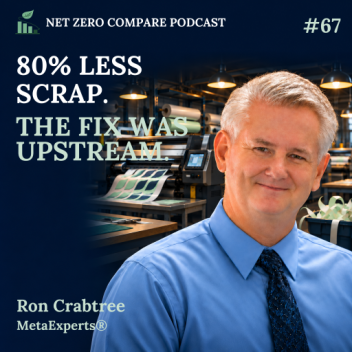
#67: Ron Crabtree (Part II) on Measuring Manufacturing Improvements and Making Them Last
In this episode
Executive summary
Ron Crabtree explains how manufacturers can identify the causes of waste, select meaningful improvement projects, and sustain results. Scrap visible on the factory floor may originate in order entry or design; correcting order information helped one manufacturer cut daily scrap by almost 80% within three months. Teams should define specific problems, test causes with data, and connect process improvements to overall business outcomes. Investment and technology choices should follow clear objectives. Lasting gains require employee involvement, training, documented procedures, maintenance support, and knowledge transfer from external specialists. Reviews should verify actual working conditions and assess progress early. Before expanding a successful trial, companies must confirm that its results can hold under normal production conditions.
Scrap recorded at a machine may originate in order entry or product design. A process change may improve one production measure without affecting the factory’s overall performance. For manufacturers investing in resource efficiency, both situations raise the same question: has the project addressed a cause that matters?
In his second conversation with Net Zero Compare, Ron Crabtree, founder and CEO of MetaOps, the company behind MetaExperts, discussed how manufacturers can investigate waste, choose projects, and sustain the results. The first episode examined practical examples of waste reduction and supplier collaboration. This discussion focused on the evidence needed to justify a change and the internal capability required to keep it working after an outside specialist leaves.
🎥 Watch the Full Conversation: Watch the second Net Zero Compare conversation with Ron Crabtree for a closer look at how manufacturers can evaluate improvement projects. Ron explains how measurements within a process should connect to the results a business expects to achieve. He also discusses employee involvement, maintenance responsibilities, and the difficulty of sustaining new working methods. The recording provides further context for his examples and his recommendations on when to continue, reconsider, or stop a project.
Define a Problem Precisely Enough to Investigate
Reducing scrap across a factory is a broad objective, but it gives a team little direction about what to examine. Crabtree recommends narrowing the investigation to a particular product, machine, or set of tooling. Pareto analysis can help identify where a relatively small number of problems account for a large share of the losses. The team can then select a focused case with enough detail to investigate its causes.
A fishbone diagram, also called an Ishikawa or cause-and-effect diagram, helps organize possible explanations. These might involve equipment condition, materials, working methods, employee support, measurement practices, or environmental conditions. The exercise produces hypotheses to test, not a confirmed diagnosis. Where information is missing, those hypotheses should guide data collection, using check sheets, gauges, or other methods to establish where the process breaks down.
Crabtree cautioned against assuming that production employees are responsible because scrap appears at their workstation. Incorrect specifications or incomplete instructions can leave capable operators trying to compensate for problems created elsewhere. Investigating only the place where a defect becomes visible can therefore miss its source.
An Order-Entry Problem That Appeared as Factory Scrap
Crabtree revisited a decal manufacturer where printing and cutting defects were reducing profits and employee bonuses. Incorrectly printed or cut decals generally could not be reworked, so the visible waste accumulated in production. A structured investigation traced much of it to orders prepared without a sufficient understanding of manufacturing constraints.
Production teams received instructions that were difficult or impossible to execute at the required quality. Operators tried to interpret or adjust them, but the communication loop back to order entry and the customer was weak. The corrective work brought production knowledge into the front office through standard procedures and guidance on specifications the factory could produce reliably.
According to Crabtree, total scrap per day fell by almost 80% within three months. He attributed the improvement to correcting the information entering production, rather than changing the manufacturing operation. For sustainability teams, the example shows how reducing physical waste can depend on fixing an administrative process. Measuring discarded material establishes the loss, but does not explain what caused it.
Connect Process Measurements to Overall Results
Crabtree distinguishes between measures that show a process is changing and those that establish whether a project has delivered its intended benefit. A process measure might track changeover time, operating temperature, or the rate of acceptable output. A result measure might track energy consumed per shipped unit or total scrap over a reporting period. Before implementation, the team should explain how movement in the process measure is expected to affect the broader result.
Reducing a changeover from two hours to 20 minutes, for example, could shorten the time equipment sits idle while consuming energy. A lower operating temperature might reduce heating and subsequent cooling requirements. These are opportunities to test, rather than savings to assume. The company still needs to determine whether the change produces the expected improvement in its chosen outcome.
A better local measurement may produce little plant-level benefit if the project targets only a small share of total consumption. Alternatively, the team’s assumptions about the cause may be wrong. If the process measure improves but the expected result does not, Crabtree recommends revisiting that relationship before committing more resources.
Capture Operational Data Without Overstating Environmental Results
Crabtree made clear that technical emissions accounting is outside his personal expertise. His advice concerned the operational information that reporting specialists need: identify where consumption and waste arise, then determine how to record them. Energy use, material sent to landfill, and used oil directed to recycling were examples of streams requiring separate attention.
Production employees may collect the information and pass it to reporting colleagues, or the company may automate parts of the data flow. The method depends on the process and the materials involved. This provides a starting point for better operational data collection, rather than a method for calculating or verifying Scope 1, 2, or 3 emissions reductions.
Select Investments Against a Clear Business Objective
When a manufacturer can fund only one improvement, Crabtree recommends agreeing first on the goal and how success will be measured. A process change, equipment replacement, or automation proposal should address a meaningful constraint on that goal. An attractive percentage improvement has limited value if it concerns a minor source of the company’s losses.
Scrap and rework can be useful starting points because they consume resources without producing the intended saleable output. The opportunity depends on where those losses occur and what drives them. Concentrating on a major source of waste also gives the organization a manageable setting in which to learn before applying the approach more widely.
Some investments require a longer view than the company’s normal payback rule allows. Crabtree described circumstances in which future customer requirements or continued market access could justify a project with a less attractive immediate return. Such proposals need senior-level consideration of the risk of not investing. He also noted that ownership strategy and investment horizon can influence how that argument is received.
Decide What Needs to Change Before Choosing Technology
The conversation considered a hypothetical furniture manufacturer seeking more saleable output from the same amount of wood. Crabtree approached this as a product and process design question before considering a particular technology. Options could include changing how the wood is processed, finding secondary uses for offcuts, or working with other companies that can use the remaining material.
Those choices have commercial consequences. Turning wood into a formed product might improve material utilization but create something different from the solid-wood furniture customers expect. A partnership could provide an outlet for leftovers without requiring the manufacturer to undertake every processing step itself. The scenario illustrated how to assess options; it was not a reported project or a quantified forecast.
Crabtree did not offer a firsthand AI or automation implementation case and acknowledged that this was not his main area of expertise. His contribution was the decision process: define the required outcome and examine the available ways to achieve it before selecting a tool. Technology evaluation should follow that work.
Build the Handover Into the Project From the Beginning
For projects involving an outside specialist, Crabtree recommends defining the end state before the engagement starts. MetaExperts uses a 47-point customer alignment worksheet to discuss the current situation, baseline, required expertise, and intended outcome. He compared the resulting conversation to developing a project charter.
Success should include documented procedures and employees who can maintain the new process. Ideally, the company also learns how to investigate similar problems independently. If a specialist performs all the analysis without transferring that knowledge, the capability leaves with them. Training therefore needs to cover how the solution was developed as well as how to follow the revised instructions.
Employee involvement should reflect their role in the change. Where success depends on operators working differently or maintaining the outcome, Crabtree argues that they should participate throughout the project. Technical specialists can help employees understand and improve the work, while supervisors and managers provide the necessary support. Ownership is ineffective without the knowledge, tools, and time to exercise it.
Sustaining Improvements Requires More Than Completed Audits
Crabtree used autonomous maintenance to illustrate shared responsibility for equipment. The approach examines which day-to-day activities operators can appropriately perform and which require specialist expertise. Training, suitable tools, clear instructions, a safe working environment, and time to perform the tasks are prerequisites. Responsibilities should follow those requirements, rather than an assumption that operators can take over maintenance because they work beside the machine.
He also discussed the sustaining stage of 5S, a Lean approach to workplace organization. As equipment, employees, products, and materials change, the working standard needs review. Initial gains can deteriorate when the routines that supported them are no longer followed.
On a return visit, Crabtree would check when the area was last audited and compare the findings with conditions on the floor. An overdue review would raise concerns, but so would completed paperwork beside obvious disorder or poorly maintained equipment. An audit needs to verify that the standard is being maintained, not simply record that a check occurred.
Review Progress Before the 90-Day Deadline
In the closing scenario, a plant manager faced rising scrap, incomplete data, and funding for one improvement. Crabtree first wanted evidence that the team had investigated possible causes and collected information to test them. Complex processes may require design of experiments to understand how variables interact, rather than examining each in isolation.
He described a recycled-plastic pipe operation where feedstock variation combined with processing conditions and the surrounding environment. Understanding those interactions helped the team determine which variables needed controlling as conditions changed. The example illustrates why a scrap problem can demand deeper process knowledge before a reliable correction is possible.
Crabtree would not wait until day 90 to assess progress. For a focused operational change, he advocated checking within roughly 30 days whether better process measures were producing the expected movement in the broader result. His suggested 30-to-90-day window for technology trials was a project-selection preference, not a universal implementation timetable. He explicitly distinguished testing a process change from work that first requires a lengthy software-development effort.
A successful trial must also hold up in normal production. A tightly controlled test may depend on information, training, or support that the wider operation cannot consistently provide. Before expanding it, the company needs to establish whether those conditions can be maintained at scale. If they cannot, the team must address that limitation or consider another solution.
Make the Next Decision With Evidence
For operational and sustainability teams, a useful project review connects the change made on the floor to the outcome the business intended to achieve. It should also establish whether the people responsible can maintain the process under everyday production conditions. That gives leaders a basis for deciding whether to expand the work, revise it, or stop.
Crabtree’s perspective is most relevant where environmental objectives depend on how work is performed. Understanding the source of material losses and resource consumption helps companies choose interventions more carefully. Keeping that understanding within the organization makes it possible to respond when production conditions change again.
Topics
More from Net Zero Compare Podcast

#66: Agustin Fernandez Blanco on What Businesses Should Check: From a First Carbon Footprint to Traceable Credits

#65: Ron Crabtree on Reducing Manufacturing Waste Through Better Processes and Supplier Collaboration
#64: What Makes Renewable Energy Projects Bankable? Energea's Chris Sattler on Solar Economics, Investment Returns, and Financing Risks
#63: Byron Irwin on Turning Waste Into Community Opportunity: Composting, Recycling, and Rural Sustainability

#62: Afonso Firmo on Australia's Mandatory Climate Reporting: Lessons for Carbon Accounting, AI, and Decarbonization