
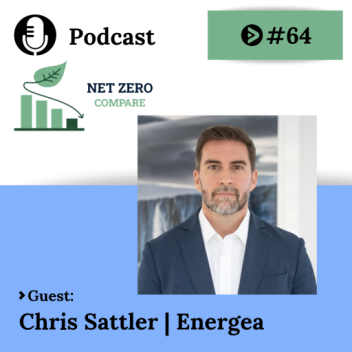
#64: What Makes Renewable Energy Projects Bankable? Energea's Chris Sattler on Solar Economics, Investment Returns, and Financing Risks
In this episode
Executive summary
Chris Sattler, Managing Partner and Co-Founder of Energea, explains what makes renewable energy projects financially viable. In this Net Zero Compare interview, he discusses solar economics, electricity contracts, financing costs, and the operational factors that shape long-term returns. Drawing on experience across Brazil, the United States, Africa, and other Latin American markets, Sattler examines currency exposure, maintenance, security, and regulatory uncertainty. He also explains how individual investors can access distributed energy infrastructure and why fees, liquidity restrictions, and investment terms require careful review. For businesses considering solar or battery storage, the discussion highlights the importance of understanding electricity costs, site conditions, and financing options before committing capital.
Solar and battery storage technologies are well established, but a technically sound renewable energy project is not necessarily a financially viable one. Its economics depend on electricity contracts, financing costs, operational performance, and the creditworthiness of customers purchasing the power. These factors influence whether a project can attract investment and generate reliable returns over its operating life. In a conversation with Net Zero Compare, Chris Sattler, Managing Partner and Co-Founder of Energea, explained how renewable energy infrastructure is financed, what separates bankable projects from riskier investments, and how individual investors can participate in an asset class traditionally dominated by institutions.
Drawing on approximately 20 years of experience in the energy sector, Sattler shared examples from Brazil, the United States, Colombia, and Africa. The discussion covered project economics, investment returns, operational risks, and the considerations businesses should weigh before financing solar or battery storage.
🎥 Watch the Full Conversation with Chris Sattler: In the full Net Zero Compare interview, Sattler explains how Energea evaluates renewable energy investments, manages operating assets, and structures investment opportunities for individual investors. He provides examples of project costs, returns, and investment fees, along with the financial and operational challenges of working across different electricity markets. The recording also offers additional context on project selection, currency risk, investor liquidity, and the financing barriers affecting renewable energy development.
From Retail Electricity Markets to Distributed Energy Infrastructure
Sattler began his career in energy as a co-founder of North American Power, a retail electricity supplier established following the deregulation of electricity markets in parts of the United States. The company grew to more than one million retail energy customers across approximately 14 markets before being sold to Calpine. Around the same time, his longtime friend and future Energea co-founder, Mike Silvestrini, developed Greenskies, a commercial solar business. Greenskies focused on installing solar systems for large retailers and using power purchase agreements (PPAs) to provide electricity without requiring customers to own the infrastructure. The company eventually sold its assets to Goldman Sachs and its development platform to a Taiwanese firm.
Following those business exits, Sattler and Silvestrini began investing their own capital in distributed energy infrastructure, initially acquiring hydroelectric and renewable energy assets in Brazil and Rwanda. As they identified more opportunities than they could finance themselves, they brought in additional investors and developed the business that became Energea. Today, the company focuses on relatively small and medium-sized energy infrastructure assets, with Brazilian projects typically requiring approximately $2 million to $5 million in capital. Its portfolios cover Brazil, the United States, Africa, and other Latin American markets.
Energea's investment model centers on holding and operating energy assets rather than primarily investing in companies developing renewable energy technology. Its portfolios generate revenue through electricity sales, contractual arrangements, and, in some Portfolios, interest on loans to energy projects, while the company manages the underlying infrastructure and distributes available income to investors.
What Makes a Renewable Energy Project Bankable?
A renewable energy project may have favorable technical characteristics without offering sufficient financial certainty to attract investment. Modern solar equipment is generally well established, but investors still need to evaluate installation quality, permits, site rights, grid connections, and commercial agreements. According to Sattler, one of the most important considerations is offtake, meaning who will purchase the electricity and under what conditions. A solar installation may operate for 20 to 25 years, but its financial value depends on the reliability of the revenue generated during that period.
Long-term electricity agreements with creditworthy customers can make future cash flows more predictable, particularly when contracts contain meaningful protections against early termination. For example, a corporate customer might sign a 15-year power purchase agreement. If that customer can terminate the contract with only two months' notice and limited financial consequences, the project could lose much of the revenue certainty on which its valuation depends. A strong customer credit rating alone does not eliminate that contractual risk.
Sattler described two commercial arrangements that Energea favors:
Corporate power purchase agreements: Long-term contracts with established organizations that have sufficient creditworthiness and enforceable obligations to purchase electricity.
Community solar: Models in which multiple electricity consumers receive credits associated with a shared solar project, allowing participants to be replaced when necessary.
In Brazil, Energea uses a community solar model in which consumers receive electricity credits through a subscription arrangement. Because the customer base can change, the project is less dependent on any single electricity buyer, although it still faces collection and subscriber-management risks. Bankability also depends on factors beyond revenue contracts. Poor installation quality, unsuitable equipment, warranty disputes, missing permits, and regulatory uncertainty can all undermine an otherwise attractive project. Energea evaluates these issues when acquiring existing installations as well as when developing new ones.
Solar Project Economics: Where the Revenue Comes From
To explain the economics of distributed solar, Sattler used a simplified, illustrative example based on community solar in Brazil. The figures are in USD and are not Energea's actual contract pricing. Suppose an electricity customer pays a standard utility tariff of $0.10 per kilowatt-hour (kWh). Through a community solar subscription, the customer receives credits that offset part of the electricity purchased from the local utility. The solar provider then charges the customer a discounted price for those credits. If the customer pays $0.08 per kWh to the solar provider, the arrangement creates savings relative to the standard tariff while generating revenue for the project owner.
Illustrative Community Solar Economics
Component | USD per kWh (illustrative) |
Standard electricity tariff | $0.10 |
Price charged by solar provider | $0.08 |
Illustrative solar generation cost | $0.04 |
Illustrative spread between selling price and generation cost (not profit) | $0.04 |
Source: Illustrative figures provided by Chris Sattler during the Net Zero Compare interview. These are not independently verified market averages.
Sattler estimated that a ground-mounted solar project of this type might generate electricity at an approximate cost of $0.04 per kWh, incorporating capital and operating costs into the calculation. Selling the electricity-related benefit for $0.08 per kWh creates a difference that helps support the investment return. However, that difference is not equivalent to the investor's net profit. Actual returns depend on the project's financing and ownership structure, operating expenses, management fees, taxes, and whether the installation produces the electricity forecast in its financial model.
Larger utility-scale solar installations can achieve lower generation costs through economies of scale. Sattler referred to projects with electricity costs or contracted prices around $0.02 to $0.03 per kWh, while noting that smaller distributed systems operate under different commercial arrangements. The underlying calculation remains the same: a project must produce electricity at a cost sufficiently below the price customers are willing or contractually required to pay, while accounting for the expenses and risks of operating the asset.
What Returns Does Energea Report?
Energea's portfolios operate across markets with different regulatory conditions, currencies, and risk profiles. During the interview, Sattler discussed target and realized net internal rates of return (IRRs) for several Portfolios, with higher figures generally associated with the additional risks of investing in emerging economies.
Market | Target IRR and realized net IRR (USD, net of Energea fees, pre-tax) |
Brazil | 12% target IRR; approximately 14% realized net IRR since inception |
Africa | 10% target IRR; approximately 10% realized net IRR |
United States | 7% target IRR; approximately 7% realized net IRR |
Source: Figures discussed by Chris Sattler during the interview. They are not guaranteed returns or general benchmarks for renewable energy investments. Target IRR is a forward-looking estimate. Realized net IRR is net of fees paid to Energea, but does not reflect intermediary commissions, early redemption discounts, or taxes, and includes the current estimated value of shares still held. Past performance does not guarantee future results.
Sattler attributed the differences partly to currency exposure and perceived market risk. U.S. projects generally offer lower expected returns but avoid the direct foreign exchange exposure associated with assets generating revenue in other currencies. These figures also require careful interpretation because the discussion included both portfolio performance and project-level return expectations, which are not necessarily equivalent to the net returns individual investors receive after fees and expenses. Historical performance does not establish future results, and investors should consult the relevant offering documents for current assumptions and risk disclosures.
The Financial and Operational Risks Investors Often Underestimate
Renewable energy assets can remain productive for decades, but their long operating lives create prolonged exposure to financial and operational risks. Sattler highlighted currency fluctuations, inadequate maintenance, and physical security as concerns that can affect returns even when the underlying technology performs as intended.
Currency Exposure in International Projects
Energea raises capital in U.S. dollars, while some of its projects generate revenue in Brazilian reais or other local currencies. Changes in exchange rates can therefore alter the dollar value of revenue and investment distributions, even when electricity generation meets expectations. Sattler explained that Energea's financial models account for potential currency depreciation by considering inflation differences between markets. Actual exchange rates, however, do not necessarily follow those assumptions. Currency movements had been favorable to some of Energea's investments at the time of the interview, but unfavorable movements could reduce future returns.
Short-term hedging instruments can help manage exchange rate exposure during a transaction, such as when a project acquisition is expected to close several months later. Protecting the cash flows of an asset over 20 years is considerably more difficult. Sattler noted that long-term hedging arrangements may be unavailable or too expensive to justify, making currency exposure an ongoing consideration for investors holding international renewable energy assets.
Maintenance and Equipment Performance
Solar systems require relatively routine maintenance, but neglecting that work can reduce generation and revenue. Sattler identified panel cleaning, vegetation management, inverter replacement, and solar tracker adjustments as recurring responsibilities. Dust accumulation alone can materially affect performance, with poorly maintained installations sometimes experiencing generation losses of approximately 10% to 15%. Solar tracking systems also require proper adjustment to maintain their intended output.
Energea occasionally encounters distressed projects whose problems stem from inadequate maintenance rather than fundamental weaknesses in the equipment or revenue model. In these cases, improving operations may help restore performance, although doing so requires technical expertise, local personnel, and additional resources. Sattler emphasized that even relatively straightforward solar installations need consistent supervision rather than being treated as assets that can operate indefinitely without attention.
Theft and Physical Security
Another risk is cable theft, particularly incidents involving copper wiring. Removing cables or connectors can force a solar installation offline, creating repair expenses and lost revenue while the equipment is replaced. Security arrangements vary by project and location, ranging from surveillance cameras to dedicated guards. Although an isolated incident may have a limited effect on lifetime returns, repeated theft can introduce ongoing expenses that were not included in the original financial model. Physical security therefore forms part of the operating costs and risk assessment, especially in locations where theft is a recurring concern.
How Individual Investors Can Access Renewable Energy Infrastructure
Direct ownership of energy infrastructure was historically concentrated among pension funds, endowments, private equity firms, and other large institutions. Traditional power generation facilities often required investments of hundreds of millions or billions of dollars, making them impractical for individual investors. Distributed solar has changed the scale of some opportunities, with smaller installations requiring only a few million dollars. Investment structures can also pool capital from multiple participants and spread it across several assets.
Energea's Portfolios are Delaware limited partnerships that own individual energy projects through underlying entities. Investors purchase interests in a Portfolio rather than acquiring direct ownership of a particular solar installation. Sattler explained that eligible individuals can begin investing with as little as $100 in certain offerings. The Portfolio receives income generated by its underlying projects, pays operating expenses, and distributes available cash to investors.
The portfolios are structured as evergreen investments, meaning they are not designed around a predetermined sale of all underlying assets. Energea intends to continue operating the infrastructure and generating income over time. According to Sattler, the portfolios have historically made monthly distributions, which are not guaranteed and may include a return of capital, which investors can choose to receive as cash or reinvest in additional shares. These arrangements make participation possible at smaller investment amounts, but the underlying assets remain private-market investments with restrictions that differ from publicly traded securities.
Understanding Fees, Liquidity, and Investment Terms
Energea's investment structure includes annual management fees and performance-based carried interest. Sattler described a 1.5% annual management fee and a 15% carried interest above a 7% annual hurdle rate, with a catch-up after the hurdle and a high-water mark. The management fee compensates Energea for managing the portfolios, while carried interest gives the company a share of returns once investors have received the 7% hurdle return. After the hurdle, a catch-up applies: Energea receives returns above the hurdle until it has received 15% of the total annual return, after which returns are split 85% to investors and 15% to Energea. The management fee is calculated on net asset value (NAV). Other fees may also apply, including origination fees of up to 5% of project cost and fees for operations and maintenance and credit management services provided by Energea affiliates, as well as sales loads and ongoing service fees on certain share classes sold through intermediaries. Investors should review the full fee disclosure in the offering documents.
Investment term | Details discussed in the interview |
Minimum investment | From $100 for eligible investors in certain offerings; higher minimums apply to other share classes |
Annual management fee | 1.5% annually, based on NAV |
Performance fee | 15% carried interest above a 7% hurdle, with catch-up after the hurdle and high-water mark |
Distributions | Monthly, subject to available income |
Initial redemption restriction | First 60 days |
Early redemption discount | 5% discount between 60 days and three years |
Redemption discount after three years | None under the terms described |
Source: Investment terms described by Chris Sattler. Investors should verify the current terms in the relevant offering documents.
Investors seeking to redeem shares before completing three years are generally subject to a 5% discount to the redemption price, which Sattler said remains within the portfolio for the benefit of other shareholders. After three years, that discount no longer applies under the terms he described. Redemptions are not guaranteed. Requests are subject to quarterly limits, generally 5% of a Portfolio's net asset value per quarter and 20% per year, Energea may reject, amend, or suspend the redemption plan, and approved redemptions may take up to 90 days to be paid. Investors should therefore approach the portfolios as long-term holdings rather than assume that their capital will always be accessible on short notice.
Eligibility also depends on the investor's location and regulatory status. The investments are not offered or marketed in every jurisdiction, and prospective investors must verify their eligibility and review the applicable offering documents before making a decision.
When Solar or Battery Storage Makes Financial Sense for Businesses
Companies considering solar or battery storage often want to reduce electricity expenses, improve energy resilience, or lower emissions. Sattler recommended beginning with a detailed analysis of existing electricity costs rather than selecting a technology or financing model first. Businesses should understand their current tariffs, consumption patterns, and whether their facilities are suitable for on-site generation. Property ownership also matters because a company leasing its premises or planning to relocate may face different financial and contractual constraints from one that owns its facility.
Once these factors have been assessed, businesses can compare available financing arrangements:
Direct ownership: The company purchases the equipment, potentially using a loan, and takes responsibility for the investment. Depending on the location and eligibility, tax incentives or rebates may affect the economics.
Power purchase agreement: A third party finances and owns the installation, while the business agrees to purchase electricity under specified contractual terms.
Third-party ownership or subscription: The business accesses renewable energy benefits without directly owning the generating asset, subject to the applicable commercial and regulatory model.
Sattler advised businesses to obtain proposals from local developers and review them with their finance teams. Incentives and electricity market rules can differ substantially between countries, states, provinces, and utility territories, meaning that a financing arrangement that works in one location may be unattractive elsewhere. Some industrial businesses, for example, already pay relatively low electricity tariffs, leaving limited room for additional savings from on-site generation even when incentives are available.
A credible financial assessment should therefore consider actual electricity prices, expected savings, capital requirements, maintenance responsibilities, and contractual obligations. Environmental benefits may strengthen the case for a particular investment, but they do not eliminate the need to determine whether the project makes commercial sense.
Measuring Solar Performance Against Financial Projections
Before a solar project is built, developers estimate its expected electricity production using engineering models. Sattler referred to PVsyst, software used to forecast solar generation and assess performance under different conditions. Project forecasts commonly include probability-based estimates known as P50 and P90. A P50 figure represents a generation level with approximately a 50% probability of being exceeded under the model's assumptions, while a P90 estimate represents a more conservative threshold with approximately a 90% probability of being exceeded. These forecasts help developers, lenders, and investors evaluate production uncertainty and its potential financial consequences.
Once a project begins operating, actual generation can be compared with the assumptions used in the original financial model. Sattler explained that solar output can vary considerably over short periods, with a particularly cloudy month potentially resulting in generation 10% to 20% below expectations. Over longer periods, production tends to be more stable, with year-to-year differences of approximately 2% to 3% in the circumstances he described. A single month of lower electricity production does not necessarily indicate a structural problem, while persistent underperformance may point to maintenance issues, equipment faults, or inaccurate modeling assumptions.
Project owners may also track environmental indicators such as estimated emissions avoided. However, electricity generated, avoided emissions, and reductions that a company can report in its own emissions inventory are not interchangeable measurements. Organizations using renewable electricity data for sustainability reporting need to apply the relevant accounting methods and maintain documentation supporting their claims, particularly when reporting Scope 2 emissions or assessing the environmental benefits of electricity purchases.
Why Financing Remains a Barrier to Renewable Energy Development
Sattler considers solar and battery storage sufficiently mature for continued commercial deployment. In his assessment, financing conditions are now a more immediate obstacle for certain types of projects than the availability of suitable technology. The cost of capital is particularly important for large developments that rely heavily on debt. Higher borrowing costs increase financing expenses and can make projects financially unattractive even when their technical performance and expected revenue remain unchanged.
Energea's smaller projects generally use equity financing rather than relying heavily on debt, according to Sattler. This reduces their direct exposure to borrowing conditions, although they still depend on attracting investment capital at a cost that supports their expected returns. Larger infrastructure developments often have different requirements, with financial viability depending on access to substantial loans, favorable interest rates, and sufficient liquidity in debt markets. As a result, two technically similar projects can face very different financing constraints depending on their size and capital structure.
How Regulation and Incentives Affect Project Economics
Government policies can encourage renewable energy investment by establishing market structures, providing financial incentives, or reducing barriers to development. Tax credits and rebates may improve project returns and make investments viable that would otherwise struggle to compete. Sattler nevertheless cautioned against excessive dependence on government support, arguing that incentives can help establish a market but should not become the permanent foundation of its economics.
He referred to Germany and the United States as markets where changing incentives and regulatory conditions have influenced renewable energy development. Poorly calibrated incentives can also encourage excessive investment or create business models that become difficult to sustain when financial support is reduced. For businesses and investors, this makes regulatory sensitivity an important part of project evaluation. An installation whose profitability depends heavily on a particular tax credit or electricity tariff may become less attractive if those conditions change.
Electricity Demand and the Long-Term Need for Energy Investment
Sattler identified three developments contributing to electricity demand growth, including in developed economies where consumption had previously been relatively stable. The first is digital infrastructure, particularly data centers, which require substantial electricity supplies and supporting power networks. The second is reindustrialization, as countries seek to expand domestic manufacturing capacity and bring certain industrial activities back into their economies. The third is electrification, including electric vehicles and the replacement of fossil fuel-based equipment with electric alternatives in other sectors.
These developments create demand for additional generation capacity beyond projects developed specifically to meet decarbonization targets. Electricity systems need to accommodate new consumption patterns while maintaining reliable and competitively priced supplies. Sattler estimated that financing a broad global energy transition could require trillions of dollars over the coming decades, presenting this as an indication of the potential scale of investment rather than a precise forecast.
He also suggested that expanding access to private energy infrastructure investments, including through eligible retirement accounts, could provide another source of capital alongside institutional and public financing. However, making additional funding available does not automatically create investable projects. Developers still need commercially viable opportunities, appropriate contractual arrangements, and financing structures capable of supporting long-term operations.
Conclusion: Start With the Economics, Not Just the Technology
Renewable energy projects need to be evaluated as long-term commercial assets, with their financial performance shaped by electricity contracts, operating costs, market conditions, and the quality of ongoing management. For businesses considering solar or storage, the starting point should be a clear understanding of existing electricity costs and the alternatives available at their specific location. Site characteristics, contract terms, incentives, and expected savings will ultimately determine whether ownership or third-party financing is commercially worthwhile.
For investors, Energea's approach illustrates how distributed energy infrastructure can be made accessible through portfolio ownership, while also demonstrating the need to assess fees, currency exposure, liquidity restrictions, and underlying asset performance alongside projected returns. As electricity demand grows, investment opportunities are likely to expand, but the ability to identify and finance projects with dependable revenue arrangements and realistic operating assumptions will remain central to their long-term viability.
Editorial note: Investment returns, portfolio terms, project economics, and market estimates presented in this article reflect statements made by Chris Sattler during the interview. They have not been independently audited for this article and may change. The information is provided for educational purposes and does not constitute investment, financial, legal, or tax advice. Nothing in this article is an offer to sell, or a solicitation of an offer to buy, any security. Any offering is made only through the applicable offering documents, and investments involve risk, including the loss of principal.
Topics
More from Net Zero Compare Podcast
#63: Byron Irwin on Turning Waste Into Community Opportunity: Composting, Recycling, and Rural Sustainability
#62: Afonso Firmo on Australia's Mandatory Climate Reporting: Lessons for Carbon Accounting, AI, and Decarbonization
#61: Lisa Drees on Building Trust in Green Hydrogen Supply Chains: Technology Is Only Part of the Answer
#60: Brandon Lapsys on Why Recycling Projects Depend on End Markets, Operational Discipline, and Better Waste Data
#59: Lisa Wright on Why eVTOL Infrastructure May Matter as Much as the Aircraft