
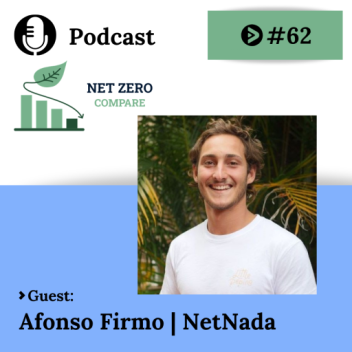
#62: Afonso Firmo on Australia's Mandatory Climate Reporting: Lessons for Carbon Accounting, AI, and Decarbonization
In this episode
Executive summary
Australia’s mandatory climate reporting is reshaping how businesses measure emissions, manage climate risks, and assign responsibility. In this Net Zero Compare interview, Afonso Firmo, Co-Founder and Director of NetNada, explains why reliable disclosures require complete data, consistent methodologies, traceable calculations, and senior management involvement. He discusses prioritizing material Scope 3 sources, improving supplier data, and using AI to support classification, document extraction, and anomaly detection while retaining human oversight. The conversation also explores how reporting can inform renewable electricity procurement, fleet investment, and operational resilience. Firmo encourages companies to prepare early, strengthen internal processes, and connect climate information with practical business decisions and measurable emissions reductions.
Australia's introduction of mandatory climate-related financial reporting is changing how companies measure emissions, assess climate risks, and prepare sustainability disclosures. Businesses must now explain not only how their emissions are calculated, but also how climate-related information is governed, reviewed, and incorporated into financial and operational decisions.
In a conversation with Net Zero Compare, Afonso Firmo, Co-Founder and Director of NetNada, discussed how Australian businesses are responding to these requirements and what organizations in other markets can learn from their experience. NetNada provides carbon accounting and climate reporting software to more than 100 organizations, according to Firmo, including publicly listed companies, private equity firms, and local governments. Drawing on his environmental engineering background and experience supporting corporate reporting, he examined the practical difficulties companies encounter with emissions measurement, Scope 3 data, external assurance, and artificial intelligence.
The discussion also explored how businesses can connect climate reporting with decisions about energy procurement, supplier relationships, operational resilience, and emissions reduction.
🎥 Watch the Full Interview with Afonso Firmo: In the full Net Zero Compare interview, Afonso Firmo discusses Australia's mandatory climate reporting requirements and the challenges businesses face when preparing reliable disclosures. The conversation includes practical examples of Scope 3 data collection, AI-assisted carbon accounting, audit preparation, and climate-related investment decisions. Watch the recording for additional context on the approaches Firmo has observed through his work with NetNada and the trade-offs companies encounter when implementing them.
Mandatory Climate Reporting Is Changing Corporate Governance
Australia's mandatory climate-related financial reporting framework is built around AASB S2, the Australian Accounting Standards Board's climate-related disclosure standard. Requirements are being introduced progressively, with companies entering the reporting regime according to applicable eligibility criteria and reporting periods. The framework covers four areas: governance, strategy, risk management, and metrics and targets. Measuring greenhouse gas emissions is therefore only one part of the reporting process.
Firmo explained that carbon accounting was previously treated by some companies as a voluntary sustainability activity, often managed by a small internal team. Mandatory reporting has expanded the responsibilities involved, bringing financial executives, boards, risk managers, and external assurance providers into the process. Companies must establish who oversees climate-related matters, how risks and opportunities are assessed, and whether their internal systems can support the information disclosed publicly. Preparing a report may involve materiality assessments, climate scenario analysis, risk workshops, and documentation of methodologies and governance arrangements.
According to Firmo, NetNada's analysis of publicly available reports suggests that responsibility for climate-related matters is increasingly being assigned to boards and senior executives. He also observed examples of executive remuneration being linked to climate-related performance. Whether these developments will lead to substantial changes in business models and investment decisions remains uncertain, although companies are already examining climate risks that could affect their operations and assets.
In property and insurance, businesses are evaluating exposure to flooding, bushfires, water shortages, and rising sea levels. These risks can influence asset values, insurance considerations, and long-term investment decisions. Australia's logistics industry faces different challenges. Flooding can interrupt major road freight routes, forcing vehicles to travel considerably longer distances and increasing delivery costs. Businesses dependent on overseas manufacturers must also consider how extreme temperatures or natural disasters could disrupt production and supply chains.
Mandatory reporting also affects businesses outside the groups directly subject to disclosure requirements. Large organizations need information about emissions associated with purchased goods, services, and other value chain activities. Consequently, smaller suppliers may receive requests for emissions data before they are required to prepare climate-related financial disclosures themselves. Understanding energy consumption, transportation activities, and other relevant emissions sources can help these businesses respond to procurement requirements and maintain relationships with larger customers.
Reliable Carbon Accounting Starts with Complete Data
A reliable carbon inventory requires more than correct calculations. Companies must establish which activities are included, where the underlying information comes from, and whether the methodology is applied consistently. Firmo identified missing records, inconsistent emissions factors, fragmented internal systems, and poorly documented reporting boundaries among the recurring problems encountered by NetNada's clients.
The difficulties vary according to reporting maturity. First-time reporters need to define their organizational and operational boundaries, identify relevant emissions sources, and determine what information is available. Companies with established inventories must examine whether their previous calculations can be reproduced and whether their reported baseline remains suitable for comparison. An organization may have published an emissions figure without retaining sufficient documentation of the data sources, exclusions, or calculation methods used. That becomes problematic when auditors request supporting evidence or when the company needs to explain changes between reporting periods.
A company can calculate emissions correctly from the information it has collected while still producing an incomplete inventory. For example, electricity emissions might be calculated accurately from available invoices, but the dataset could exclude several operating locations or months of consumption. A Scope 3 inventory might include business travel and purchased goods while omitting other relevant categories without documenting those exclusions. Firmo emphasized that companies need to understand the completeness of their reporting before placing too much confidence in the final figures.
Addressing these gaps requires consistent data collection procedures and clearly assigned responsibilities. Sustainability teams often depend on information held by finance, procurement, facilities, and operations, making coordination between departments necessary. Standardizing how information is collected, stored, and reviewed can reduce the need to reconstruct records or chase missing information during each reporting cycle.
Companies must also distinguish operational changes from adjustments to their accounting methodology. Reported emissions may change when an organization switches emissions factor databases, improves source information, revises calculation methods, or expands its reporting boundary, even if its activities remain largely unchanged. For example, replacing an expenditure-based estimate with more detailed activity data may produce a different emissions figure without a corresponding change in physical emissions. Material methodological changes should therefore be explained, particularly when they affect comparisons with previously reported results.
Scope 3 Reporting Requires Prioritization and Better Supplier Data
Scope 3 emissions are often the most difficult to measure because they arise from activities across a company's value chain. Unlike Scope 1 emissions from owned or controlled sources and Scope 2 emissions associated with purchased energy, Scope 3 calculations frequently depend on information held by suppliers and other external organizations. Companies may need to estimate emissions associated with purchased goods and services, transportation, business travel, waste, and other relevant activities. Some categories can be measured using detailed activity data, while others initially rely on expenditure-based estimates and industry-average emissions factors.
Firmo argued that companies should prioritize their most material emissions sources rather than attempting to obtain equally detailed information from every supplier. A supplier-specific emissions figure may appear more reliable than an industry-average estimate, but its usefulness depends on how it was calculated. If the supplier used incomplete records, inconsistent boundaries, or unsuitable emissions factors, the resulting figure may not provide a better basis for decision-making. Companies should evaluate the quality of the methodology alongside the specificity of the data.
Firmo recommended assessing suppliers according to factors such as expenditure, estimated emissions, industry exposure, and their importance within the value chain. This allows sustainability teams to identify where more detailed information would be most valuable. Instead of requesting extensive data from hundreds of suppliers simultaneously, a company could begin with a small group of priority suppliers and work directly with them to improve reporting.
Automated questionnaires and standardized information requests can make data collection more manageable, while workshops, individual meetings, and educational resources can help suppliers develop their reporting capabilities. This approach can benefit both parties. Large customers receive better information for their Scope 3 inventories, while suppliers become better prepared to respond to similar requests from other buyers.
Not every improvement requires supplier-specific emissions figures. For business travel, companies may be able to obtain flight routes and other details from travel management systems rather than relying solely on expenditure. For freight, information about transport modes, distances, and routes can replace broad spending-based estimates. These changes can make calculations more informative and help identify opportunities to reduce emissions.
AI Can Improve Carbon Accounting, but Methodology Determines Reliability
Artificial intelligence can reduce the manual work involved in processing financial, operational, and supplier information. Firmo described several applications used or being developed by NetNada, including transaction classification, emissions factor matching, anomaly detection, document extraction, and assistance with climate-related disclosures. However, he cautioned against allowing AI to make accounting decisions without appropriate methodological controls.
Carbon accounting platforms often need to classify financial transactions and associate them with relevant emissions factors. Automating this process can substantially reduce the time required to process large datasets, but selecting an emissions factor involves more than matching a transaction description to a category. Systems must consider geography, reporting year, the source of the factor, and distinctions such as location-based versus market-based electricity accounting. An automated platform could otherwise select a plausible but unsuitable emissions factor, producing a calculation that appears precise while relying on an incorrect methodology.
AI can also help companies investigate unusual results. Firmo described how a system might flag a substantial difference in emissions between two months. A lower figure could initially suggest improved performance, but further investigation might reveal that several days of invoices were missing. Similar checks can identify unexpected changes in emissions intensity, unusual consumption patterns, or inconsistencies between comparable locations. The software does not necessarily explain why a discrepancy occurred, but it can direct attention to records that deserve closer examination.
Another application is extracting activity data from documents. Traditional financial data extraction focuses on invoice numbers, dates, and monetary amounts, while carbon accounting requires additional information, including electricity consumption, fuel quantities, and other activity measures. AI can help extract these details from invoices and supporting documents. It may also assist in distinguishing between electricity products described as renewable, carbon-neutral, or supplied through the conventional grid. These distinctions can affect emissions calculations, making validation necessary when documents are incomplete or use inconsistent terminology.
Firmo used waste accounting in New Zealand to illustrate why local methodology matters. Landfill emissions calculations can depend on whether landfill gas is captured or flared. A generic calculation that does not account for these conditions may be inappropriate for the activity being measured. Comparable issues arise with specialized waste classifications, local emissions factor databases, and jurisdiction-specific reporting requirements.
AI can also assist with preparing climate risk workshops and drafting disclosures by organizing information and helping teams identify areas requiring attention. However, the resulting assessments still require stakeholder input and professional review. Firmo's broader point was that automation can make established processes more efficient, but it cannot compensate for accounting rules or assumptions that are incorrect or missing.
Audit-Ready Reporting Requires Traceable Calculations
As climate disclosures become subject to external assurance, companies need to provide evidence supporting their reported figures. An emissions total generated by software is not sufficient on its own. Reviewers must be able to understand the data, assumptions, and calculations behind it.
Firmo described how NetNada documents emissions factors, calculation logic, source information, and adjustments. Depending on the calculation, supporting records may include the emissions factor's publication year, its source, currency conversions, inflation adjustments, and mathematical operations. This allows users and auditors to examine how individual figures were produced rather than relying on unexplained outputs.
Firmo recommended beginning validation with straightforward reconciliation checks. If a company operates ten locations, it should confirm that the relevant locations appear in its reporting dataset. If the inventory covers twelve months, it should verify that the expected records exist throughout that period. Financial records provide another useful reference. For example, a company can compare energy expenditure recorded in its enterprise resource planning system with the corresponding transactions included in its carbon accounting platform. Differences may reveal missing invoices, duplicate records, classification errors, or other problems.
A well-organized reporting system should allow users to retrieve original activity data, calculation methods, emissions factors, and relevant assumptions. Firmo discussed the value of making this information available to external reviewers through exports or direct access to supporting records. Such transparency helps organizations prepare for assurance, although it does not replace independent verification or professional judgment.
Reporting processes should also identify who is responsible for preparing, reviewing, and approving information. Firmo recommended involving the final decision-makers early, particularly CFOs and board members responsible for approving disclosures. This gives them an opportunity to raise questions before the report reaches its final review and reduces the risk that a sustainability team completes months of work only to discover that senior management requires additional evidence or explanations.
Greenwashing Risks Extend to Inadequate Climate Disclosures
Greenwashing is commonly associated with environmental marketing claims that exaggerate a company's performance. Firmo highlighted another concern emerging from mandatory climate-related financial reporting: companies may fail to identify or adequately explain material climate risks. For example, a business operating in an industry with substantial exposure to physical or transition risks might publish a disclosure identifying few or no material risks. That does not automatically mean the report is misleading, but it raises questions about how the company assessed its exposure and reached its conclusions.
Firmo expects comparisons between companies in similar industries to become increasingly useful as more climate disclosures are published. An investment firm with substantial exposure to mining, forestry, or transportation may identify several climate-related risks, while another organization with comparable investments might report none. Different conclusions may be justified by differences in geography, operations, or risk management. Nevertheless, companies should be able to explain the assessments supporting their disclosures.
Firmo also observed that some businesses appear to be moving away from broad net-zero announcements toward more specific commitments. Examples discussed during the interview included reducing market-based Scope 2 emissions, procuring renewable electricity when moving premises, and investing in electric vehicle fleets. These measures do not necessarily amount to a complete decarbonization strategy, but their implementation and results can be easier to assess than a distant target without a defined plan. Companies should ensure that public claims remain consistent with the underlying evidence, reporting boundaries, and actions actually being taken.
Decarbonization Investments Should Reflect Business Priorities
An emissions inventory can help identify where a company produces greenhouse gases, but it does not determine which reduction measures are financially or operationally appropriate. Businesses must consider emissions impact alongside investment costs, available resources, operational constraints, and exposure to climate-related risks. Firmo emphasized that emissions reduction and business resilience can sometimes be addressed through the same investment.
He described a factory in Western Sydney facing high electricity costs and potential operational pressures during periods of extreme heat. Battery storage, renewable electricity procurement, or changes to power purchase arrangements could help manage energy-related risks while reducing certain emissions. The financial case would depend on the facility's consumption patterns, existing contracts, and investment costs.
Transport businesses face similar considerations. Changes to vehicle fleets, including reducing dependence on diesel where operationally feasible, may lower emissions while limiting exposure to fuel-price fluctuations. However, the appropriate investment depends on route requirements, vehicle availability, infrastructure, and total operating costs. For companies with substantial transportation activities, decarbonization planning should be integrated with fleet replacement schedules and capital expenditure decisions.
Not every response to climate risk reduces emissions. Firmo discussed how construction companies may need to adjust working hours or introduce additional heat-management measures during prolonged periods of extreme temperatures. These actions can improve working conditions and operational resilience without necessarily reducing greenhouse gas emissions. Flood protection, alternative supply routes, and supplier diversification can serve similar adaptation purposes. Businesses should distinguish between investments that reduce emissions and those that reduce exposure to physical climate risks, even when both contribute to a broader climate strategy.
Smaller Businesses Have Different Decarbonization Options
Large companies may have enough purchasing influence to encourage suppliers to improve emissions reporting or adopt lower-emissions processes. Smaller organizations generally have less leverage. A business with twenty or thirty employees might be able to change its electricity procurement, replace vehicles, or improve its operating practices without having much influence over the emissions of major manufacturers.
Firmo suggested that smaller companies should also consider their position within industries undergoing decarbonization. Rather than focusing exclusively on their own operational emissions, they can examine whether their products, services, or expertise could support customers making climate-related changes. A manufacturer might explore opportunities to supply components used in lower-emissions infrastructure, while a professional services business could consider how its existing capabilities apply to clients implementing sustainability initiatives.
This approach does not remove the need to manage the company's own emissions. It recognizes that smaller businesses may find commercially relevant opportunities by participating in value chains where customers are investing in decarbonization. The appropriate priorities will depend on the company's resources, customers, and long-term business objectives.
Australia's Electricity Transition Has Implications for Scope 2 Reporting
As Australia's electricity generation mix changes, the emissions intensity of grid electricity can change with it. This affects companies reporting Scope 2 emissions, particularly those using location-based calculations. Firmo explained that a business may report lower electricity-related emissions even when its electricity consumption remains unchanged. If the applicable grid emissions factor declines, the company's calculated location-based Scope 2 emissions may also decrease. This reduction differs from one achieved through energy efficiency or other operational measures.
Companies should understand how changes in the electricity system affect their reported performance, particularly when evaluating progress against emissions targets. Clear methodological explanations help readers distinguish changes in grid emissions intensity from company-specific improvements. The distinction also matters when businesses compare their performance across locations or reporting periods.
Firmo discussed the differences between electricity products marketed as renewable or carbon-neutral and their treatment under Scope 2 accounting. Companies should examine the contractual arrangements, supporting instruments, and applicable reporting rules before assuming that these products have equivalent emissions implications. The distinction between location-based and market-based reporting is particularly relevant when evaluating electricity procurement decisions.
Australia also offers various government initiatives and incentives that may affect the economics of solar installations, battery storage, and electric vehicle fleets. Firmo suggested that companies consider the availability of relevant support programs when planning investments, while remaining attentive to their own financial circumstances. Procurement requirements can also influence decisions. Businesses supplying government agencies or large corporate customers may encounter sustainability criteria relating to transportation, materials, or energy use. Understanding these expectations in advance can help companies prioritize investments that support both emissions objectives and commercial opportunities.
Firmo cautioned against making rushed decisions based solely on the direction of the wider energy transition. Climate-related investments should be evaluated in the context of the company's financial position, operating requirements, and long-term plans.
Reporting Priorities for the Next 12 to 24 Months
Firmo outlined different priorities for Australian companies depending on their stage of mandatory climate reporting. Although his recommendations were framed around Australia's reporting groups, many apply to businesses in other jurisdictions.
Companies that have completed their first report should evaluate the process before beginning the next one. Firmo recommended reviewing costs, identifying activities that required substantial external support, and determining which capabilities could be developed internally. Companies that relied heavily on consultants may be able to incorporate selected reporting activities into their regular business processes. They should also examine how recurring data collection can be automated and where their Scope 3 information needs improvement. Firmo advised against allocating the entire reporting budget to software and consulting services, as businesses should retain resources for supplier engagement, training, and improvements to value chain data.
Businesses entering their first reporting cycle can learn from organizations that have already published disclosures. Existing reports provide examples of governance arrangements, climate risk assessments, reporting structures, and methodological explanations. These examples should inform preparation rather than serve as templates to copy without considering the company's circumstances. Firmo also recommended budgeting for implementation support, whether through a software provider, consultant, or internal training. Reporting technology can support calculations and documentation, but organizations may still need guidance on boundaries, methodologies, responsibilities, and the interpretation of requirements.
Organizations not yet subject to mandatory reporting can begin with basic preparation. Identifying emissions sources, reviewing available information, assigning internal responsibilities, and understanding customer expectations can make subsequent reporting more manageable. The appropriate investment depends on the company's size, available resources, and anticipated obligations. Starting early can also reduce the difficulty of obtaining historical records once reporting becomes necessary.
Across reporting groups, Firmo recommended reducing manual work through better integration between existing financial and operational systems and carbon accounting platforms. Automated data flows can reduce repeated spreadsheet consolidation, copying, and information requests. The time saved can be directed toward activities that require greater judgment, including climate risk assessments, supplier discussions, investment planning, and engagement with senior management.
Conclusion
Australia's mandatory climate reporting regime is bringing greater scrutiny to how companies collect emissions data, assess risks, and explain their climate-related decisions. Firmo's experience suggests that the technical calculations are often more manageable than the organizational work required to establish reliable processes, assign responsibilities, and determine how climate-related information should influence business decisions.
A company can produce a technically adequate inventory without developing an effective approach to climate risk or emissions reduction. It can also invest in sophisticated software while retaining incomplete records, unclear responsibilities, or weak internal review procedures. Addressing these problems requires management decisions and coordination across the business, not simply additional automation.
For organizations preparing their first disclosures, the priority is to establish dependable data and reporting processes that can improve over time. For more experienced reporters, the opportunity is to use that information to evaluate investments, strengthen supplier relationships, and make better-informed operational decisions. The value of climate reporting ultimately depends on whether companies can use what they measure, rather than treating disclosure as an exercise completed once a year.
Topics
More from Net Zero Compare Podcast
#61: Lisa Drees on Building Trust in Green Hydrogen Supply Chains: Technology Is Only Part of the Answer
#60: Brandon Lapsys on Why Recycling Projects Depend on End Markets, Operational Discipline, and Better Waste Data
#59: Lisa Wright on Why eVTOL Infrastructure May Matter as Much as the Aircraft
#58: Arjun Gupta on Packaging EPR in the US: How AI Is Changing Compliance, Data Management, and Cost Forecasting

#57: Lubomila Jordanova on Corporate Sustainability: From Carbon Accounting to Business Value
