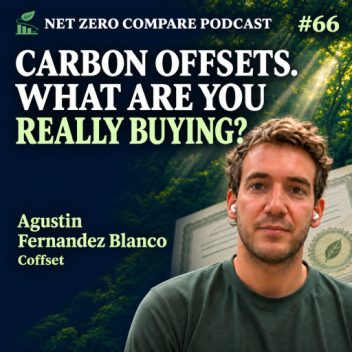
#66: Agustin Fernandez Blanco on What Businesses Should Check: From a First Carbon Footprint to Traceable Credits
In this episode
Executive summary
How can a small business estimate its carbon footprint and verify a voluntary carbon credit purchase? In this episode of the Net Zero Compare Podcast, Agustin Fernandez Blanco of Coffset explains how fuel receipts and electricity bills can support a first estimate, why Scope 3 sources such as employee commuting can be overlooked, and how emissions factors shape the result. He discusses how Coffset uses AI to interpret inputs and when businesses need more detailed data to choose where to cut emissions. In a live demo, he shows how buyers can trace their purchase from a certificate to public registry retirement records, even when several purchases are retired together. Throughout the conversation, he emphasizes reducing emissions first and reporting retired credits separately from emissions reductions.
A customer requests emissions figures, and a small business has to work out what it can calculate from fuel receipts, electricity bills, and supplier invoices. Those records provide a starting point, but turning them into useful information requires decisions about coverage, assumptions, and data quality.
In a conversation hosted by Net Zero Compare, Agustin Fernandez Blanco of Estonia-based Coffset discussed how his company approaches initial footprint estimates and voluntary carbon credit purchases. His emphasis was on understanding the limits of a calculation, using it to identify opportunities to reduce emissions, and being able to follow a credit purchase through to its retirement record.
🎥 Watch the Full Interview: Watch the full Net Zero Compare interview with Agustin Fernandez Blanco for a closer look at Coffset’s approach to carbon footprint calculations and voluntary credits. The conversation includes a screen demonstration showing how purchase certificates connect to project information and public registry records. It also explores the tradeoffs behind a simplified calculator and a predefined credit portfolio. Watching the discussion provides additional context for the capabilities and limitations described below.
Give the First Estimate a Clear Purpose
Fernandez Blanco began exploring carbon accounting through his own travel habits. He wanted to understand his footprint and investigate ways to address emissions he could not avoid. That research exposed two problems he later sought to address through Coffset: calculators that required substantial effort before delivering a result, and credit purchases that were difficult to trace.
His response was to make an initial calculation accessible enough for someone to complete without extensive preparation. For businesses, he described Coffset’s calculator as a way to obtain a first estimate, with further investigation needed when the user requires more detail.
That distinction matters when choosing a tool. A business looking for an initial indication of its emissions has a different need from one preparing a detailed customer response or evaluating a specific operational investment. Fernandez Blanco acknowledged that Coffset’s simplified calculator does not provide the granularity needed to compare every production process or reduction scenario.
The useful question is therefore what decision the estimate can support. It can help a team begin examining its footprint, while also revealing where more detailed information is necessary.
Look Beyond the Bills That Are Easiest to Find
The interview followed a hypothetical distributor with a warehouse, delivery vans, and purchased goods. Fuel and electricity records offer relatively direct starting points, but Fernandez Blanco emphasized the importance of considering activities beyond those visible in the office or accounting system.
Employee commuting was one example. Its significance varies with the business, its location, and how employees travel. For a service company, commuting could deserve substantial attention; a manufacturer may have a very different emissions profile. His point was that teams can overlook relevant activities when they focus only on the records closest at hand.
He also raised remotely hosted servers. A company may count the computers in its office while overlooking the energy associated with infrastructure located elsewhere. In that situation, the location and electricity supply of the servers become relevant to the estimate.
These examples illustrate the challenge of Scope 3 data: some information depends on employees, suppliers, or other organizations. Even willing respondents may lack precise records. A useful first calculation should make those gaps visible rather than allowing missing information to disappear into a seemingly complete total.
Understand the Assumptions Behind the Result
Fernandez Blanco described the basic calculation process as applying emissions factors to information about activities, then combining the results. The difficult work often sits behind the factors: how they were developed, what they represent, and whether they fit the activity being assessed.
Electricity provides a practical example. The same amount of consumption can have different associated emissions depending on the electricity supply. He also acknowledged that approximations may be necessary when the calculator lacks a suitable country-specific factor.
According to Fernandez Blanco, Coffset publishes methodology pages explaining its calculations, the factors it uses, and when those factors were updated. He described presenting results as a range to avoid suggesting that a short questionnaire can establish an exact annual footprint.
For a business reviewing an estimate, the practical task is to understand which inputs came from records and which relied on assumptions. An electricity bill provides different evidence from an estimate based on floor area. Knowing that difference helps the team decide where collecting better data would be worthwhile.
Keep AI’s Role Separate From the Calculation Method
Although Coffset uses an AI-supported interface, Fernandez Blanco said its role is to interpret user responses. The emissions calculations follow the methodology already established for the tool.
He illustrated this with a travel entry: if someone provides an incomplete destination, the interface can ask for clarification before passing the information into the calculation. In his description, AI helps the interaction flow without selecting a new accounting method or independently determining the arithmetic.
This distinction gives businesses a more useful way to assess an AI feature. The relevant questions concern how the system interprets an answer, how users can correct it, and which documented calculation follows afterward.
The discussion did not establish a detailed workflow for converting supplier expenditure into a Scope 3 inventory. Businesses seeking that capability would need further methodological information before relying on the tool for that purpose.
Turn a Broad Total Into Specific Reduction Questions
An overall estimate does not automatically tell a business which change to fund. During the interview, the hypothetical distributor faced a choice between improving delivery routes and working with suppliers. Fernandez Blanco declined to prescribe a universal answer, pointing instead to differences in cost, operational constraints, and available information.
His suggested approach was to break a large emissions source into smaller problems that the business could investigate. He also acknowledged that Coffset’s calculator cannot currently perform all of that analysis.
For decision makers, the implication is straightforward: use the initial result to identify where to look next. If a broad category appears significant, investigate its components before committing money to a particular change. The next step may require better records or specialist support rather than another high-level estimate.
Follow a Credit Purchase Beyond the Certificate
For businesses that also choose to buy voluntary credits, Fernandez Blanco emphasized traceability. During the screen demonstration, he showed a certificate containing the purchased quantity, project allocations, and links leading toward retirement information.
Coffset works with CNaught as its carbon credit procurement partner, a relationship also identified on Coffset’s website. Coffset Fernandez Blanco described CNaught as conducting project due diligence and preparing portfolios, with Coffset using a portfolio selected from that offering.
The demonstration also highlighted an important detail for buyers: a public retirement record may cover a larger batch and identify the procurement partner’s customers collectively. The buyer therefore needs to understand how its individual purchase connects to that batch.
A useful review follows the evidence through several stages:
The quantity recorded on the purchase certificate.
The allocation across the listed projects.
The associated public retirement records.
The explanation connecting the buyer’s allocation to any pooled retirement.
This makes the purchase more inspectable. It also distinguishes evidence of retirement from the broader assessment of a project’s quality. In the interview, Coffset’s approach to project selection relied on its procurement partner’s due diligence.
Understand the Portfolio Before Comparing Prices
Fernandez Blanco described Coffset’s standard offering as a predefined portfolio combining different project types. Buyers can see where their purchase was allocated, but they cannot select individual projects through that standard offering.
He presented this as a tradeoff that simplifies purchasing and supports a flat price. During the conversation, the stated starting price was €0.04 per kilogram, equivalent to €40 per metric ton. That was the price discussed in the interview, rather than a comparison of equivalent offers across the market.
Fernandez Blanco cautioned against treating price alone as proof of quality. Different project activities have different costs, and technology-based carbon removal can be expensive. Equally, a higher price does not automatically establish that a credit is better.
For procurement teams, the comparison needs to include the project activity, the verification and documentation available, and the service included in the purchase. A portfolio purchase also involves accepting the provider’s allocation decisions, making transparency about those decisions particularly relevant.
Keep Emissions and Credit Purchases Distinct
One hypothetical example brought the reporting issue into focus: a distributor measures 100 metric tons of emissions and retires credits covering 20 metric tons.
Fernandez Blanco acknowledged that the company’s emissions remain the same. The credit purchase does not demonstrate that its operations or value chain emitted 20% less. He repeatedly returned to the importance of reducing the underlying footprint, with voluntary compensation considered afterward.
For readers of a report, those figures need distinct explanations: what the business emitted, what it changed to reduce emissions, and what credits it purchased and retired. Combining them into a single number can obscure whether operational progress occurred.
Fernandez Blanco was also cautious about carbon-neutral product labels and said he would not want Coffset used as the basis for such a stamp. He acknowledged limits to the legal and accounting guidance his company could provide. A purchase certificate cannot, by itself, answer every question about reporting obligations, tax treatment, or permissible marketing claims.
Make the Evidence Useful for the Next Decision
The conversation’s practical value lies in separating decisions that are often bundled together. An initial footprint estimate can help a business understand where to investigate. More detailed data may then be needed to choose a reduction measure or explain the result to a customer. A voluntary credit purchase requires its own evidence, including a clear connection between the buyer’s allocation and retirement records.
Fernandez Blanco’s recurring advice was to take time to understand the information and prioritize reductions. For organizations starting this work, that means choosing tools according to the decision at hand and being explicit about what the resulting evidence can support.
Topics
More from Net Zero Compare Podcast
#65: Ron Crabtree on Reducing Manufacturing Waste Through Better Processes and Supplier Collaboration
#64: What Makes Renewable Energy Projects Bankable? Energea's Chris Sattler on Solar Economics, Investment Returns, and Financing Risks
#63: Byron Irwin on Turning Waste Into Community Opportunity: Composting, Recycling, and Rural Sustainability
#62: Afonso Firmo on Australia's Mandatory Climate Reporting: Lessons for Carbon Accounting, AI, and Decarbonization
#61: Lisa Drees on Building Trust in Green Hydrogen Supply Chains: Technology Is Only Part of the Answer