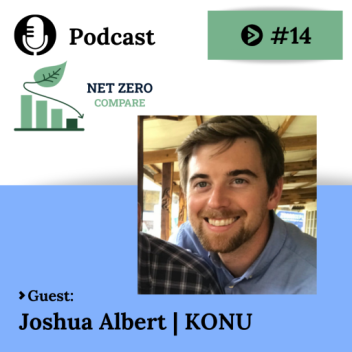
#14: Joshua Albert (KONU) on Adaptive Leadership in Climate and Sustainability
In this episode
Executive summary
KONU’s Joshua Albert discusses how adaptive leadership, systems thinking, and inner development help climate and sustainability organizations navigate complexity, manage resistance, and make lasting progress toward net zero. The conversation explores practical methods for leading change across diverse stakeholders, building organizational capacity, and sustaining momentum in challenging transitions.
In the global race toward net zero, technology and finance often dominate the conversation. Yet, as anyone working in sustainability knows, the real challenge frequently lies elsewhere, in leadership, culture, and the ability to navigate complexity.
To understand how organizations can build these capabilities, our Co-Founder, Karol Kaczmarek, spoke with Joshua Albert, Associate Partner at KONU, a firm specializing in leadership development, organizational transformation, and systems change in complex environments.
Drawing from his background in institutional reform and global health, including his work in Liberia during the 2014 Ebola outbreak, Albert explained how adaptive leadership and adult development frameworks can help organizations overcome resistance and drive meaningful, systemic progress in the sustainability and climate sectors.
🎥 Watch the Full Interview. Joshua Albert, Associate Partner at KONU, explains how adaptive leadership, systems thinking, and inner development can help climate and sustainability organizations make real progress.
From Institutional Reform to Systems Leadership
Albert’s early work at Last Mile Health, a social enterprise focused on strengthening health systems in remote communities, shaped his interest in how large, interconnected systems adapt. “I became fascinated by how you can mobilize a wide range of stakeholders to shift behavior and address challenges that cross institutional boundaries,” he says.
That experience ultimately led him to KONU, where the focus is on equipping leaders and organizations to make progress amid competing priorities, power structures, and diverse agendas, the very conditions that define modern sustainability challenges.
What Makes a “Change Agent”?
At KONU, a change agent isn’t a title reserved for executives. “It’s anyone who feels stuck, frustrated, or in over their head working too hard for too little result in a complex system,” Albert explains. The firm partners with these individuals and organizations to strengthen their capacity to navigate uncertainty, align stakeholders, and make progress on deeply interdependent problems.
KONU’s Distinctive Approach to Leadership Development
Albert identifies two features that set KONU’s approach apart from traditional leadership programs.
First, KONU applies the adaptive leadership framework, developed at Harvard Kennedy School, to real-world settings. Adaptive leadership emphasizes that leadership is not about the authority role you hold, but the work you do: mobilizing people to tackle difficult, value-laden challenges for which no clear technical solutions exist. “It’s a resource for thinking across boundaries and seeing the broader system,” Albert notes.
Second, KONU focuses on learning design for real work. Instead of theoretical sessions, participants in KONU sessions apply concepts to live challenges immediately. “We get people to try out what they’re learning right away,” says Albert. “The goal is to shrink the gap between the classroom and the workplace.”
Tailoring Change Work for Climate and Sustainability Sectors
When working with climate tech and sustainability organizations, KONU adjusts its methods to match the scale and complexity of their stakeholder ecosystems.
“In traditional businesses, leadership challenges are often close to home, a manager, a department, a performance issue,” Albert explains. “In sustainability, organizations operate within vast stakeholder ecosystems that include regulators, financiers, and community actors.”
Mapping those ecosystems and helping participants understand the legitimate perspectives of each stakeholder becomes foundational. Polarization, the “us versus them” mindset, is common in this space. KONU’s programs emphasize perspective-taking and constructive engagement with opposition, which Albert calls “critical for adaptive progress.”
Adaptive vs. Technical Change
A key distinction in KONU’s methodology is between technical problems (with known solutions) and adaptive challenges (which require learning and judgment).
“In climate and transition work, scaling solutions almost always triggers value trade-offs and institutional shifts,” says Albert. “When decisions involve judgment rather than data alone, you’re in adaptive territory.”
Treating adaptive challenges as technical ones leads to brittle, short-lived solutions. “The alternative is a learning process, engaging stakeholders so they’re enrolled in the change, not just subject to it.”
Facilitating Systems Change
KONU often collaborates with partners such as Dalberg and the UN system to run multi-stakeholder “leadership labs.” One example involved supporting UN, government, and civil society actors in Somalia to address water and climate crises.
“The goal is to speak about problems more honestly,” Albert explains. “Stakeholders often hold different pain points, sovereignty versus humanitarian urgency, and both are valid. The task is to create a space where those differences can coexist productively.”
He points to South Africa’s transition from apartheid as a classic case of adaptive progress: “Both Mandela and de Klerk accepted losses to avoid civil war. True systems change always involves loss on all sides, and partnership despite that.”
Measuring Impact in “Soft” Interventions
Leadership and culture programs are sometimes criticized for being hard to measure. Albert acknowledges the challenge but insists that progress can be tracked.
KONU integrates evaluation models such as the Kirkpatrick framework, which measures engagement, learning, behavior change, and system outcomes. “It’s still surprisingly common for learning and development programs to stop at level one, participant satisfaction,” he says. “We go further, tracking behavior changes and looking for evidence of shifts in collaboration.”
He also cites an RCT study by the Hong Kong Jockey Club, which showed measurable improvements in social entrepreneurs’ ability to mobilize innovation after KONU’s adaptive leadership program.
Scaling Without Dilution
KONU plans to triple in size over the next five years, balancing growth in its client service team (coaches and facilitators) with investment in systems that support quality at scale.
KONU works through cohorts, groups of 25 to 100 participants, typically guided by two facilitators. Each cohort develops a shared vocabulary and applies the frameworks to real organizational challenges. This model allows a relatively small KONU team to have a large impact within client systems. Internal case libraries and customizable curricula support replication without losing depth, a knowledge management system KONU expects to amplify with AI tools.
“The core coaching infrastructure grows slowly,” Albert adds. “It takes time to find and train facilitators who can hold a deep learning process. But we are investing in systems to scale impact alongside that organic growth in human capital.”
Managing Resistance and Fatigue
Working in systems under constant pressure, such as climate organizations, means managing emotional and cognitive fatigue.
Albert uses the concept of disequilibrium, balancing comfort, learning, and panic zones. “Most leaders are already near burnout, spending much of their time in the panic zone,” he says. “So, our workshops often combine conceptual learning with space to breathe, to lower the heat.”
KONU’s sessions integrate reflection on purpose and meaning. Asking simple questions like “What do you find most meaningful about your work?” often re-energizes participants. “People rarely give themselves time to reflect at that depth,” Albert notes, “and that reflection becomes fuel for change.”
The Inner Work of Leadership
KONU also brings psychological insight into leadership. Using frameworks like Immunity to Change, the team helps leaders uncover unconscious mental “scripts” that block growth.
“Often there’s a part of your brain committed to change, and another part equally committed to not changing,” Albert explains. “When you identify the hidden fears or assumptions behind resistance, you unlock new possibilities.”
This inner work supports KONU’s broader definition of leadership, an activity anyone can perform, regardless of title or personality. “It’s about mobilizing systems to make progress, not about charisma or authority,” he says.
Partnering for Greater Impact
Beyond direct clients, KONU partners with foundations, UN agencies, and nonprofits to embed systems-change practices in larger programs, from global health and social innovation to criminal justice reform in the United States.
These collaborations help KONU amplify its reach without becoming a mass-training organization. “We’re exploring models where we can support conveners or backbone institutions that bring stakeholders together,” Albert explains.
Looking Ahead: Leadership for the Transition Economy
Over the next five years, KONU plans to deepen its engagement in the climate, energy transition, and sustainability sectors.
Albert sees two key growth pathways:
Capacity building for individual leaders navigating scale-up and institutional transformation.
Convening multi-stakeholder ecosystems through leadership labs that foster adaptive collaboration.
With teams already active across the United States, Europe, and the Middle East, KONU is positioning itself as a global partner for organizations tackling complex, cross-sector transitions.
His final message to climate and energy professionals:
We’re all in the same lifeboat. The stakeholders who resist change are still part of the system, and therefore part of the solution. Partnership, even when uncomfortable, is often the only way forward.
Topics
More from Net Zero Compare Podcast

#57: Lubomila Jordanova on Corporate Sustainability: From Carbon Accounting to Business Value

#56: Hesham Gamal Gaafar on Digital Twins in Smart Cities and Infrastructure: Where the Real Value Comes From
#55: Bhuva Shakti on What Makes a Climate Company Investable, and Where AI Actually Helps
#54: Patrick Sherwin on What Makes Clean Energy Technology Work in the Real World

#53: Josh Harrison on Why Climate Adaptation Requires Connected Solutions for Forests, Buildings, and Cities