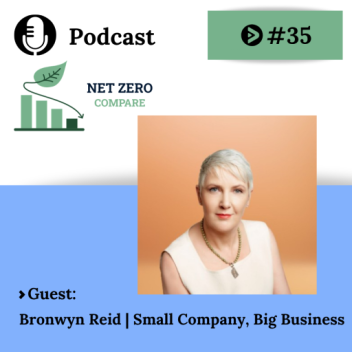
#35: Bronwyn Reid on Why ESG Strategies Break Down in Practice and What Companies Can Do About It
In this episode
Executive summary
The conversation with Bronwyn Reid highlights a persistent gap between sustainability strategy and real-world execution. While many organizations have formal ESG commitments, implementation often breaks down when responsibility shifts to operational teams and suppliers, particularly small and medium enterprises with limited resources. These businesses typically approach ESG reactively, responding to external demands rather than building structured capabilities. Reid emphasizes that growing regulatory complexity adds pressure without providing sufficient practical guidance, leading to confusion and fatigue. ESG is also still frequently treated as a secondary function, rather than integrated into core business operations, which creates internal resistance and slows progress. Key challenges include communication gaps between large companies and suppliers, mismatched expectations, and limited internal capabilities. The discussion stresses that progress requires starting with small, manageable steps, building on existing practices, and developing capabilities over time. Ultimately, effective ESG implementation depends on long-term integration, internal alignment, and realistic, consistent action rather than waiting for perfect clarity or comprehensive solutions.
Bronwyn Reid, author, speaker, and founder of Small Company, Big Business, works with organizations navigating the growing complexity of regulation, ESG expectations, and operational constraints. Her experience spans both large corporations and small suppliers, giving her a clear view of how sustainability strategies are developed and where they fail in practice.
In a recent conversation hosted by Net Zero Compare, she outlined a recurring issue across industries: while sustainability commitments are becoming more common, the ability to implement them consistently across organizations and supply chains remains limited.
🎥 Watch the Full Conversation: This discussion looks at how ESG expectations translate into real operational challenges, particularly for companies working across supply chains with different levels of capability and resources. Bronwyn Reid explains why many organizations struggle to move beyond reporting and where the most common breakdowns occur. The full recording adds useful context, especially for those responsible for implementation, compliance, or supplier engagement.
The Gap Between Strategy and Execution
Many organizations today have sustainability strategies in place. These are often driven by regulation, stakeholder expectations, or internal commitments. On paper, they are clear and structured. In practice, they frequently lose coherence once they move beyond the strategy layer.
The main issue is that execution is rarely handled by the same people who define the strategy. Instead, responsibility shifts to operational teams and suppliers, many of whom were not involved in the initial planning.
At that point, a simple but critical problem appears. Organizations know they are expected to act, but they are not always sure what actions are required or how to prioritize them. The result is hesitation, fragmented responses, or superficial compliance.
Where Implementation Actually Happens
A key point from the conversation is that ESG implementation often takes place within small and medium enterprises rather than large corporations.
Large organizations define expectations through procurement requirements, reporting obligations, or contractual conditions. However, smaller businesses within the supply chain are the ones expected to operationalize these requirements.
For many of these companies, ESG does not begin as a strategic priority. It arrives as a request.
This has several consequences. Instead of building structured capabilities, businesses focus on responding to individual demands. Efforts become reactive, narrow in scope, and difficult to scale into a consistent approach.
At the same time, these organizations are often constrained by limited resources. Leadership teams are already managing operations, finances, and staffing, and ESG requirements are added on top without clear guidance.
Regulatory Complexity Without Practical Guidance
The expansion of ESG frameworks and regulatory requirements has increased pressure on organizations, but not always clarity.
Companies are now dealing with multiple standards across jurisdictions, often with overlapping or inconsistent requirements. For organizations without dedicated sustainability teams, this creates a situation where the main challenge is not willingness to comply, but understanding what compliance actually looks like.
Bronwyn Reid describes this stage as comparable to the early development of sanitation systems. At that time, societies were still figuring out how to manage water and waste in a structured way. Today, organizations are going through a similar process with emissions and environmental impact.
This helps explain why confusion and fatigue are common. The system is still evolving, and organizations are expected to adapt while that evolution is ongoing.
ESG Is Still Treated as a Side Function
One of the more persistent issues is how ESG is positioned inside organizations. In many cases, it is still treated as an additional layer rather than a core part of business strategy.
This creates internal resistance. When sustainability is seen as separate from core operations, it competes with other priorities such as cost control, efficiency, and delivery timelines.
Reid’s position is clear. ESG cannot be treated as something that is added later. It needs to be integrated into how decisions are made across the organization.
Without this integration, even well-designed strategies struggle to translate into consistent action.
The Most Common Gaps Inside Organizations
The challenges discussed can be grouped into a few recurring gaps that appear across industries. The most common include:
Communication gap: Large organizations and smaller suppliers often interpret requirements differently, leading to misalignment.
Expectation gap: Regulatory bodies, customers, and stakeholders expect rapid progress, while organizations may lack the capacity to deliver immediately.
Capability gap: Many companies do not have the tools, expertise, or time needed to implement ESG initiatives effectively.
These gaps are interconnected. Addressing one often requires addressing the others, which is why quick fixes rarely work.
Why Starting Small Is the Only Realistic Approach
A consistent theme throughout the discussion is the importance of starting with manageable steps rather than attempting comprehensive transformation from the outset.
For many organizations, this means focusing on what already exists. Smaller businesses, in particular, are often already contributing to social and environmental outcomes through their role in local communities or through informal practices.
The first step is to make these activities visible. That involves documenting them, measuring them where possible, and building from there.
Progress tends to follow an exponential pattern. Early efforts may appear limited, but consistent improvements create momentum over time. The opposite is also true. Delaying action increases the risk of falling behind, making future adjustments more difficult.
Internal Alignment Is a Long-Term Process
Another recurring challenge is internal alignment. Sustainability initiatives often require coordination across multiple departments, each with different priorities.
This cannot be solved quickly. It requires sustained effort, leadership commitment, and, in many cases, changes to how performance is evaluated within the organization. Key elements that support alignment include:
Clear direction from leadership
Integration of ESG into core strategy
Incentives linked to measurable outcomes
Organizations that approach ESG as a long-term transformation rather than a short-term requirement are more likely to achieve consistent results.
Progress Is Visible, but Not Uniform
Compared to a decade ago, ESG awareness has improved significantly. Most organizations are now familiar with the terminology, and sustainability is part of mainstream business discussions.
However, progress is uneven. Some companies are moving toward operational integration, while others continue to treat ESG primarily as a reporting requirement or delay action until external pressure forces a response.
This mixed landscape reflects both the complexity of the topic and the different starting points of organizations across sectors.
Practical Direction for Leaders
For executives dealing with increasing regulatory pressure and internal complexity, the message is straightforward. ESG should not be treated as a problem to solve alone.
Organizations routinely rely on external expertise for financial reporting and compliance. The same approach applies here. Bringing in the right expertise can help clarify requirements, reduce uncertainty, and accelerate implementation.
There is now a wide range of professionals and tools available to support this process, making it more accessible than it was even a few years ago.
Conclusion
The discussion with Bronwyn Reid highlights a central issue in sustainability today. The challenge is not defining strategies but executing them effectively across organizations and supply chains.
Gaps in communication, capability, and expectations continue to slow progress, particularly where smaller businesses are expected to deliver on requirements set by larger organizations.
The practical path forward is not about designing more complex strategies. It is about starting with what is already in place, building capability over time, and integrating ESG into the core of how businesses operate.
For companies navigating sustainability and compliance, progress depends on consistent, realistic action rather than waiting for clarity or perfect conditions.
Topics
More from Net Zero Compare Podcast

#59: Lisa Wright on Why eVTOL Infrastructure May Matter as Much as the Aircraft
#58: Arjun Gupta on Packaging EPR in the US: How AI Is Changing Compliance, Data Management, and Cost Forecasting
#57: Lubomila Jordanova on Corporate Sustainability: From Carbon Accounting to Business Value

#56: Hesham Gamal Gaafar on Digital Twins in Smart Cities and Infrastructure: Where the Real Value Comes From
#55: Bhuva Shakti on What Makes a Climate Company Investable, and Where AI Actually Helps