


Available Carbon Accounting Features
Missing Carbon Accounting Features
Pricing
Starting Price
Options
- Free Trial
- Monthly Subscription
Available Since
Deployment Options
- Web Browser (Cloud - Based)
Good Option For
- Small Business (11-50 people)
- Medium Business (51-250 people)
- Large Business (250+ people)
Deep dive
Core Features
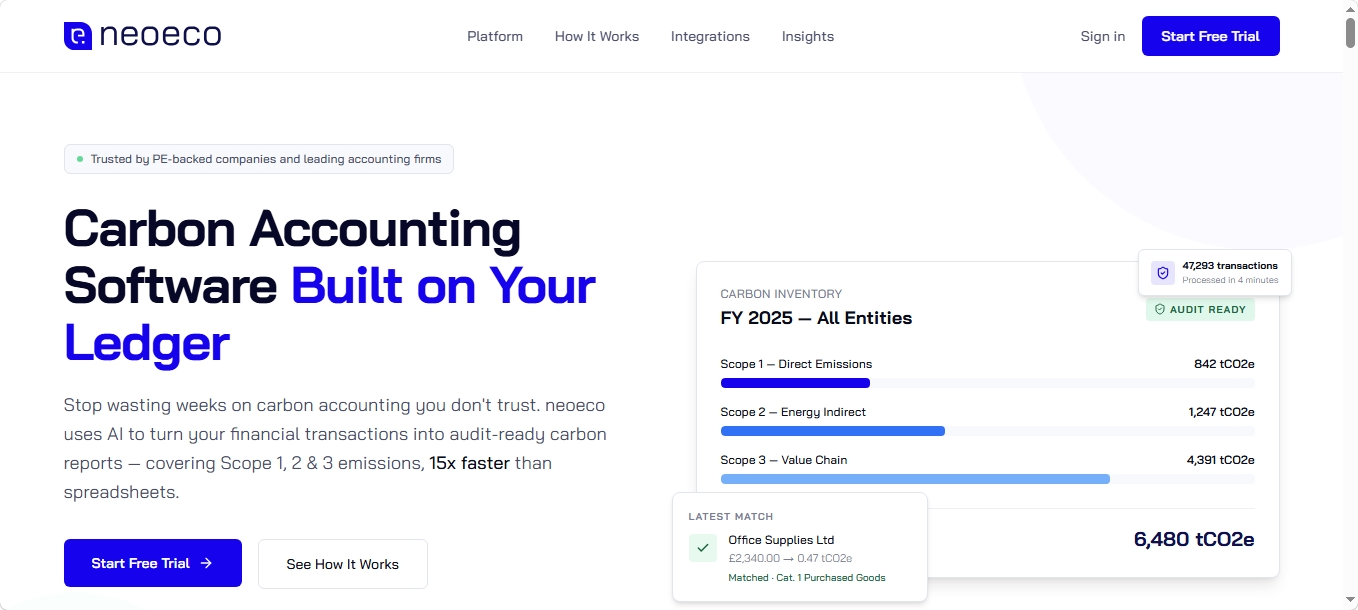
neoeco is structured around a ledger-based approach, where financial transactions form the basis of emissions calculations. It combines AI-driven processing with human oversight to produce transparent and traceable carbon data. Some of its main features are:
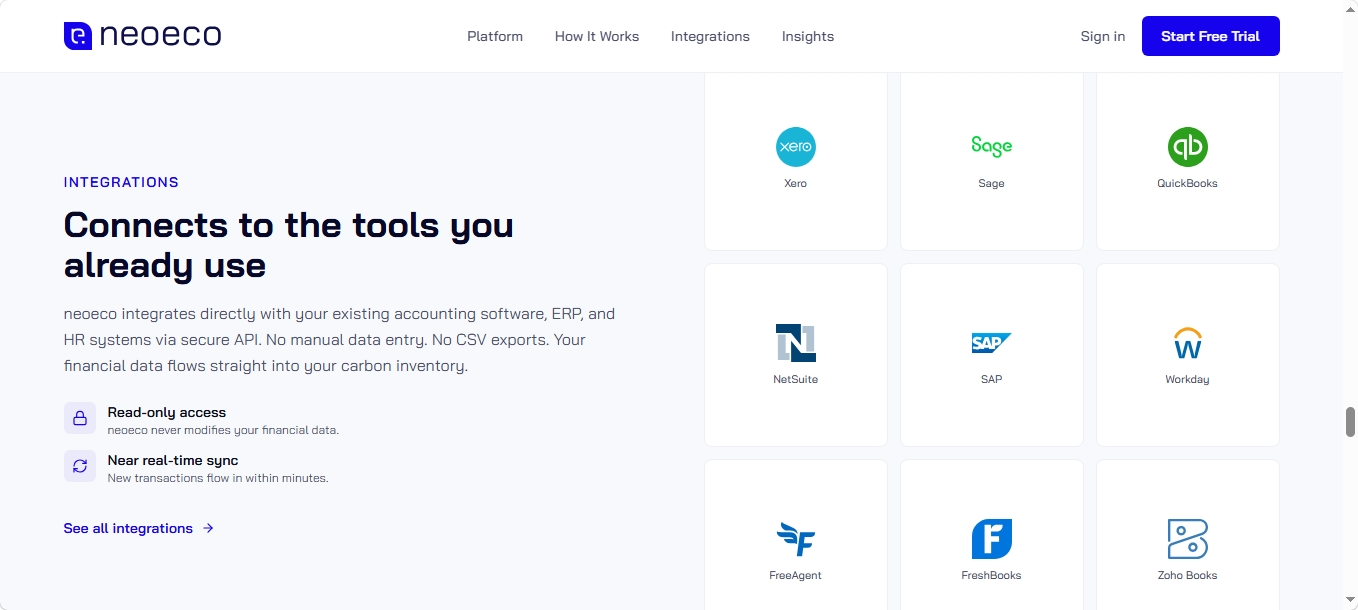
Ledger-first data ingestion: Connects directly to accounting systems such as Xero, Sage, QuickBooks, and ERP platforms, automatically importing chart of accounts, entities, and reporting boundaries.
AI-driven transaction matching: Classifies financial transactions and maps them to appropriate emission factors at line-item level, covering Scope 1, 2, and all categories of Scope 3.
Human-in-the-loop controls: Allows users to review, challenge, override, and approve all calculations, ensuring transparency and control over final reported figures.
Audit-ready reporting and traceability: Maintains a full audit trail linking each emission back to a specific financial transaction, supporting compliance with frameworks such as GHGP, SECR, and ISSB / IFRS S2.
Multi-entity consolidation: Supports complex organisational structures with entity-level drill-down and group-level roll-ups aligned to financial reporting boundaries.
Report builder and compliance templates: Provides configurable, board-ready reporting templates and exports aligned with major disclosure frameworks, enabling rapid generation of formal carbon reports.
Closing Insights
neoeco’s positioning reflects a shift toward integrating carbon accounting directly into financial systems rather than treating it as a parallel sustainability process. By using audited financial data as its starting point, the platform addresses a recurring issue in carbon reporting: the difficulty of defending figures derived from estimates or fragmented datasets. Its transaction-level approach is particularly relevant for organisations that require clear audit trails, such as those preparing disclosures under SECR, ISSB, or GHG Protocol frameworks.
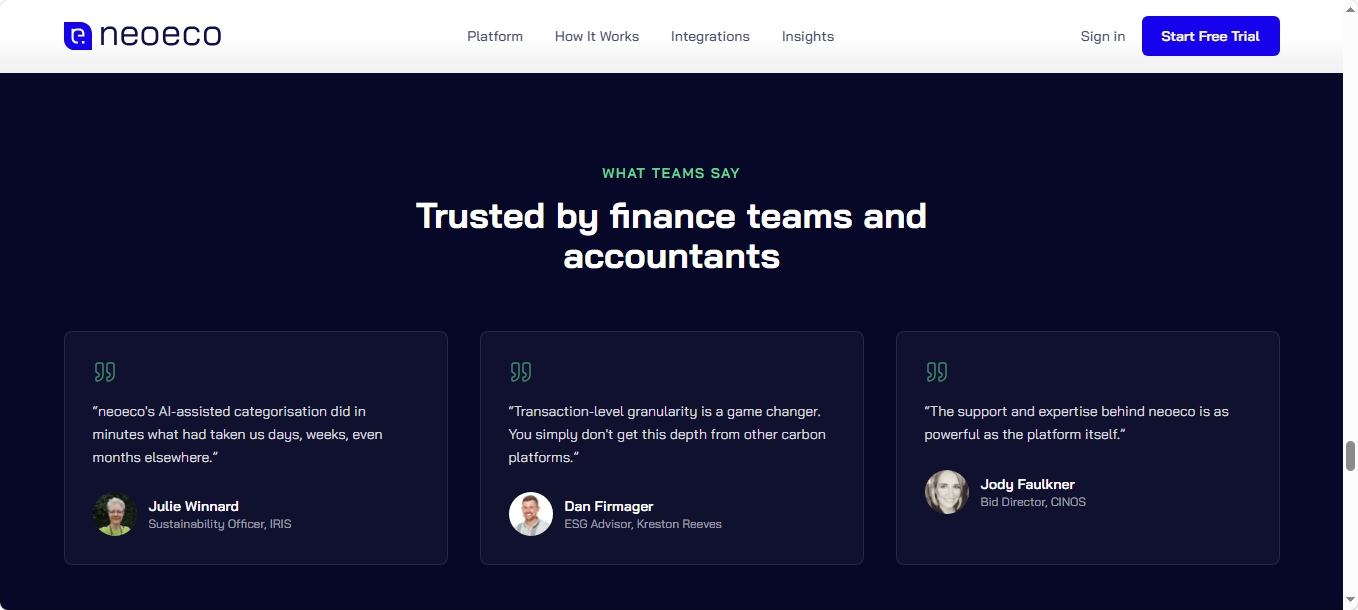
The platform is used by organisations including IRIS, Kreston Reeves, and CINOS, indicating applicability across both corporate teams and accounting firms delivering carbon reporting services to clients. This dual use case aligns with its support for multi-entity structures and portfolio-level reporting, which is relevant for private equity-backed groups and professional services firms.
neoeco’s emphasis on combining AI processing with human validation highlights a balance between automation and control. Features such as anomaly detection, document extraction, and real-time transaction syncing extend its role beyond reporting into ongoing data management. For organisations seeking audit-ready, finance-aligned carbon accounting, it presents a model that integrates emissions reporting directly into existing financial workflows rather than building it separately.