

Available Other Features
Missing Other Features
Pricing
Starting Price
Options
- Free
- Annual Subscription
Available Since
Deployment Options
- Web Browser (Cloud - Based)
Good Option For
- Freelancers (1 person company)
- Microbusiness (2-10 people)
- Small Business (11-50 people)
- Medium Business (51-250 people)
- Large Business (250+ people)
Deep dive
Core Features
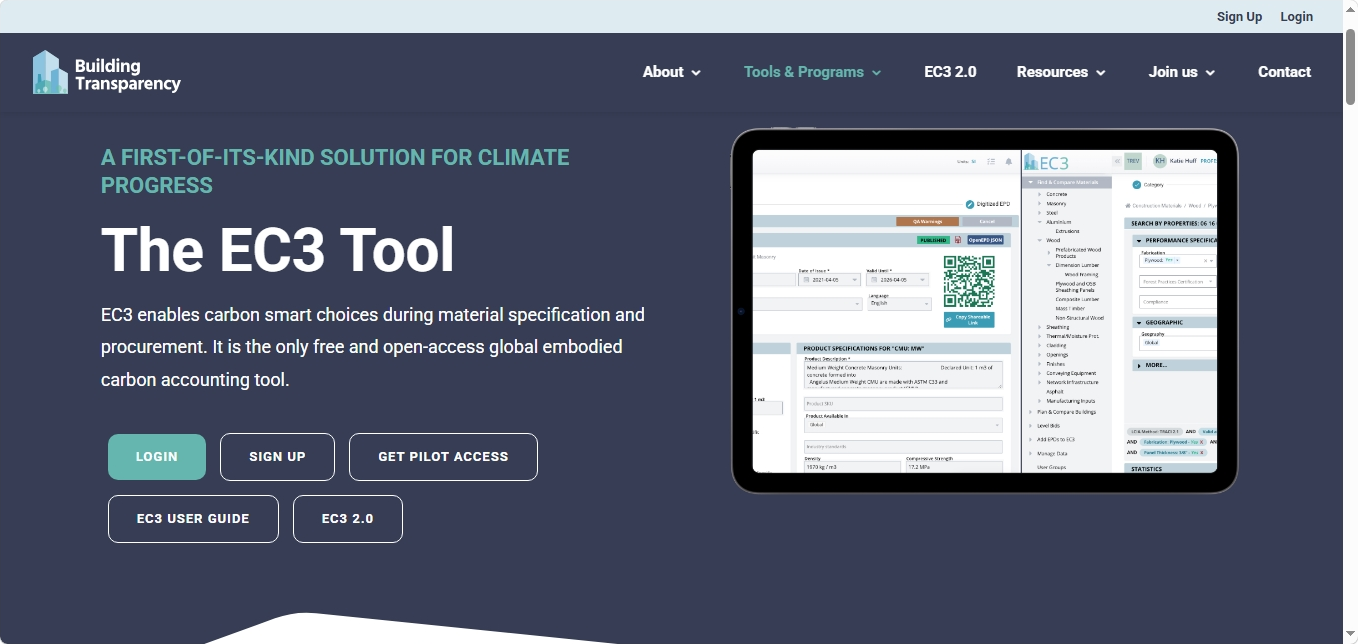
EC3 focuses on upfront embodied carbon, measured as global warming potential (GWP) in kgCO₂e. It combines construction quantities with third-party EPD data, allowing users to move between individual product comparisons and project-level assessments. Building Transparency distinguishes this scope from whole-life LCA, which also considers future use and end-of-life impacts.
EPD Database: EC3 provides access to more than 200,000 EPDs. Building Transparency converts EPD information from PDFs and digital sources into structured data that can be searched and compared.
Material Search & Comparison: Users can filter materials according to characteristics including geography and performance requirements and compare their GWP. EC3 incorporates declared-unit conversion and other controls intended to improve the relevance of EPD comparisons.
Project Embodied Carbon Assessment: The Plan & Compare Buildings feature combines material quantities with GWP data to estimate potential and realized embodied carbon. Quantities can be entered manually from estimates or bills of materials or imported from BIM-related workflows.
Baselines & Reduction Targets: EC3 provides baseline, average, conservative and achievable GWP values. Users can apply Carbon Leadership Forum baselines, establish project or material-category targets and assess performance against them.
Product & EPD Management: Manufacturers and other users can upload EPD PDFs for digitization, while EC3's Declare Your Product functionality supports standardized digital EPD information. Imported EPDs undergo parsing and quality checks before becoming searchable.
API & Integrations: EC3 data can be incorporated into external research, software and production systems through Building Transparency's API.
Closing Insights
EC3 originated from work by Skanska USA and C Change Labs, with initial development supported by Microsoft, before being transferred to the nonprofit Building Transparency. Today, its usefulness extends across several points in the construction value chain: designers can investigate lower-carbon specifications, contractors can assess procurement alternatives, owners can establish project targets, and manufacturers can make product-specific environmental information accessible for comparison. Building Transparency says more than 2,000 organizations across 84 countries rely on its EPD database for material-selection decisions.
For prospective users, the EC3 web application remains free and open access, allowing construction professionals to search EPDs, compare materials and assess project embodied carbon without a software licence fee. Organizations that want to use EC3 data within their own software, analytics or other production systems should note that different terms apply to the API. Free API access is rate-limited and intended for research, learning, pilots and feasibility testing; it does not include commercial-use rights. Commercial or production applications require paid API access, which currently starts at US$5,000 per year, with fees increasing according to organizational scale.