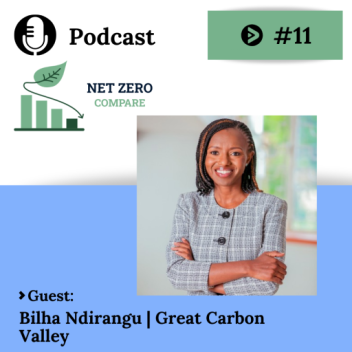
#11: Bilha Ndirangu on Building a Carbon Removal Hub in Kenya’s Rift Valley
In this episode
Executive summary
Bilha Ndirangu, CEO of Great Carbon Valley, speaks with our Co-Founder Karol Kaczmarek about why Kenya’s Rift Valley offers a rare opportunity to build a world-class carbon removal hub. The conversation touches on geothermal energy, basalt storage, permitting, MRV, and how carbon removal can bring infrastructure, skills, and jobs to local communities.
Kenya’s Rift Valley sits on a geological seam that is reshaping the continent’s energy and climate story. The region combines abundant geothermal resources, basalt formations suitable for mineralizing CO₂ underground, and a national grid that is already predominantly renewable. For Great Carbon Valley CEO Bilha Ndirangu, that mix adds up to a once-in-a-generation opportunity to build a credible hub for durable carbon removal in East Africa, while unlocking jobs and infrastructure for local communities.
In our conversation, Ndirangu described a model that aims to do three things at once. First, match global direct air capture technology providers with sites that have the right energy and storage profile. Second, orchestrate the permitting, land, and infrastructure puzzle that slows many early projects. Third, ensure that green industry growth benefits local people, from water access to green skills and employment.
“You very rarely find a country or a region where all the different things you need for direct air capture come together. In the Rift Valley, they do,” she says.
🎥 Watch our full interview with Bilha Ndirangu, CEO of Great Carbon Valley, where she explains why Kenya’s Rift Valley fits DAC plus storage, how the team is structuring early projects, and how green industry growth can deliver local water, power, and jobs.
Why the Rift Valley
Direct air capture is energy-intensive and must be powered by low-carbon electricity to deliver real climate benefit. Kenya’s grid is roughly ninety percent renewable, driven by geothermal and hydropower. Unlike many countries that must first decarbonize their grids, Kenya already has clean power online and more potential waiting for demand.
Ndirangu adds geology to the equation. Basalt formations in the Rift can mineralize injected CO₂ into stable carbonates. Critically, geothermal resources and basalt formations are co-located at several sites. That colocation matters because many DAC systems need not only electricity, but also heat. Waste heat from geothermal plants can reduce operating costs and improve the carbon intensity of captured tons.
Talent is the fourth leg. “People do not realize that Africa is the youngest continent. Kenya has many young, talented engineers,” she notes. The model is not just about hardware and rock chemistry. It is about building a repeatable industrial know-how that can be exported across the region.
An orchestrator rather than another DAC developer
Great Carbon Valley positions itself as a systems orchestrator. The company wants technology firms to focus on what they do best, which is the capture process, while a local partner solves the enabling conditions.
The orchestration work includes:
Site identification and preparation, including land access and geotechnical diligence.
Energy procurement, with a preference for geothermal where possible, and coordination with independent power producers.
Permitting and regulation, from environmental approvals to subsurface management.
Storage development, working with specialist partners on injection planning and monitoring.
Stakeholder alignment, so the developer, the DAC company, the storage provider, and the government are solving the same problem on the same timeline.
“Having the technology is not enough. You have to find where to put it, where the energy will come from, how to permit it, and how to build the infrastructure. It helps to have someone in the middle making sure everyone is talking to each other,” Ndirangu says.
This division of labor also reflects geography. Many DAC firms are headquartered in Europe or North America, and they often pilot in countries that lack optimal storage geology or low-cost renewable heat at scale. The Rift Valley allows the hard parts, capture, and permanent storage to live side by side.
Partnerships and early milestones
Ndirangu describes a partnership mindset. The company engages with multiple capture technology providers, storage specialists, and energy developers, precisely because the scale of removal required will exceed any single firm’s capacity.
Early steps include:
Feasibility work on storage, with a goal to demonstrate mineralization locally.
Small pilots in the next two years, with geothermal or other renewable power.
A pathway toward larger-scale projects by 2030, once early storage and siting challenges are resolved.
The objective for 12 to 24 months is clear. Prove storage in the Rift by showing mineralization at field conditions, secure the first wave of pilot deployments, and establish offtake relationships that validate quality and bankability for global buyers.
How the first projects pencil out
Financing will evolve through distinct phases.
Pilots and first-of-a-kind storage: grant or concessional capital is the realistic choice for subsurface proof points, since the storage element is new to Kenya and carries early uncertainty.
Early capture pilots: typically a mix of venture capital and small grants on the technology side, with pre-purchase offtake contracts to bridge to maturity.
Commercial scale: transition to project finance with a high share of debt, since capital needs quickly move into tens or hundreds of millions for large plants.
“Pre-financing through offtake can help get technologies to a level of maturity, but for large-scale plants, we have to shift to project finance,” Ndirangu explains.
The bankability barrier that matters most is storage confidence, which is why the company is prioritizing local validation and MRV readiness from day one.
MRV and standards: global credibility by design
Carbon removal buyers and standards bodies expect consistent, verifiable evidence. Great Carbon Valley does not plan to reinvent MRV. Instead, it will align with established global providers and frameworks that buyers already trust.
The approach is pragmatic. Technology partners can bring their preferred MRV providers if they meet international expectations. Project documentation will reflect global best practice for DAC and storage, using similar evidence types seen in Iceland, the United States, or Europe. The team is also tracking the evolution of Article 6 and potential pathways for access to compliance markets in the global north, because that is where the majority of emissions must be balanced.
The principle is simple. If a buyer can verify a DAC plus storage project in another jurisdiction, they should be able to verify it in Kenya with the same level of confidence.
Power and water: adding demand that grows clean supply
A frequent concern in carbon removal is competition for scarce electricity and water. Ndirangu argues that Kenya’s challenge is different. There is significant untapped clean power potential, and developers cannot build it without predictable demand.
Bringing steady industrial load to the grid can therefore catalyze new geothermal or renewable capacity that benefits the wider economy. The result should be more power available and lower unit costs across time, not less.
On water, the company will follow strict national regulations and build on Kenya’s geothermal experience, which already includes reinjection practices and careful management of subsurface flows. In some locations, developing water sources for the project can also serve nearby communities through shared infrastructure for wells, piping, and storage.
“We are in a different paradigm. These projects can help activate the provision of water and energy, rather than compete for existing resources,” Ndirangu says.
Land, consent, and benefit sharing
Debates about land rights and carbon projects in Africa are real. Ndirangu sees two design choices that reduce conflict and increase clarity.
First, use private land by default for DAC and storage infrastructure, negotiated through standard leases with individual owners. DAC plants have a small physical footprint compared to nature-based projects that require thousands of hectares, so private parcels are viable.
Second, recognize that Kenya’s Climate Change framework outlines revenue sharing and governance where community land is involved. Where projects do interface with communities, Great Carbon Valley plans to formalize benefits such as shared water infrastructure, local hiring, and support for public services like schools, in addition to contractual land arrangements.
The point is to move beyond the old paradigm of tree planting on community lands. DAC and other high-durability pathways are industrial facilities with compact footprints. They can be sited and governed accordingly.
Green skills and jobs: building an ecosystem, not a single plant
Ndirangu co-founded Jacob’s Ladder Africa, a platform focused on preparing youth and women for opportunities in the green economy. She views DAC and related industries as catalysts for a wider employment story.
Job creation spans:
Direct roles: engineers, geologists, process operators, data and MRV specialists.
Construction and fabrication: civil works, mechanical trades, electrical installation.
Energy buildout: solar and geothermal contractors, operations, and maintenance.
Logistics and services: transport, accommodation, catering, and site services.
New support sectors: EV maintenance and charging if fleet operators electrify, software and analytics for MRV and asset management.
Anchor projects seed clusters. The presence of a DAC plant, or a green ammonia facility, triggers demand for suppliers and skills that quickly spill over into other sectors. Training pipelines reduce delivery risk, and a stable base of local capability lowers costs for every subsequent project.
A portfolio approach to durable carbon removal
Great Carbon Valley is a DAC-focused platform, but Ndirangu argues for a portfolio of high durability pathways in Africa, including enhanced rock weathering, mineralization, biochar, and more. The climate need requires a gigaton scale. No single pathway will be enough.
There is also a credibility dividend. If Africa is seen as a source of high-quality removal credits across multiple methods, policymakers and buyers will take the region more seriously. That, in turn, improves the investment case and creates leverage with governments to design sensible storage rules, incentives, and talent programs that serve multiple verticals.
Policy signals that would accelerate responsible deployment
Kenya already has strengths to build on. Renewable energy policy is functional, geothermal regulation is established, and public institutions understand subsurface management. The next steps are about enabling innovation while providing predictable rules.
Storage regulation: codify responsibilities and standards for CO₂ injection and mineralization that build on geothermal practice, with room for pilot learning.
Access to compliance markets: allow African projects to sell into emissions trading systems in the global north, since that is where most offsetting demand originates.
Stable MRV guidance: align national practice with the international methodologies buyers already use, while monitoring Article 6 evolution.
Public procurement and concessional instruments: support early storage validation and first-of-a-kind deployments with grants and guarantees that crowd in project finance.
The common theme is proportionate regulation. Let projects demonstrate safety and permanence, gather data, and scale up under clear guardrails, without closing the door with over-prescriptive rules too early.
What to watch in the next 12 to 24 months
Ndirangu sets out three credibility markers.
Proof of storage in Rift Valley basalt, with evidence of mineralization under local conditions. This can begin with small tonnages, since the purpose is to validate science and operations.
Multiple pilot deployments of DAC units at suitable sites, ideally using geothermal power and heat where available.
Visible off-take announcements with global buyers. Confirmed sales to reputable voluntary or pre-compliance buyers will signal that Kenyan projects meet international standards.
If those markers are met, the region moves from slide decks to steel in the ground and opens the door to debt-backed project finance.
Reframing the global equity question
Some critics ask whether the global north is outsourcing its removal obligations to the global south. Ndirangu sees a different lens. Carbon is evenly mixed in the atmosphere. If Kenya can deliver high-quality removals more efficiently, the climate benefits are universal.
The economic case is also strong. “We have the resources that the world needs to decarbonize. If Kenya and East Africa can contribute and, in the process, build industries and create jobs for young people, that is a positive,” she says.
The promise of the Rift Valley is not to absorb the world’s responsibilities. It is to compete as a credible, trusted supplier of durable climate services, and to convert that role into long-term local value.
Practical takeaways for developers, buyers, and policymakers
For technology developers
Bring a capture system and an MRV plan that meets international expectations. Expect a local partner to solve siting, energy, and permitting.
Prepare for geothermal integration where feasible, including heat.
Design pilots to generate storage data that banks and buyers will accept.
For buyers
Treat Rift Valley projects like any other DAC plus storage project. Apply the same diligence, then take advantage of favorable geology and clean power.
Consider multi-year pre-purchase agreements to accelerate early deployments.
Ask for transparent MRV, storage evidence, and community benefit plans.
For policymakers
Build storage rules that draw on geothermal experience and allow safe learning by doing.
Enable access to compliance or pre-compliance demand in partner countries.
Support anchor projects with concessional finance and clear, stable permitting.
Conclusion: from potential to a durable industry
Kenya’s Rift Valley combines clean power, favorable geology, and a young technical workforce. That mix can support a high-integrity carbon removal hub, provided the region solves orchestration, storage validation, and bankable off-take. Ndirangu’s plan treats DAC as the beginning of a broader green industry strategy that adds power, water, and jobs rather than competing for them.
The markers for the next two years are straightforward. Prove storage locally. Run multiple pilots. Close offtake with global buyers. Do those three things, and East Africa will have a credible pathway from potential to industry, with benefits that reach far beyond the fence line.
Topics
More from Net Zero Compare Podcast

#65: Ron Crabtree on Reducing Manufacturing Waste Through Better Processes and Supplier Collaboration
#64: What Makes Renewable Energy Projects Bankable? Energea's Chris Sattler on Solar Economics, Investment Returns, and Financing Risks

#63: Byron Irwin on Turning Waste Into Community Opportunity: Composting, Recycling, and Rural Sustainability

#62: Afonso Firmo on Australia's Mandatory Climate Reporting: Lessons for Carbon Accounting, AI, and Decarbonization
#61: Lisa Drees on Building Trust in Green Hydrogen Supply Chains: Technology Is Only Part of the Answer