

Available Circular Economy Features
Missing Circular Economy Features
Pricing
Starting Price
Options
Available Since
Deployment Options
- Web Browser (Cloud - Based)
Good Option For
- Small Business (11-50 people)
- Medium Business (51-250 people)
- Large Business (250+ people)
Deep dive
Core Features
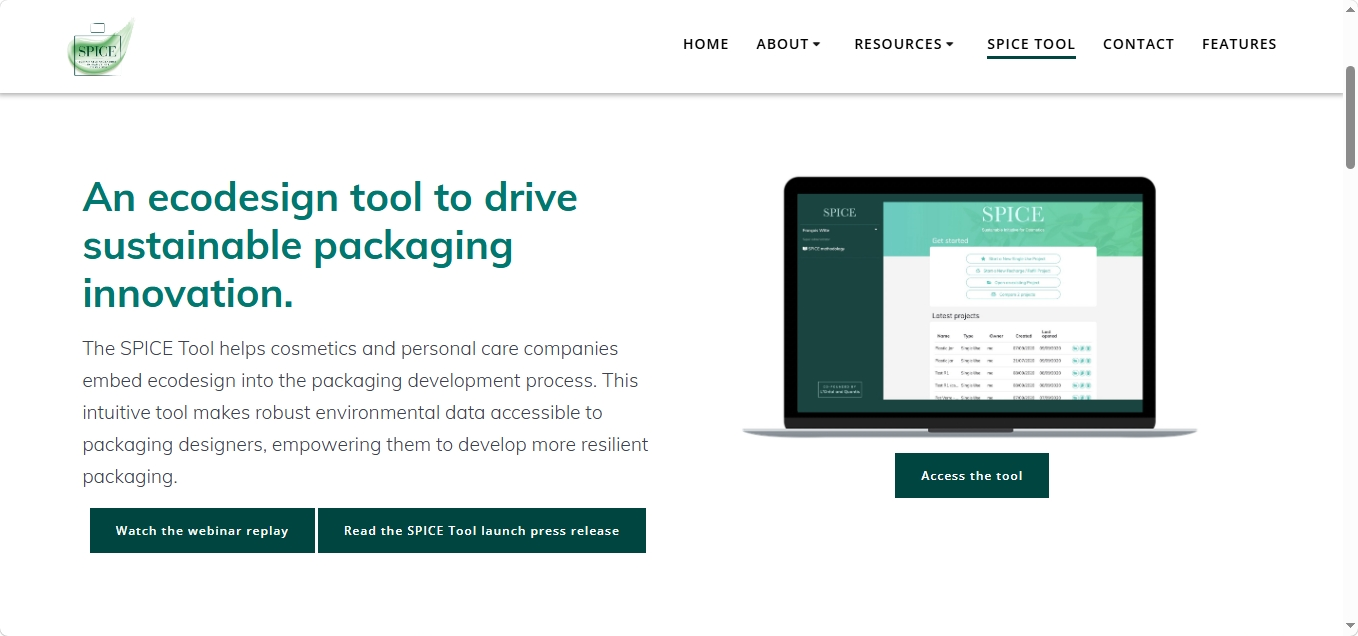
The SPICE Tool applies a harmonized, science-based lifecycle methodology developed specifically for cosmetics packaging. Its assessment uses a common functional unit, lifecycle scope, environmental datasets and impact methodology to enable consistent comparisons between packaging options. Its features include:
Lifecycle Footprinting: Assesses packaging from raw-material production through manufacturing, distribution and end-of-life.
Multi-Impact Assessment: Calculates 16 environmental impact categories and aggregates results into a single environmental score.
Impact Breakdown: Shows results by packaging layer, lifecycle stage and environmental impact category to reveal where impacts arise.
Scenario Modelling: Simulates packaging alternatives to assess opportunities for reducing environmental impacts.
Packaging Comparison: Pro users can compare two packs and multiple scenarios, supporting ecodesign decisions between alternative concepts.
Reuse Assessment: Supports evaluation of single-use and recharge/refill systems, complemented by SPICE guidance addressing reuse models.
Closing Insights
The SPICE Tool originated from the wider SPICE initiative, launched by L’Oréal and Quantis in 2018 to establish common environmental assessment approaches for cosmetics packaging. After publishing its methodology in 2019, the initiative launched the Tool in September 2020, co-developed with 25 beauty-industry participants. Its sector-specific character is important: the platform translates life-cycle assessment principles into an interface intended for packaging designers. SPICE has since grown to more than 30 members, with corporate participants including major brands like Chanel, L’Oréal, and Unilever Prestige.
PICE Tool Lite is free, allowing assessment of one pack, while SPICE Tool Pro adds storage, multiple packs and scenarios, comparisons and company user administration; Pro pricing is available on request. Sector-specific solutions like the SPICE tool are relevant in light of regulatory emphasis on ecodesign, recyclability, recycled content, reuse and lifecycle environmental performance, arising from regulations like EU regulations like PPWR and ESPR.