

Available Carbon Accounting Features
Missing Carbon Accounting Features
Pricing
Starting Price
Options
- Annual Subscription
Available Since
Deployment Options
- Web Browser (Cloud - Based)
Good Option For
- Small Business (11-50 people)
- Medium Business (51-250 people)
- Large Business (250+ people)
Deep dive
Core Features
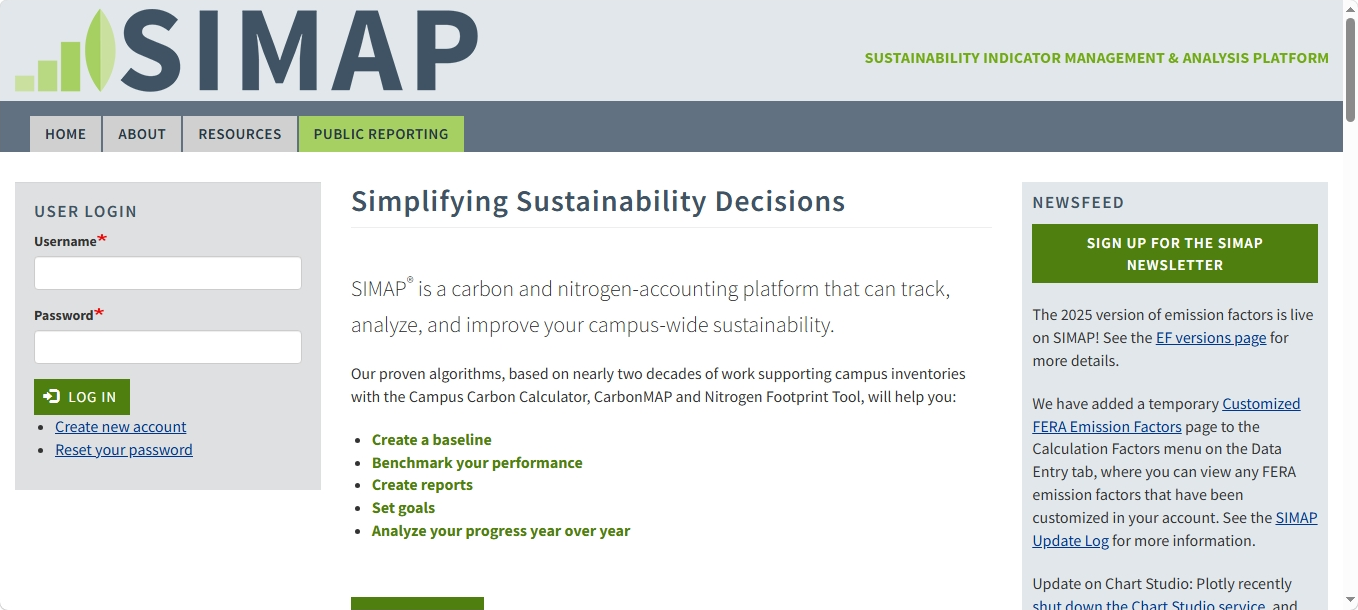
SIMAP is built around an activity-based methodology derived from nearly two decades of footprinting research at the University of New Hampshire. Its algorithms draw on the Greenhouse Gas Protocol and integrate the University's earlier Campus Carbon Calculator, CarbonMAP, and Nitrogen Footprint Tool into a single web-based platform. Its main capabilities include:
Carbon Footprint Accounting – Calculates greenhouse-gas emissions from energy use, transportation, waste management, purchasing activities, and other campus operations.
Nitrogen Footprint Analysis – Measures reactive nitrogen releases associated with food systems, fertilizer use, energy consumption, and transportation activities.
Scope 1, 2 & 3 Reporting – Supports comprehensive emissions inventories, including a Scope 3 module based on the WRI Scope 3 Protocol.
Benchmarking & Goal Setting – Enables users to establish baselines, compare performance over time, and support sustainability target-setting initiatives.
Reporting & Public Disclosure – Generates annual sustainability reports and supports public reporting through partnerships such as Second Nature's Climate Leadership Commitments.
Multi-Campus Analysis – Tier 2 subscriptions allow organizations to compare multiple campuses, buildings, departments, or operational units within a single account.
Closing Insights
SIMAP originated at the University of New Hampshire Sustainability Institute and represents the latest stage in a footprinting effort that began with a UNH master's thesis in 2001. Over time, the original Campus Carbon Calculator evolved into a series of tools used throughout higher education before being redesigned as the web-based SIMAP platform in 2017. The project brought together carbon accounting and nitrogen footprinting, creating a broader sustainability assessment framework than is typically found in conventional greenhouse-gas inventory tools.
A notable aspect of SIMAP is its integration of nitrogen accounting alongside greenhouse gas reporting. The platform's developers argue that many operational activities generate both climate and nitrogen impacts, making a combined assessment more useful for sustainability decision-making. According to UNH, SIMAP is used by more than 500 colleges, universities, nonprofits, municipalities, and other organizations internationally. The platform also maintains partnerships with organizations including Second Nature, AASHE, and GRITS.
Subscription is priced annually with Tier 1 ($500) and Tier 2 ($750) plans available alongside optional data-review and advisory services. For higher-education institutions seeking a specialized sustainability accounting platform, SIMAP offers a mature, academically grounded solution supported by extensive sector experience and a long-standing sustainability community.