


Available Carbon Accounting Features
Missing Carbon Accounting Features
Pricing
Starting Price
Options
- Annual Subscription
Available Since
Deployment Options
- Web Browser (Cloud - Based)
Good Option For
- Small Business (11-50 people)
- Medium Business (51-250 people)
- Large Business (250+ people)
Deep dive
Core Features
Greenable is built around a product-centric approach to sustainability, where environmental data is collected, structured, and analysed at the level of individual products, materials, and processes. Rather than focusing only on corporate-level reporting, it emphasises transparency across the full product lifecycle. Some of its main features are:
Product Carbon Footprint Calculation - Calculates emissions at product, material, and process levels using recognised standards such as ISO 14067 and the GHG Protocol, supported by lifecycle datasets.
Digital Product Passport (DPP) - Centralises product sustainability data into structured digital passports, supporting regulatory requirements and enabling consistent data sharing across value chains.
Centralised Product Data Management - Stores and organises sustainability data—including emissions, materials, transport, and waste—in a single platform, improving visibility across the product lifecycle.
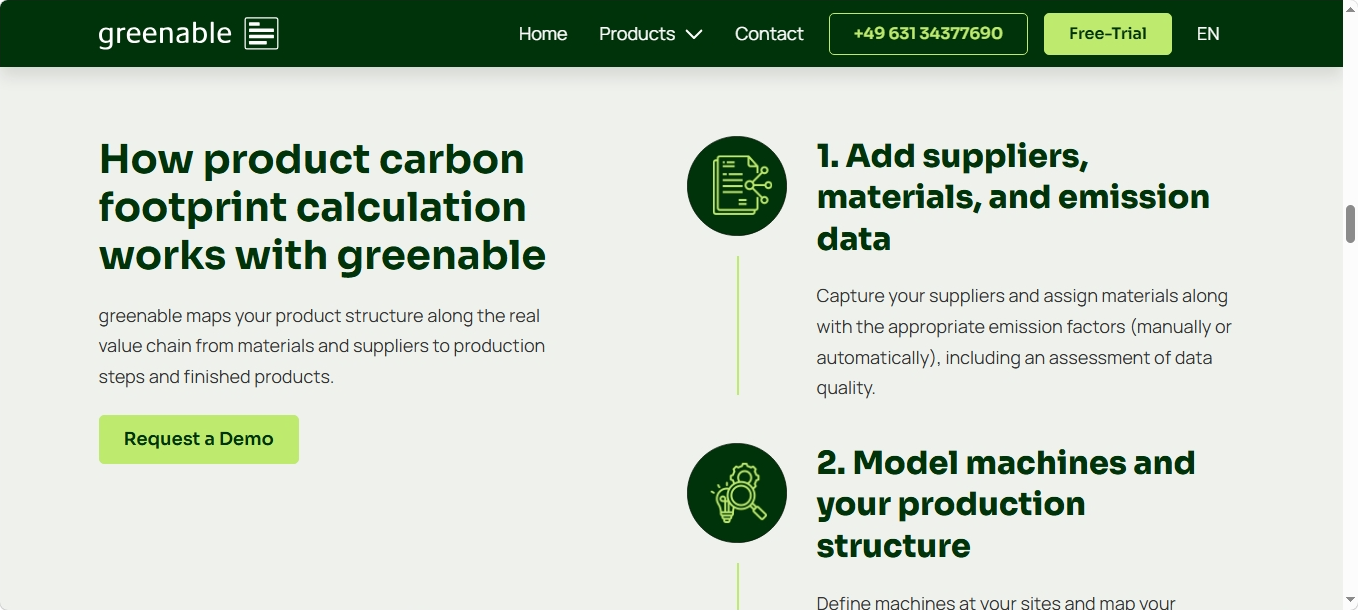
Supplier Data Integration - Facilitates the collection of environmental data from suppliers, enabling more complete Scope 3 assessments and improved supply chain transparency.
Product Comparison & Eco-Design Insights - Enables comparison of product variants and materials, helping organisations identify opportunities for reducing environmental impact during product development.
Closing Insights
Greenable is positioned within a growing category of sustainability platforms that focus on product-level environmental data rather than solely organisational reporting. Its capabilities on digital product passports reflects emerging regulatory trends in Europe, particularly the Ecodesign for Sustainable Products Regulation (ESPR), which requires detailed, standardised product information across supply chains.
The platform is used by manufacturing sectors such as mechanical engineering, automotive, and plastics, where product complexity and supplier networks make environmental data management particularly challenging. By enabling structured data collection from suppliers and linking it to product-level calculations, Greenable supports organisations in addressing Scope 3 emissions and lifecycle impacts more systematically.
A distinguishing aspect is its integration of sustainability data with operational functions such as procurement, product development, and sales. This allows environmental information—such as carbon footprints or material impacts—to be used not only for reporting but also for decision-making across departments.
As regulatory requirements evolve and digital product passports become more widespread, platforms like Greenable are likely to play an increasing role in helping manufacturers manage, standardise, and communicate product-level sustainability data.