


Available Other Features
Missing Other Features
Pricing
Starting Price
Options
Available Since
Deployment Options
- Web Browser (Cloud - Based)
Good Option For
- Freelancers (1 person company)
- Microbusiness (2-10 people)
- Small Business (11-50 people)
- Medium Business (51-250 people)
- Large Business (250+ people)
Deep dive
Core Features
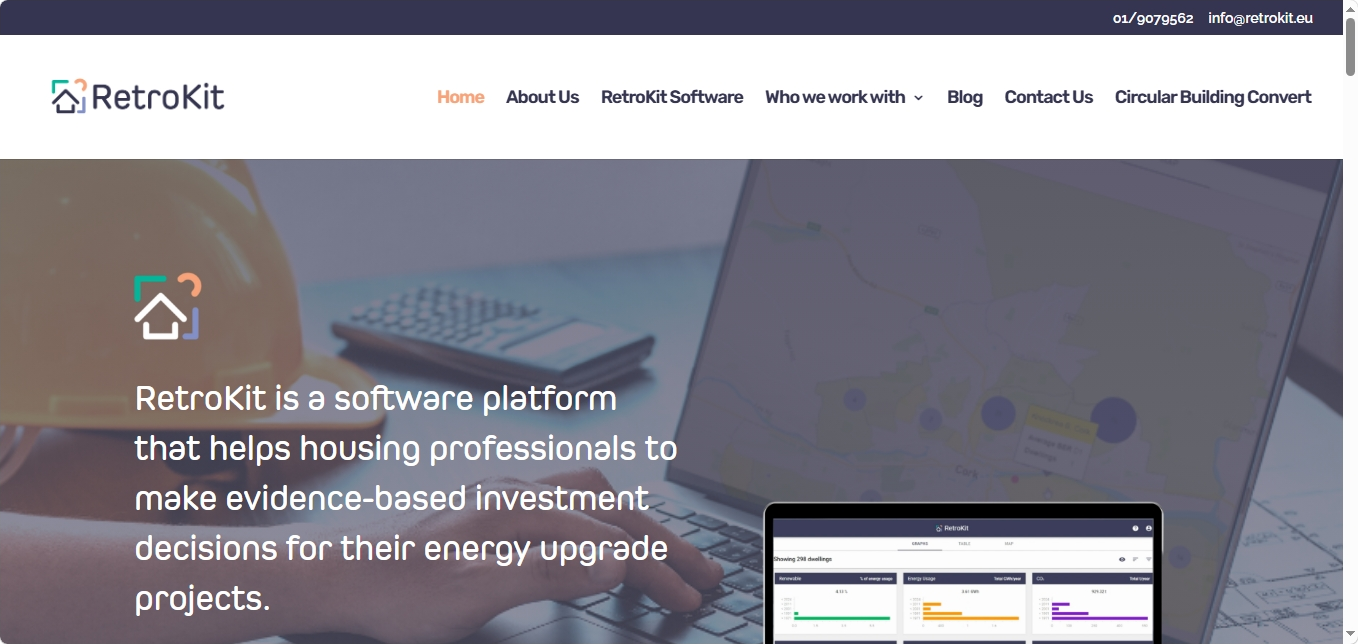
RetroKit organizes retrofit planning around three stages—Database, Analyse and Plan—moving from understanding existing housing performance to evaluating alternatives and producing an actionable investment plan. Key capabilities include:
Housing Energy Baselines: Creates a customized database of housing-stock performance, including energy use and expenditure, CO₂ emissions and BER ratings, with analysis available at portfolio, cohort and individual-home level.
Retrofit Scenario Modelling: Models and compares energy-renovation scenarios against objectives such as budget, CO₂ reduction, energy performance, housing conditions and fuel-poverty targets.
Property Prioritization: Helps identify homes and retrofit measures with the greatest potential, using parameters including BER rating, heat-loss indicators, CO₂ emissions, energy costs and dwelling type.
GIS & Spatial Analysis: Maps housing data and renovation scenarios geographically, supporting area-based programmes and targeted analysis by community or other defined locations.
Cost & Funding Analysis: Develops retrofit packages with budget estimates and funding opportunities, while its Energy Master Plan functionality can compare scenarios using cost-benefit analysis.
Retrofit Action Planning: Converts analysis into tailored energy-conservation packages, work plans and visual reports; reports, action plans and bills of quantity can also be customized.
Closing Insights
RetroKit grew from an SEAI-funded research project in 2017, with RetroKit Ltd founded in 2020 by Xavier Dubuisson, Susan O'Flaherty and Shay Kavanagh. Deployments illustrate different planning needs. Cork City Council used RetroKit to establish a baseline for its social housing, prioritize properties and identify effective retrofit measures. Peter McVerry Trust used the platform in developing an Energy Master Plan, comparing retrofit approaches across different building types and energy-performance levels. For Cavan Sustainable Energy Group, RetroKit supported fuel-poverty mapping, identification of homes potentially suitable for grant assistance and analysis of retrofit scenarios. RetroKit is therefore particularly relevant where organizations need to turn large housing datasets into prioritized retrofit investment plans. Prospective users can contact RetroKit to discuss requirements for their housing portfolio or community.