


Available Carbon Accounting Features
Missing Carbon Accounting Features
Pricing
Starting Price
Options
Available Since
Deployment Options
- Web Browser (Cloud - Based)
Good Option For
- Small Business (11-50 people)
- Medium Business (51-250 people)
- Large Business (250+ people)
Deep dive
Core Features
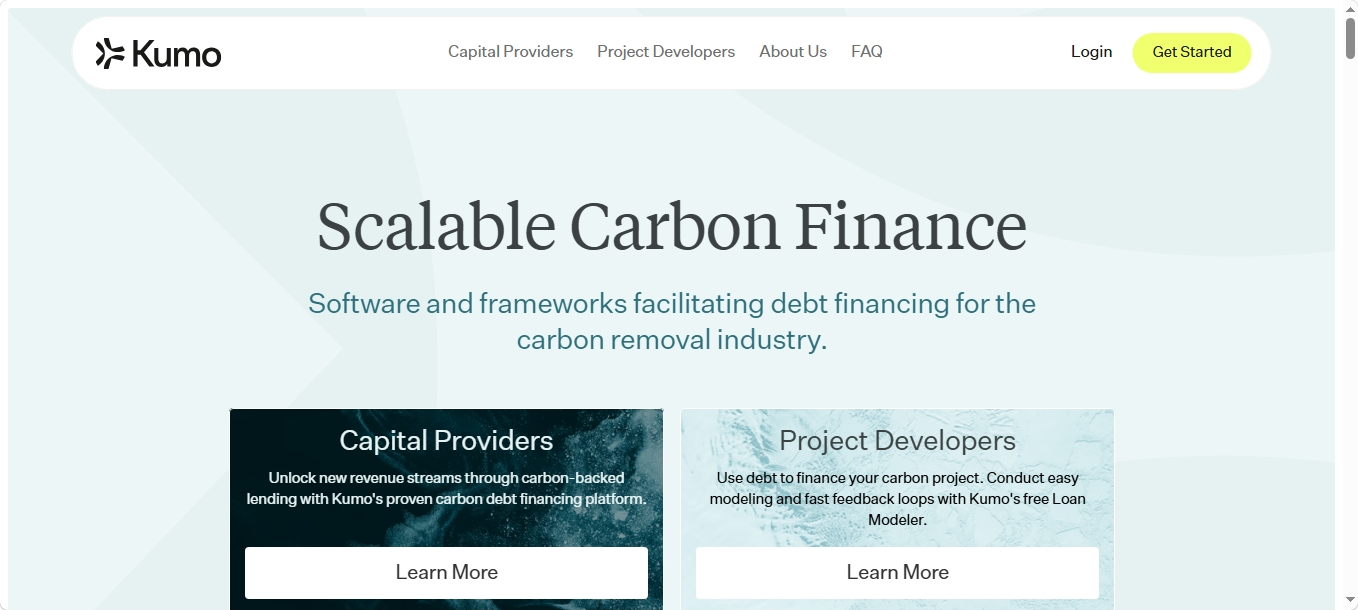
Kumo is not conventional carbon accounting software. Its method is closer to structured finance infrastructure for the carbon market: it helps assess carbon projects, convert future carbon-credit value into financeable collateral, connect projects with institutional capital, and manage loan-related information across the financing lifecycle. Some of its main features are:
Carbon-backed lending for capital providers — Kumo enables capital providers to use future carbon credits as legal collateral for loans, with the platform taking legal custody of the credits so lenders can reduce exposure to unsecured project risk.
Finance-ready project assessment — For lenders and investors, Kumo aggregates project information and applies pre-deal assessment workflows intended to reduce the friction of evaluating carbon-credit projects as financing opportunities.
Collateral and SPV structuring — Kumo describes structures that can package carbon projects into financing vehicles backed by cash flows from carbon-credit sales, offtake agreements, and other revenue streams.
Non-dilutive capital for project developers — For developers, Kumo provides a route to debt financing for operations or new project investment without requiring the project owner to give up equity.
Developer onboarding and cash-flow modelling — The platform supports onboarding, assessment, cash-flow modelling, matching, financing structuring, monitoring, reporting, and repayment workflows for project developers seeking finance.
Use of credits and offtake agreements as collateral — Developers can use carbon credits and offtake agreements to secure financing while retaining ownership of credits and participating in potential future value appreciation.
Closing Insights
Kumo functions at the intersection of carbon markets, project finance, and financial infrastructure. Its clearest proof point is the 2023 carbon-secured loan it says it executed with ABN AMRO, using Kumo’s software infrastructure to channel funding to Vlinder, a mangrove project developer. That example helps explain the platform’s purpose: Kumo is not just matching buyers and sellers of credits, but trying to make future carbon-credit revenues usable in lending decisions.
The platform documentation also notes that Kumo is delivered as both software and specialist support. Capital providers get access to structured project data, project comparison, benchmarking, post-issuance monitoring, and collateral structures; project developers get Kumo’s proprietary Loan Modeler, financeability assessment, lender access, and specialist consultant support for deeper analysis. This hybrid model matters because carbon-backed lending still requires legal, financial, and project-quality judgement alongside automation.
Kumo does not publish standard subscription pricing and is likely engagement-specific rather than a self-serve SaaS tariff.