


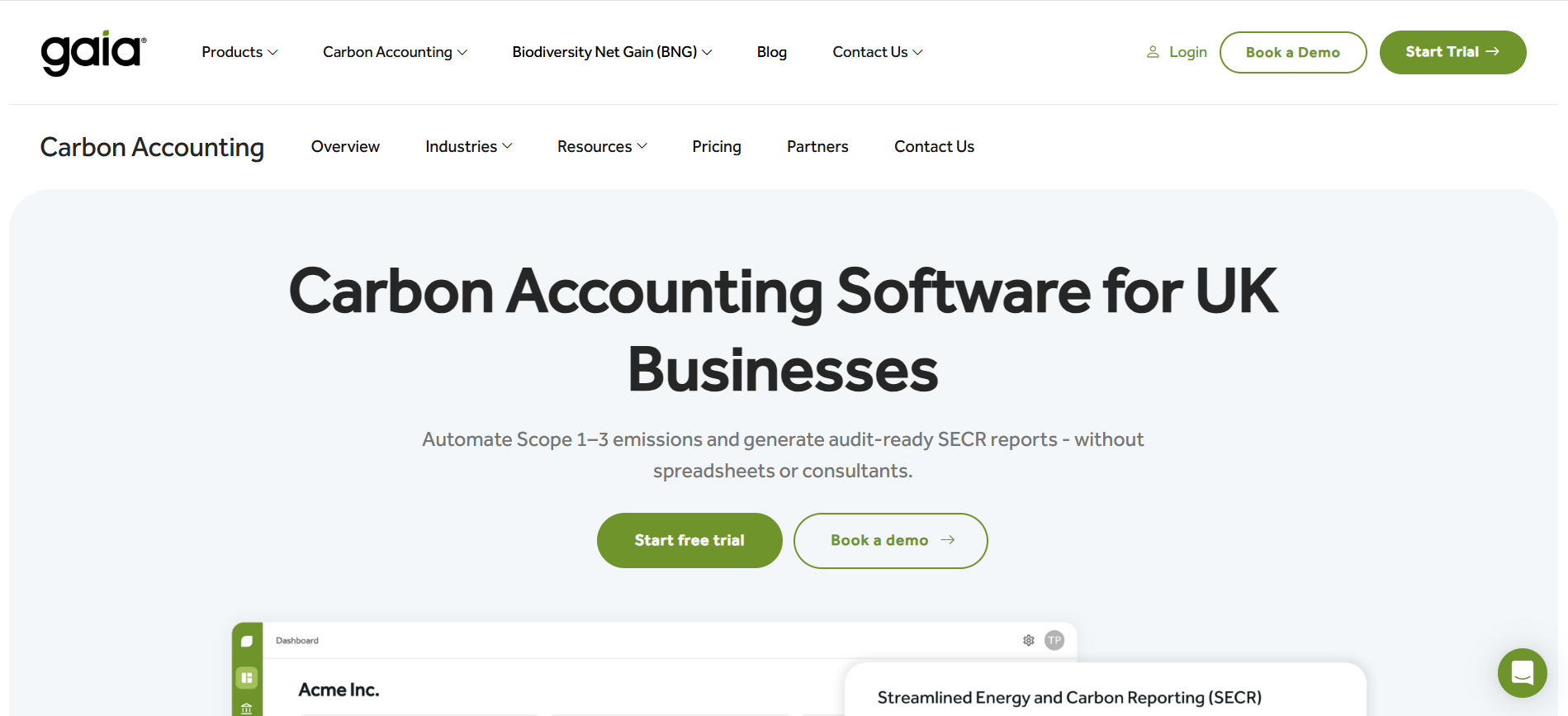
Available Carbon Accounting Features
Missing Carbon Accounting Features
Pricing
Starting Price
Options
- Monthly Subscription
- Free Trial
Available Since
Deployment Options
- Web Browser (Cloud - Based)
Good Option For
Deep dive
Core Features
1) Carbon Emissions Accounting
The core capability of Gaia is greenhouse gas accounting across organisational activities.
The platform calculates emissions by converting operational activity data into CO₂-equivalent emissions, applying recognised emissions factors and accounting methodologies.
This allows companies to generate a structured carbon footprint covering:
Scope 1 (direct emissions).
Scope 2 (purchased energy emissions).
Scope 3 (value chain emissions).
The calculation engine follows established carbon accounting frameworks such as the GHG Protocol, which is widely used globally for organisational emissions reporting.
2) Automated Data Collection
The platform automates emissions data collection by integrating with internal operational systems and data sources used across the organisation.
These data sources may include:
financial systems.
operational activity records.
energy consumption data.
procurement information.
Automating data ingestion helps reduce manual reporting work and improves data consistency across reporting cycles.
3) Compliance-Ready Carbon Reporting
Gaia includes built-in reporting tools that help organisations generate emissions reports aligned with regulatory and disclosure frameworks.
These outputs may support reporting processes related to:
UK Streamlined Energy and Carbon Reporting (SECR).
EU Corporate Sustainability Reporting Directive (CSRD).
GHG Protocol disclosures.
The platform generates structured reports intended for internal review, auditors and external stakeholders.
4) AI-Supported Analysis
The platform advertises AI-supported functionality designed to automate parts of the carbon accounting workflow, including emissions calculations and reporting generation.
AI-supported workflows may assist with:
identifying emissions patterns.
automating calculation processes.
generating reporting outputs.
However, publicly available product documentation provides limited technical detail on the specific AI models or automation mechanisms used.
5) Emissions Reduction Planning
Beyond emissions measurement, the platform provides analytical insights that help organisations identify opportunities for emissions reduction.
This includes generating recommended carbon reduction actions based on the organisation’s emissions profile.
These recommendations may include operational efficiency improvements or changes in procurement or energy use.
6) Scope 3 Supply Chain Emissions Tracking
Gaia also supports measurement of value chain emissions through Scope 3 carbon accounting.
Scope 3 tracking allows companies to evaluate emissions across upstream and downstream activities, such as:
purchased goods and services.
logistics and transportation.
supplier activities.
This capability is increasingly required as organisations expand climate reporting to cover supply chain emissions.
Plans & Pricing
Public listings indicate starting pricing around:
approximately £165 per user per month, with free trial availability in some contexts.
Pricing models likely vary depending on organisational size and reporting complexity.
Integrations
Public documentation indicates that Gaia integrates with various internal business systems to automate emissions data collection.
Potential integration contexts include:
accounting systems.
ERP systems.
energy consumption records.
operational data sources.
However, the vendor does not publicly document a detailed integration catalogue or open API specifications.
Certifications & Methodology
The software follows recognised emissions accounting methodologies, including:
Greenhouse Gas Protocol.
DEFRA emissions factors.
alignment with recognised reporting standards.
These frameworks provide methodological guidance for emissions calculation and reporting.
Expert Voices & Reviews
Public third-party analyst coverage of Gaia Carbon Accounting appears relatively limited. Software review platforms list the tool among carbon accounting solutions, but show limited verified user reviews.
Organisations evaluating the software would typically perform additional due diligence, including:
product demonstrations.
methodology validation.
emissions factor verification.
audit readiness evaluation.
Customers & Use Cases
Typical use cases include:
corporate carbon footprint reporting.
regulatory climate disclosure preparation.
sustainability reporting processes.
emissions reduction planning.
supply chain emissions analysis.
Industries may include manufacturing, retail, finance, technology and services.
Closing Insights
Gaia Carbon Accounting should be positioned primarily as carbon accounting and emissions management software designed to help organisations measure, report and reduce greenhouse gas emissions. Its value lies in structured emissions measurement, automated calculation workflows and regulatory reporting outputs. The platform does not appear to provide lifecycle assessment modelling, financial climate risk analytics, or full ESG governance management.