


Available Climate Risk Management Features
Missing Climate Risk Management Features
Pricing
Starting Price
Options
Available Since
Deployment Options
- Web Browser (Cloud - Based)
Good Option For
- Small Business (11-50 people)
- Medium Business (51-250 people)
- Large Business (250+ people)
Deep dive
Core Features
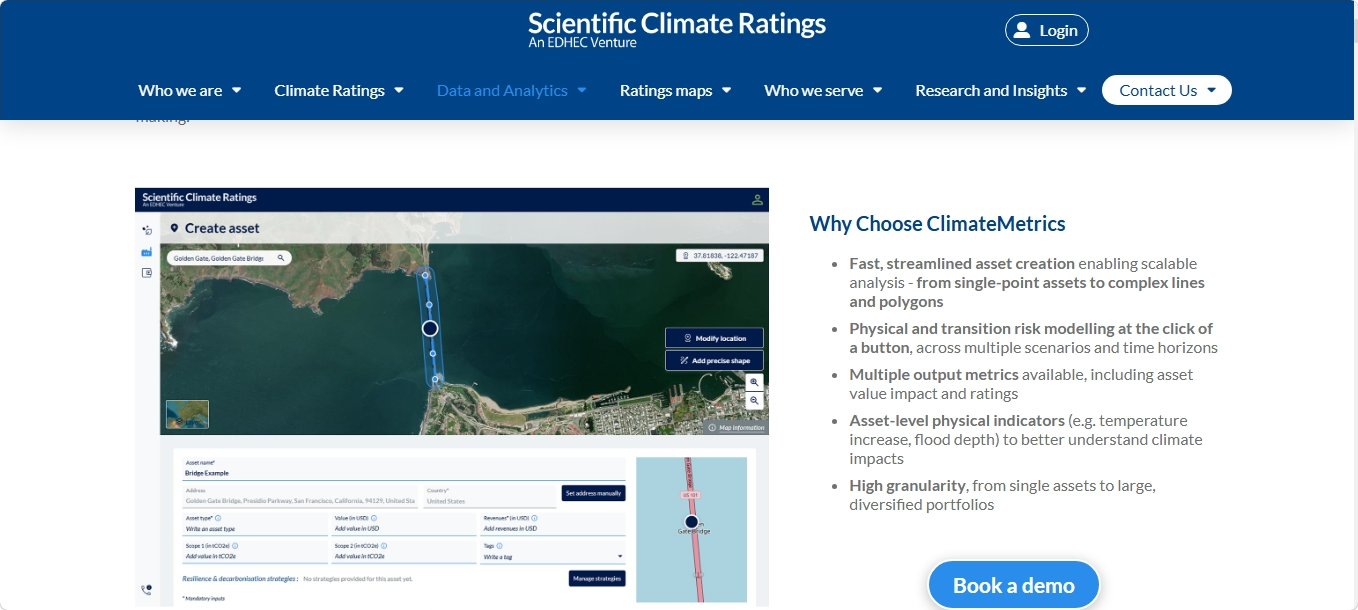
ClimateMetrics is built around a methodology that combines high-resolution geospatial climate data with financial valuation models to quantify both physical and transition climate risks. Its principal capabilities include:
Asset- and Portfolio-Level Risk Analysis – Evaluates individual assets as well as diversified portfolios using a consistent methodology across sectors and geographies.
Physical and Transition Risk Modelling – Assesses hazards such as floods, wildfires, storms, heat stress, and transition risks arising from the shift to a low-carbon economy under multiple climate scenarios.
Financial Impact Quantification – Estimates climate-related effects on revenue, costs, cash flow, asset values, and net asset value (NAV), providing outputs suitable for financial modelling and investment decisions.
Geospatial Climate Analytics – Uses precise asset locations rather than broad regional averages, enabling more detailed assessments for facilities, infrastructure, and development projects.
Scenario and Time-Horizon Analysis – Supports forward-looking assessments across multiple climate pathways and future time horizons, helping users compare potential outcomes under different assumptions.
Regulatory-Ready Outputs – Produces standardized metrics intended to support disclosures under frameworks such as ISSB, CSRD, and SFDR while maintaining transparency over the underlying methodology.
Closing Insights
ClimateMetrics was launched in April 2026 by Scientific Climate Ratings, an EDHEC venture created from the university's climate finance research ecosystem. The company combines expertise in climate science, geospatial analytics, and financial valuation with the objective of making climate risk directly relevant to financial decision-making. Its leadership includes CEO Rémy Estran-Fraioli alongside a multidisciplinary team of climate scientists, financial engineers, and researchers.
A notable aspect of ClimateMetrics is its focus on translating climate risks into standardized financial metrics, moving beyond generic ESG scores and qualitative climate assessments. The platform provides confidence intervals alongside its calculations and makes its methodology transparent, enabling users to understand the assumptions behind the results. It is intended for infrastructure issuers, institutional investors, listed companies, and public institutions evaluating both existing assets and prospective investments.
SCR has also announced plans to expand its coverage from infrastructure assets to thousands of listed companies. Pricing is available on request through demonstrations and commercial engagement with the company. Organisations seeking to integrate climate considerations into valuation, investment, and enterprise risk management may find ClimateMetrics particularly relevant because of its combination of asset-level geospatial modelling and financially oriented outputs.