

Available Carbon Accounting Features
Missing Carbon Accounting Features
Pricing
Starting Price
Options
- Free Trial
Available Since
Deployment Options
- Web Browser (Cloud - Based)
Good Option For
- Small Business (11-50 people)
- Medium Business (51-250 people)
- Large Business (250+ people)
Deep dive
Core Features
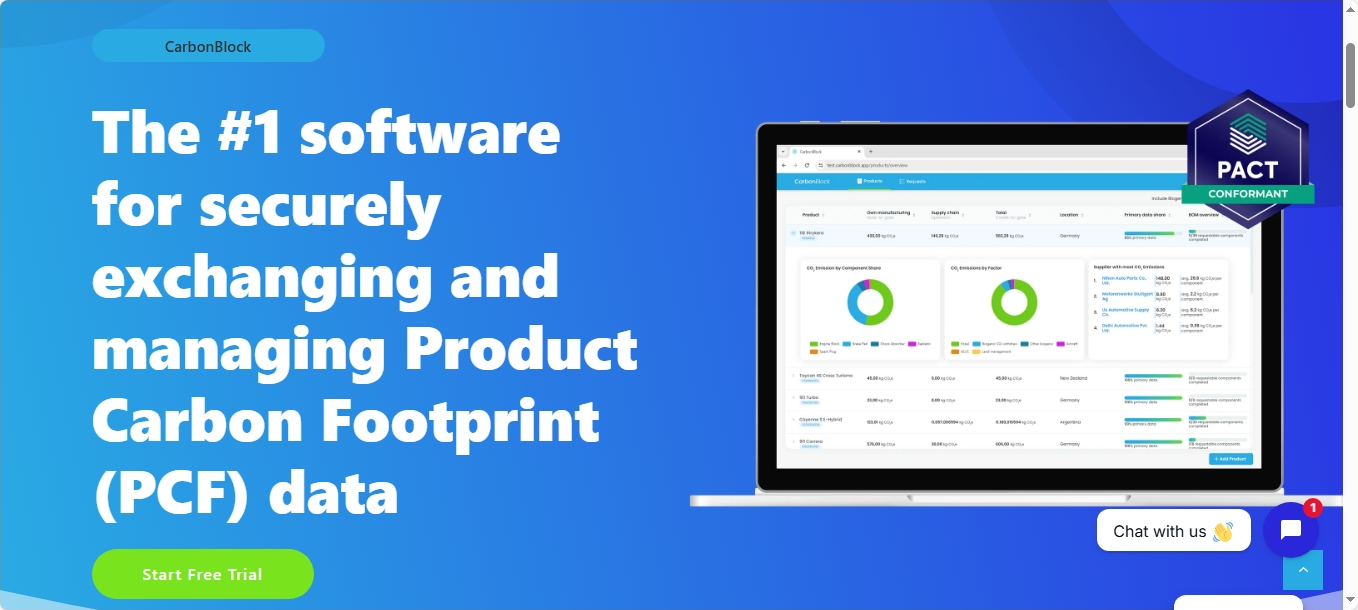
CarbonBlock facilitates supplier primary data exchange. Each tier calculates its own contribution using real production parameters and passes the verified figure downstream. The platform functions as an interoperability layer rather than an LCA tool, assuming suppliers already know their numbers and merely need a tamper‑evident channel to share them. Some of its specific capabilities are:
AI Entity Mapping: Classifies thousands of bill-of-material lines using transformer models, matching component descriptions to LCA database fields without manual intervention.
Multi-tier Chaining: Reads a PCF from Tier 2, appends Tier 1 processing emissions, and delivers a cumulative figure to the OEM.
Hotspot Analysis: Flags which suppliers or components contribute the highest share of emissions, prioritising where to request primary data.
Supplier‑Controlled Access: Suppliers grant time‑limited viewing rights; data never resides permanently on the buyer’s server.
PACT‑Conformant Exchange: Uses WBCSD’s open standard, ensuring data received from one PACT‑certified tool can be consumed by any other.
PACIFIC Module: A dedicated Catena‑X–certified instance for automotive serial parts tracking.
Closing Insights
CarbonBlock was developed to address a specific operational constraint: suppliers possess emissions data but lack secure mechanisms to share it with customers. CircularTree, founded in Berlin in 2018, designed the platform to function as an interoperability layer rather than a primary calculation tool.
The company’s initial validation came through a 2020 pilot with Porsche, BASF, and Motherson as part of Startup Autobahn, which received a Global Innovation Award from Plug and Play. That same year, CircularTree was invited as an innovation member to the WBCSD’s Carbon Transparency Pathfinder initiative (now PACT).
Subsequent development has focused on specific industry applications. The company completed a demonstrator for the SHIFT project, applying its PCF exchange model to telecommunications infrastructure supply chains. A collaboration with the German Research Center for AI (DFKI) under the Green-AI Hub programme developed entity-mapping capabilities to automate component classification for carbon hotspot analysis.
The platform’s regulatory relevance stems from its PACT-conformant architecture. For organisations in jurisdictions requiring auditable primary-data exchange—including companies preparing for CBAM reporting—this conformance enables interoperability with other certified systems. Pricing is custom-quoted and includes direct engineering support.