

Available Life Cycle Assessment (LCA) Features
Missing Life Cycle Assessment (LCA) Features
Pricing
Starting Price
Options
Available Since
Deployment Options
- Web Browser (Cloud - Based)
Good Option For
- Small Business (11-50 people)
- Medium Business (51-250 people)
- Large Business (250+ people)
Deep dive
Core Features
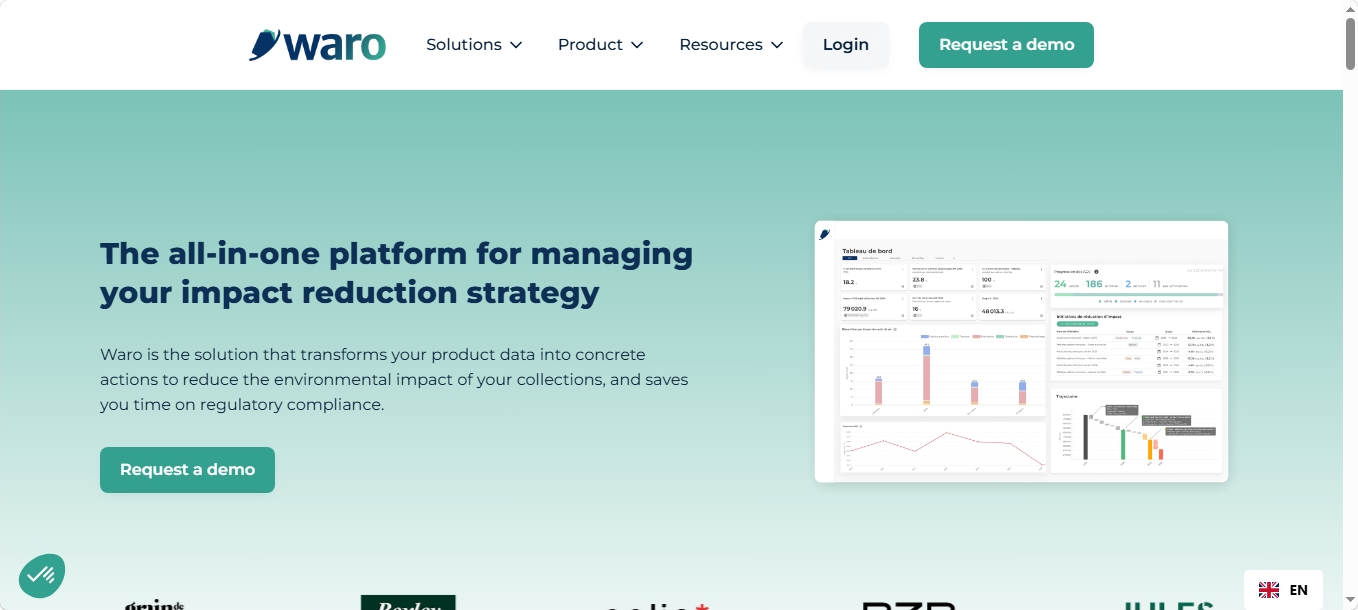
Waro is presented as less as a generic carbon accounting platform and more as an operational environmental management system for product-centric industries. Its approach is built around transforming product and supply-chain data into eco-design decisions, environmental compliance workflows, and measurable impact reduction trajectories. Accordingly, its main capabilities include:
Product-Level Lifecycle Assessment (LCA) – Waro automates lifecycle assessment workflows for products using methodologies aligned with ISO 14040/14044, ADEME standards, and the European PEF framework.
Environmental Labelling and Regulatory Compliance – The platform is strongly oriented toward French and European product-environment regulations.
Impact Reduction Trajectory Management – Waro helps organisations build quantified environmental reduction trajectories using simulation tools, hotspot analysis, and operational action plans tied to sourcing and product decisions.
Eco-Design Decision Support – The platform integrates environmental impact analysis directly into product development workflows, allowing teams to simulate material substitutions, sourcing changes, recycled-content targets, and supplier alternatives during collection development.
Granular Scope 3 and Supply Chain Analysis – Waro places strong emphasis on upstream supply-chain emissions and product-level hotspots, with detailed analysis capabilities across suppliers, product categories, materials, and purchasing decisions.
Collaborative Operational Workflows – Unlike many sustainability tools designed mainly for CSR departments, Waro is explicitly built for cross-functional use by sourcing, purchasing, product, management, and sustainability teams.
Closing Insights
Waro belongs to a newer generation of European sustainability platforms focused on operational product intelligence rather than broad corporate ESG aggregation. Its market positioning is closely connected to industries where sustainability performance increasingly depends on granular upstream product and supply-chain data, particularly fashion, furniture, and consumer goods sectors facing rising pressure around transparency, ecodesign, and circularity.
Waro consistently frames sustainability data as an input for sourcing, merchandising, collection planning, and supplier-management decisions. This operational orientation differentiates it from many ESG platforms that focus primarily on corporate reporting, compliance, and investor disclosures.
The company has also gained visibility through collaborations with retail and consumer brands including Celio, Camif, Grain de Malice, Bexley, and Ebac. These case studies reflect Waro’s concentration on product-heavy sectors where environmental performance is increasingly tied to purchasing decisions and supply-chain traceability requirements.