


Available Scope 3 Emissions Features
Missing Scope 3 Emissions Features
Pricing
Starting Price
Options
Available Since
Deployment Options
- Web Browser (Cloud - Based)
Good Option For
- Small Business (11-50 people)
- Medium Business (51-250 people)
- Large Business (250+ people)
Deep dive
Core Features
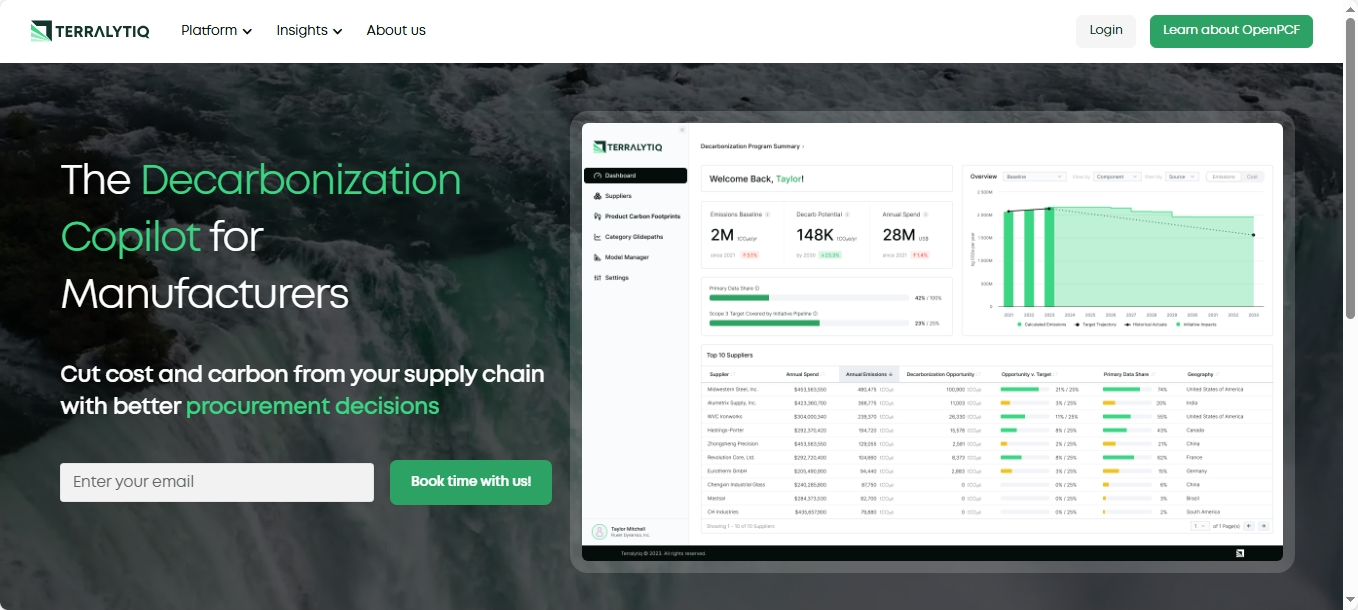
Terralytiq approaches supply chain decarbonization as an actionable business transformation, not just an accounting exercise. Its methodology is built on activity-based, cradle-to-gate Product Carbon Footprint (PCF) models, providing a more accurate and actionable foundation. Its ultimate goal is to generate clear, costed decarbonization pathways that procurement teams can execute. To achieve this, the platform’s functionality is built around several core pillars:
Digital Supply Chain Twin: Creates a dynamic, multi-tier model of a company's entire supply chain, pre-filled with emissions data to immediately visualize hotspots without starting from blank supplier surveys.
Supplier-Specific PCFs: Calculates granular Product Carbon Footprints using 100% activity data and integrates facility-level primary data (e.g., from specific smelters or factories) to enable true supplier performance benchmarking.
Trusted Supplier Portal: Facilitates collaboration by allowing suppliers to view pre-filled PCFs, exchange primary data, and co-develop reduction plans in a single portal, moving beyond repetitive, manual surveys.
Initiative Impact Modeling: Quantifies both the carbon reduction potential and the associated cost impact of specific decarbonization initiatives (like switching to renewable energy or increasing recycled content) at a facility level.
Decarbonization Roadmaps: Generates actionable, procurement-led glidepaths that outline sequenced initiatives, track supplier progress, and provide the business case needed to secure internal funding for sustainable procurement.
Extensive Value Chain Library: Leverages over 100 pre-built decarbonization models for key industrial materials like aluminum, polyethylene, and glass to accelerate analysis and scenario planning.
Closing Insights
Terralytiq was founded by Dr. Alexander Pfeiffer (CEO) and Will Glazener (COO), who built a team of decarbonization experts, software developers, and industry practitioners. The company emerged from Columbia University's entrepreneurial ecosystem. Going beyond corporate-level carbon accounting, Terralytiq drills into product-level data to create a commercial dialogue between buyers and suppliers. Terralytiq has garnered recognition, including a multi-year partnership with global consultancy Bain & Company, which both uses and helps develop the platform to serve its industrial clients. The platform is also part of the PACT Network, an open global network for interoperable Product Carbon Footprint data exchange.
For potential users, Terralytiq is best suited for industrial manufacturers, particularly in sectors like automotive, electronics, and heavy equipment, where complex, multi-tier supply chains dominate the carbon footprint. It is especially relevant in regulatory contexts like the EU’s CBAM, which taxes imported goods based on their embedded carbon, making granular PCFs a financial imperative. Companies considering Terralytiq should note its integration with advanced data sources like Climate TRACE and its alignment with industry standards for PCF exchange. The platform’s value proposition centers on translating decarbonization from a strategic ambition into a series of executable, cost-justified procurement decisions.