

Available Carbon Accounting Features
Missing Carbon Accounting Features
Pricing
Starting Price
Options
- Monthly Subscription
Available Since
Deployment Options
- Web Browser (Cloud - Based)
Good Option For
- Small Business (11-50 people)
- Medium Business (51-250 people)
- Large Business (250+ people)
Deep dive
Core Features
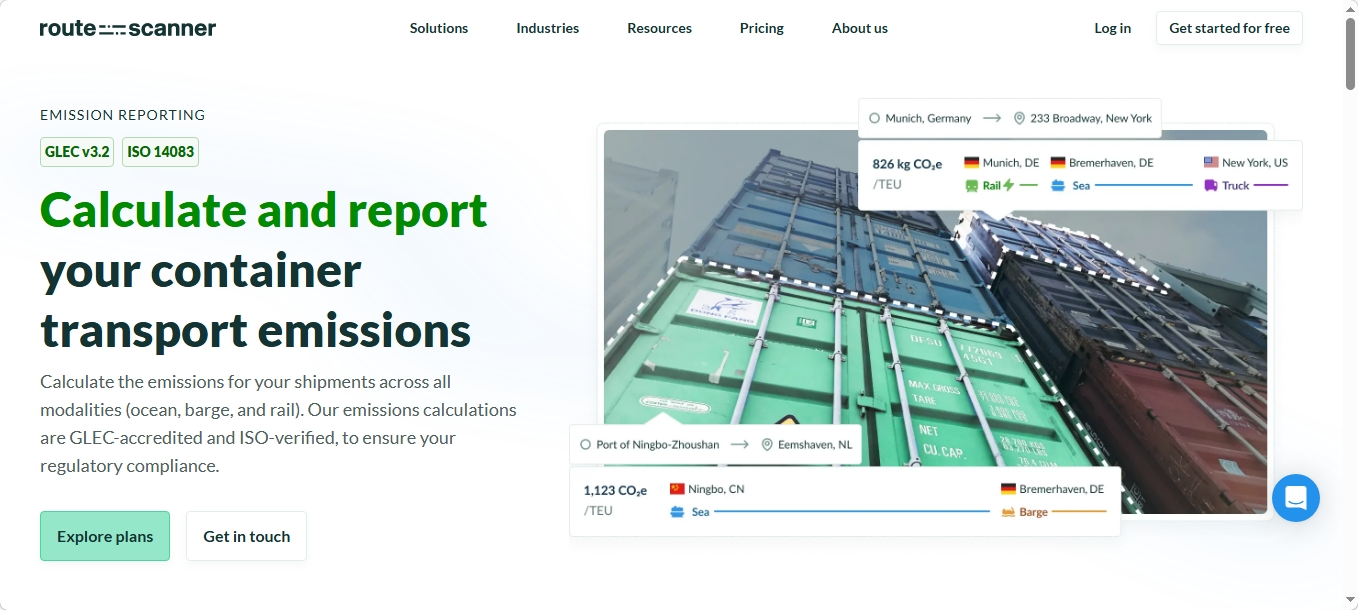
Routescanner’s Emissions Reporting is built around ISO 14083, which structures calculations by “Transport Chain Elements” (TCEs) so multimodal moves are computed consistently across legs. In practice, the API returns emissions in kg CO₂e per twenty-foot equivalent unit (TEU) and per ton alongside distance, giving teams both operational and reporting-ready numbers. Routescanner's main features include:
Standards-aligned methodology - Calculations follow ISO 14083, which Routescanner describes as breaking transport into TCEs to ensure transparency and comparability across modes and legs. This gives shippers and forwarders a recognized basis for disclosures and KPI tracking.
Multimodal coverage with flexible origins/destinations - Enables the computation of emissions for deep-sea, barge, rail, or truck legs, using UN/LOCODEs or latitude/longitude pairs for the origin and destination. Schedule-driven coverage spans ocean and European inland networks, supporting practical door-to-door assessments.
Parameter-rich accuracy controls - Refine results with vessel specifics, container type (DRY/REEFER), and mode-appropriate fuel choices—e.g., HVO blends or hydrogen for barge; diesel/electric for rail; and diesel, LNG, HVO, or electric for truck.
Granular, comparable outputs - API responses include CO₂e per TEU, CO₂e per ton, and distance (meters), enabling consistent comparison between routings or suppliers and straightforward roll-ups into corporate inventories or tenders.
Discovery endpoints for workflow automation - Beyond the core emission call, endpoints users can search terminals (for distance/emission queries) and standardize inputs before calculating.
Closing Insights
Routescanner’s emissions reporting already supports practical needs across the industry. Schavemaker Logistics reports that partnering with Routescanner helps it meet new emission regulations, while giving customers clear insight and emission certificates. Freight forwarders use the platform’s verified, GLEC-aligned CO₂ figures per route, leg and carrier to answer ESG questions and substantiate tenders with lower-emission options. For enterprises standardizing disclosures, developers can embed the Emission API in TMS/ERP workflows to automate distance and CO₂ calculations; documentation is up-to-date and continues to add query parameters that improve reporting flexibility.
Looking ahead, Routescanner’s schedule-based distances for rail and barge, together with one of the largest ocean and inland schedule networks, position the solution to serve growing reporting obligations with credible, comparable metrics. As of February 2026, pricing ranges from €25 (one-time fee for a trial) to €325 per month for the "expert" plan. Customized services and bulk API requests are also available.