


Available Other Features
Missing Other Features
Pricing
Starting Price
Options
Available Since
Deployment Options
- Web Browser (Cloud - Based)
Good Option For
- Freelancers (1 person company)
- Microbusiness (2-10 people)
- Small Business (11-50 people)
- Medium Business (51-250 people)
- Large Business (250+ people)
Deep dive
Core Features
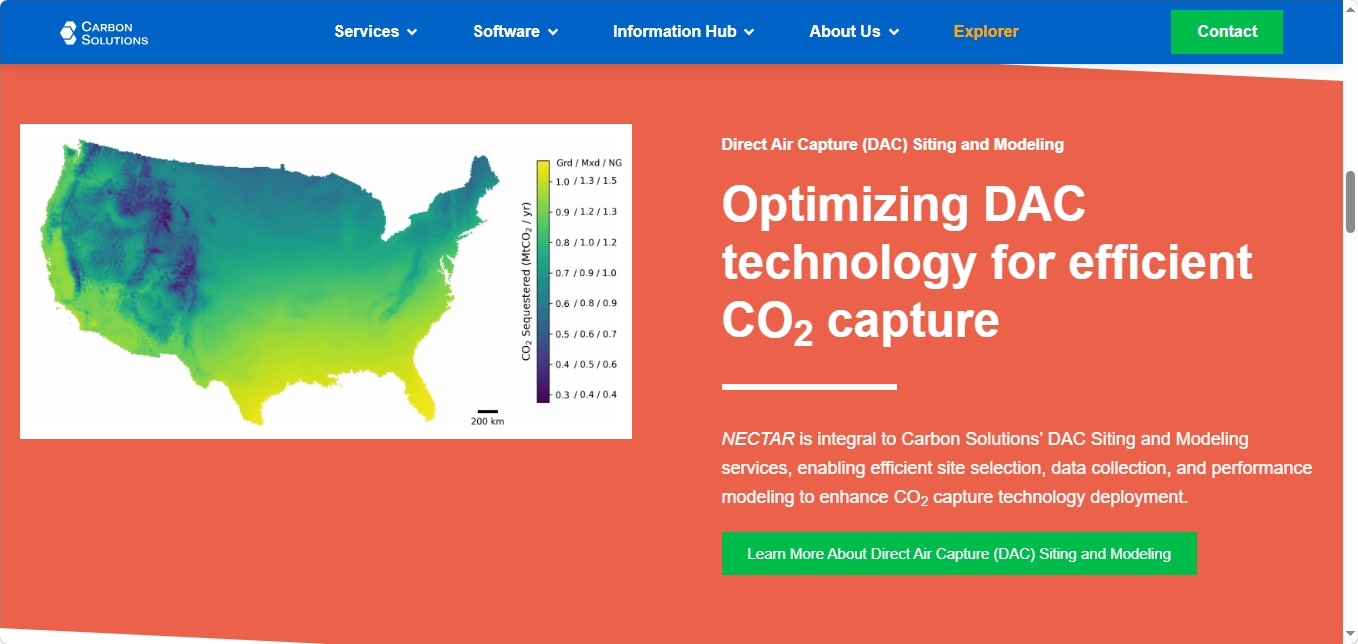
NECTAR uses geospatial modelling to evaluate the suitability of locations for carbon removal facilities, particularly direct air capture installations. Its key capabilities include:
DAC Site Suitability Assessment: Evaluates potential locations using climate conditions, energy availability, water resources, geological storage opportunities and environmental constraints. Users can compare locations to identify areas suitable for DAC deployment.
Climate-Dependent DAC Performance Modelling: Assesses how temperature, humidity and elevation influence the performance of different DAC technologies. It considers hourly and seasonal weather variations to support location-specific assessments.
Energy Supply and Heat Assessment: Evaluates energy requirements and potential heat sources for DAC operations, including geothermal energy, heat pumps, waste heat and concentrated solar power. It also considers the availability and costs of renewable electricity.
Water and Resource Requirements: Examines water consumption and other resource constraints that may affect DAC project feasibility. This helps users identify locations where resource availability could limit deployment.
CO₂ Storage Proximity Assessment: Incorporates geological storage information to evaluate whether potential DAC sites have access to suitable CO₂ sequestration opportunities. This helps account for storage access when comparing locations for DAC with carbon storage (DACCS).
Environmental and Social Risk Assessment: Incorporates natural hazard risks, climate-related vulnerabilities and social considerations into site screening. These assessments help identify potential environmental and community-related constraints before project development.
Closing Insights
NECTAR was developed through a US DoE-funded research conducted between 2022 and 2024. Its initial development combined process-level DAC modelling with geospatial analysis to assess how carbon removal facilities could be integrated with energy and storage infrastructure.
Carbon Solutions offers DAC siting and modelling services alongside the software, including technology performance assessments and resource availability analysis. NECTAR can also work with the company's separate geological storage assessment tool, SCO₂Tᴾᴿᴼ, when more detailed subsurface analysis is required. Public licensing prices are not disclosed, so prospective users should contact Carbon Solutions for access and implementation details.