

Available Carbon Accounting Features
Missing Carbon Accounting Features
Pricing
Starting Price
Options
- Free
- Monthly Subscription
Available Since
Deployment Options
- Web Browser (Cloud - Based)
Good Option For
- Small Business (11-50 people)
- Medium Business (51-250 people)
- Large Business (250+ people)
Deep dive
Core Features
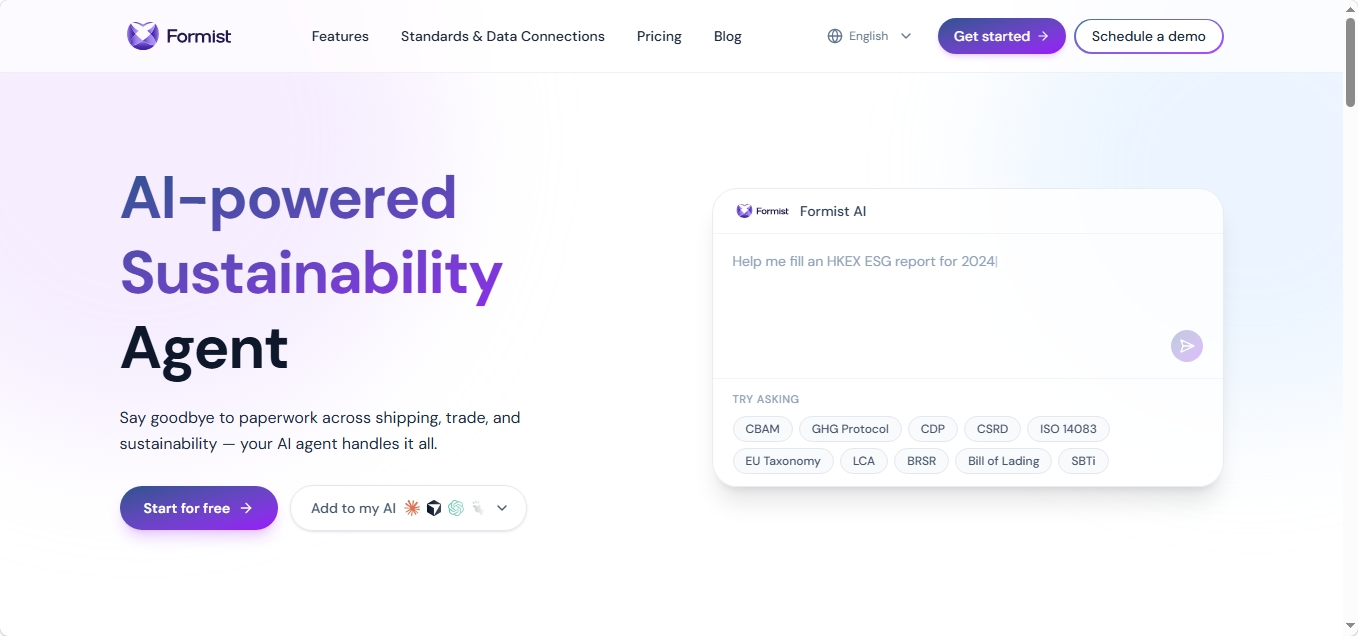
Formist is presented as an agent-native platform: its workflow revolves around communicating with an AI agent and supplying the source material needed for a reporting task. Its features include:
Document-Based Data Processing: Users can provide invoices, spreadsheets, supplier documents and other source material for the AI agent to interpret and use in reporting workflows, reducing reliance on manually transferring data into forms.
Multi-Framework Compliance: The platform covers 18 sustainability frameworks, with published support including GHG Protocol, CBAM, CSRD/ESRS, ISSB, EU Taxonomy, CDP and SBTi.
Reporting Outputs: Formist is designed to turn supplied information into reporting artifacts rather than stopping at emissions dashboards. Its supported exports include Excel and XML, while its CBAM workflow addresses regulatory filing requirements.
Product and Supply-Chain Carbon Data: Formist supports LCA screening and product carbon footprint information, while its multi-framework model allows supplier information to contribute to both carbon accounting and regulatory reporting.
Multilingual Support: Work in English, Chinese, French, or Arabic, with the AI communicating in the selected language while producing standards-compliant outputs.
Closing Insights
Formist is built by WeCarbon, a Chinese climate-tech company. The platform takes a different approach from conventional carbon-management systems: It focuses on producing sustainability reports and compliance outputs, rather than simply displaying emissions data in dashboards. Users communicate with an AI agent, provide source documents and review the resulting compliance work. This makes Formist particularly oriented toward organizations where sustainability reporting falls to small teams handling multiple frameworks rather than dedicated climate departments. Accessibility is another notable aspect. The Free plan includes all 18 frameworks, built-in data sources and Excel/XML export. Pro costs $29 per month, adding unlimited chats and tokens, team projects, API access and connections to external data sources such as Climatiq and ecoinvent.