


Available Extended Producer Responsibility Features
Missing Extended Producer Responsibility Features
Pricing
Starting Price
Options
- Annual Subscription
Available Since
Deployment Options
- Web Browser (Cloud - Based)
Good Option For
- Medium Business (51-250 people)
- Large Business (250+ people)
Deep dive
Core Features
SKU-Level Packaging Data Management
The platform centralizes finished-product stock-keeping units (SKUs), packaging components, material types, weights, and associated attributes. This creates a shared dataset for classification, calculations, and reporting preparation.
Material Classification and State Mapping
EPR Axis uses standardized packaging classifications and state-specific crosswalks to map material information to different reporting categories. The provider describes rules-based logic for applicable exclusions and jurisdictional distinctions.
Fee Calculations and Financial Forecasting
The software combines packaging weights, material classifications, and applicable fee schedules to estimate producer fee exposure. Financial analysis and scenario tools support comparisons of packaging choices and potential compliance costs. Forecasts depend on input quality and available fee schedules.
Multi-Brand and Parent-Company Management
The platform supports centralized oversight of parent companies, subsidiaries, brands, and product portfolios, with brand-level visibility alongside consolidated reporting information.
Reporting Preparation and Data Exports
EPR Axis organizes packaging information into structured reporting outputs for supported jurisdictions. The submission confirms reporting preparation and exports, but does not establish a live direct connection to every regulator or producer responsibility organization portal.
Audit Trails and Validation
The platform maintains traceable classifications, supporting records, and change histories. The provider also reports validation tools intended to identify missing information and classification inconsistencies.
Dashboards
Centralized dashboards provide visibility into packaging portfolios, state-level reporting information, and projected EPR financial exposure for compliance and finance teams.
Plans & Pricing
EPR Axis uses an annual SaaS subscription model, with pricing based primarily on the number of finished-product SKUs managed. The provider also considers organizational complexity, implementation requirements, and service scope.
The submitted model includes supported states under a unified multi-state subscription. Multi-brand configurations, onboarding, packaging data preparation, and optional consulting can affect the overall proposal.
No numerical subscription prices, free tier, or trial terms were specified in the supplied materials. Demonstrations and customized quotations are available from the provider.
Integrations and Deployment
The submission confirms structured packaging data imports and reporting exports.
An Eco Modulation Engine covering the 2027 rules for Oregon, Colorado and California is available in the platform.
An Integration API for structured product, packaging, and supply data is available to customers and is deployed when a customer needs it. Named ERP connectors are configured per customer.
Axis SourceAI™ is a planned enhancement. Proposed applications include packaging data analysis, classification assistance, inconsistency detection, and AI reading of PDFs, Word files, and images. These should not be listed as current AI capabilities.
The provider identifies Vercel for application hosting and Supabase for backend database and authentication services. Customers access the platform through a browser. On-premises and customer-managed deployments were not specified.
Certifications and Awards
The submission does not claim platform-level SOC 2 attestation or ISO 27001 certification. The public security page describes SOC 2 alignment as in progress, which does not establish completion of an independent examination.
The provider describes role-based access, tenant isolation, encryption, audit logging, and backup controls. These are vendor statements rather than independently verified security findings.
The reviewed materials document no software awards.
Expert Voices and Reviews
David Gray, the company’s founder and the platform’s creator, presents EPR management as a financial and operational responsibility alongside regulatory reporting. The submitted biography attributes 40 years of packaging industry experience to him.
This represents the developer’s perspective. The materials reviewed did not include independent product reviews, third-party benchmark results, or named customer testimonials.
Customers and Case Studies
The provider describes an implementation for an unnamed U.S. consumer products company operating several brands across direct-to-consumer and retail channels. Onboarding kicked off in Q4 2026 and is complete, and the client is live on EPR Axis™ across four states with active EPR programs, with several thousand SKUs in one dataset.
The case study models annual EPR fee exposure in the mid-six figures and projects:
10% to 20% below conservative spreadsheet estimates, roughly $35,000 to $75,000 per year.
60% to 75% fewer hours per reporting cycle than a manual spreadsheet process.
A 30-day go-live target against a 90-day contractual timeline.
100% of reported figures traceable to source data, user, and change history, by design.
These figures are supplier-reported projections and targets. They are not verified realized savings, measured reporting improvements, or confirmed delivery times. The supplied material does not publicly identify the customer.
Closing Insights
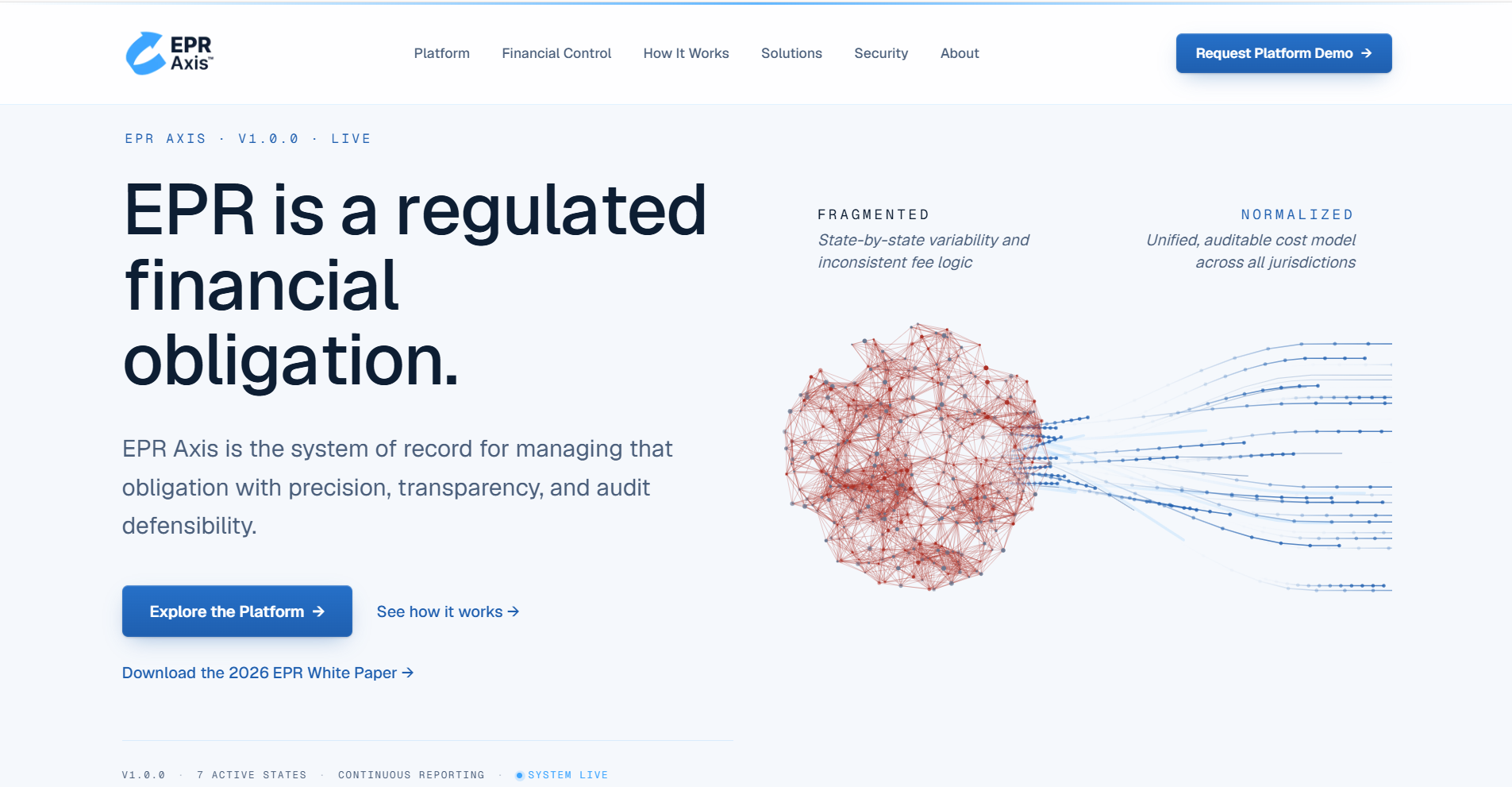
EPR Axis is positioned for organizations that need to connect packaging data, multi-state reporting preparation, and EPR fee planning. Its stated strengths include SKU-level records, material mapping, multi-brand oversight, and traceable calculations.
A demonstration using the buyer’s own packaging data would help assess classification accuracy, reporting compatibility, and the assumptions behind financial estimates. Organizations requiring live enterprise integrations or AI functionality should evaluate the current product separately from the roadmap.