

Available EPD Features
Missing EPD Features
Pricing
Starting Price
Options
Available Since
Deployment Options
- Web Browser (Cloud - Based)
Good Option For
- Individuals
- Freelancers (1 person company)
- Microbusiness (2-10 people)
- Small Business (11-50 people)
- Medium Business (51-250 people)
- Large Business (250+ people)
Deep dive
Core Features
EPD Analyzer is designed as an interpretative and analytical layer for Environmental Product Declarations, focusing on helping users understand, compare, and reuse EPD data rather than generating it from scratch. It applies structured evaluation methods to make life cycle assessment results more accessible and decision-relevant. Its key features include:
Centralised EPD Management – Store and organise EPD datasets, PDFs, PCRs, and related documentation, with visibility on validity periods to support timely updates.
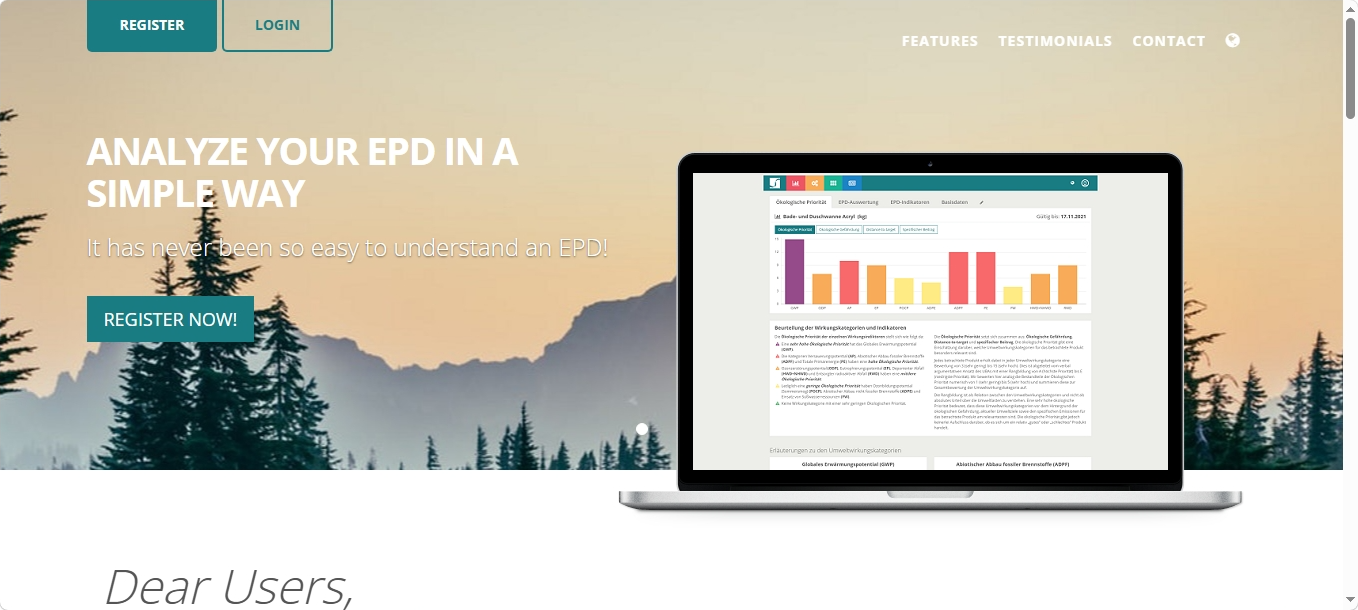
Ecological Impact Evaluation – Interpret and weight EPD indicators using the German Federal Environmental Agency’s methodology, highlighting priority impact categories.
EPD Data Reuse & Project Generation – Create new datasets or project scenarios based on existing EPD data for internal analysis and comparison.
Benchmarking & Comparison Tools – Compare multiple EPDs to assess environmental performance across products, components, or projects.
Digital EPD Import (ILCD+EPD) – Import structured EPD data from programme operators and databases in standardised XML formats.
ÖKOBAUDAT Integration – Directly access and import EPD datasets from the ÖKOBAUDAT database to streamline data acquisition.
Closing Insights
EPD Analyzer reflects a response to the growing adoption of Environmental Product Declarations, particularly in construction and procurement contexts where they are increasingly required for tenders. The platform addresses a recognised knowledge gap: many organisations possess EPDs but lack the tools or expertise to interpret them effectively. Its emphasis on structured evaluation—based on the German Federal Environmental Agency’s ecological priority approach—distinguishes it as a tool focused on interpretation rather than calculation.
The platform has been referenced by practitioners and academics such as Tobias Brinkmann (brands & values GmbH) and Prof. Dr. Christian Härtwig (FOM University of Applied Sciences), highlighting its role as both an analytical and educational resource. This dual function is particularly relevant for organisations building internal understanding of life cycle assessment concepts alongside operational use.
As regulatory and market demand for transparent environmental data increases, tools like EPD Analyzer are likely to become more relevant in bridging the gap between technical LCA outputs and practical decision-making. It is particularly suited to organisations seeking to extract actionable insights from existing EPD datasets rather than develop full LCA models.