


Available Other Features
Missing Other Features
Pricing
Starting Price
Options
- Free
Available Since
Deployment Options
- Web Browser (Cloud - Based)
Good Option For
Deep dive
Core Features
The calculator combines building stock projections, embodied carbon intensity benchmarks, and policy modelling methodologies to estimate how different interventions could affect construction-related emissions over time.
Baseline Emissions Projections: Estimates business-as-usual embodied carbon emissions using projected building floor area, construction types, and emissions intensities. Users can select a US state and assessment timeframe to establish their baseline.
Building Reduction Target Policies: Models requirements for new buildings to achieve specified percentage reductions in embodied carbon compared with reference buildings, with options for different life cycle stages and building components.
Building Embodied Carbon Budgets: Evaluates policies that establish maximum embodied carbon intensities for buildings, allowing users to assess the emissions reduction potential of building-level carbon limits.
Material Emissions Limits: Simulates the effects of product global warming potential (GWP) limits for concrete and steel, helping policymakers evaluate material-specific procurement or regulatory requirements.
Building Reuse Incentives: Estimates the potential emissions savings from policies encouraging renovation and adaptive reuse of existing buildings instead of demolition and replacement with new construction.
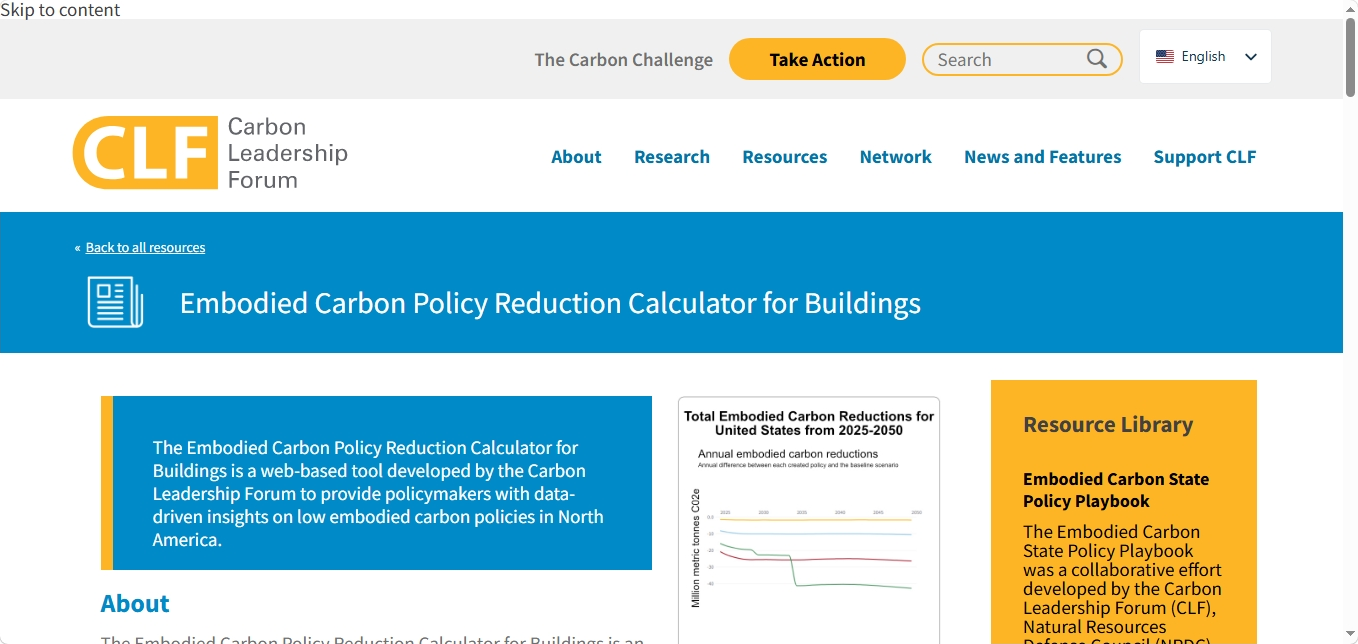
Scenario Comparison and Visualization: Compares projected emissions under different policy scenarios against the business-as-usual baseline, presenting results through graphs, tables, and numerical estimates.
Closing Insights
Released in April 2026, the calculator builds on a 2022 proof-of-concept developed by the Carbon Leadership Forum and C40 Cities. That earlier initiative involved pilot assessments in New York City, Portland, and Austin, examining how different construction policies could reduce embodied carbon emissions.
Version 1.0 incorporates updated methodologies and embodied carbon benchmarks. Its modelling covers commercial, multifamily residential, and single-family residential buildings, including structural, enclosure, interior, and mechanical systems. Users can also model phased policy implementation to examine how progressively stricter requirements affect emissions projections.
The calculator is publicly accessible and published under a Creative Commons Attribution-ShareAlike 4.0 licence. Its main limitation is geographic: the underlying projections and embodied carbon intensity data are US-specific. Furthermore, results are estimates based on generalized building types and modelling assumptions, not forecasts of actual compliance outcomes. For policymakers, the tool provides a useful starting point for comparing interventions, although local data and further analysis remain important before adopting regulations.