


Available DPP Features
Missing DPP Features
Pricing
Starting Price
Options
- Free
- Annual Subscription
Available Since
Deployment Options
- Web Browser (Cloud - Based)
Good Option For
- Medium Business (51-250 people)
- Large Business (250+ people)
Deep dive
Core Features
Digital Product Passport Generation
dpp.cloud enables manufacturers to create, manage and publish Digital Product Passports. The platform automatically generates DPP pages from imported product data and connects each product to a QR code.
QR Code Product Access
Each product receives a QR code that links to the digital product page. The QR code can provide access to mandatory compliance information and additional content such as manuals, tutorials, support options or webshop links.
This makes dpp.cloud a strong fit for Smart Packaging Software and Connected Product Software, although its primary category remains DPP.
PIM and ERP Data Integration
dpp.cloud is designed to connect with existing systems. The integration page describes mapping PIM or ERP data fields to a DPP pilot template, while the FAQ states that the platform is API-first and integrates into PIM, ERP and CRM systems.
High-Volume Product Data Processing
The home page states that dpp.cloud can deliver and update DPP data for more than 100,000 products in seconds and handle high-volume DPP data without manual cleaning or preparation.
Product Manuals, Guides and AI Chat
dpp.cloud can connect product scans to tutorials, step-by-step instructions and AI chat for the exact item, without requiring an app.
This is a strong customer support and self-service feature. It should be treated as connected product functionality, not as ESG reporting.
Service and Support Automation
The platform supports automated routing for customer support interactions. Its pricing page also references ticketing systems, in-app chat and video call support in more advanced packages.
This gives dpp.cloud a stronger after-sales and support automation angle than many DPP tools.
Shop and Aftermarket Integration
dpp.cloud can link relevant products, surface promotions, and send QR traffic directly to a store. The pricing page distinguishes basic shop integration from deeplink shop integration.
This supports aftermarket revenue opportunities, spare parts sales and customer engagement.
Versioned Product Data
The platform states that all DPP data is centrally maintained, versioned and managed in alignment with future EU data standards.
This is important for auditability, product lifecycle governance and regulatory readiness.
GS1 Digital Link Support
dpp.cloud’s roadmap states that it formalises a GS1 partnership and begins implementing GS1 Digital Link in 2026, with every product QR code resolving through a standards-compliant GS1 Digital Link.
Analytics Dashboards
The platform provides dashboards and statistics on locations, service cases and interactions. This supports product analytics and operational visibility.
It should not be confused with environmental performance analytics or carbon accounting.
White-Label Branding
dpp.cloud references white-label branding options in the FAQ. This allows manufacturers to present DPP pages and product interactions under their own brand experience.
Pilot-to-Scale Rollout
The platform offers a five-step process for launching a first DPP pilot in as little as eight weeks, including pilot scope, data mapping, code creation, physical rollout and KPI evaluation.
This is useful for manufacturers that need a structured implementation path rather than a fully open-ended consulting project.
Plans & Pricing
dpp.cloud offers transparent modular pricing with a one-time setup fee, annual platform license and one-off per-SKU activation bundles. Growth starts at €3,000 setup plus €7,000/year, Professional at €5,000 setup plus €12,000/year, and Enterprise is priced on request. SKU activation bundles range from €2,000 to €5,000, with reference prices from €1.00 to €0.25 per SKU.
Integrations
dpp.cloud connects to existing product data and business systems. Confirmed or stated integration categories include:
PIM systems
ERP systems
CRM systems
shop/webshop integrations
QR code workflows
GS1 Digital Link
product data templates
API-first integration
Akeneo PIM integration
The company states that a 2025 Akeneo partnership enables manufacturers to pull product data directly from their PIM and generate Digital Product Passports automatically.
Certifications & Awards
No specific third-party security certifications or awards are clearly disclosed on the reviewed pages. dpp.cloud states that it supports ESPR-aligned DPP data accessibility, security and interoperability and is implementing GS1 Digital Link. These references relate to DPP readiness and standards alignment, not product-level environmental certification or third-party sustainability assurance.
Expert Voices & Market Position
dpp.cloud occupies a practical position in the DPP software market. It is built for manufacturers that want to implement DPPs quickly using existing product data and QR access, while also using the DPP as a service and aftermarket channel.
Compared with adjacent DPP platforms:
PSQR is stronger for EPCIS-based event traceability and regulated supply chain infrastructure.
Arianee is stronger for open protocol product identity, ownership and luxury-oriented lifecycle engagement.
Kezzler is stronger for connected product serialization and broad smart packaging infrastructure.
Bombiix is stronger for PLM/PIM/DAM-native product development workflows.
Qliktag is stronger for NFC, digital twins and multi-carrier smart product deployment.
dpp.cloud is strongest where a manufacturer wants a fast DPP rollout connected to PIM/ERP data, QR product pages, service support and aftermarket experiences.
dpp.cloud should be positioned as:
Digital Product Passport Software.
Product Compliance Software.
Connected Product Software.
Smart Packaging Software.
Product Information Management Integration Software.
Circular Economy Software.
Its main differentiator is that it makes DPPs operationally useful beyond compliance. The platform turns product pages into service, support, spare parts and customer communication touchpoints.
Customers & Use Cases
dpp.cloud is designed for manufacturers, brands and distributors navigating EU DPP requirements. The pricing page explicitly names manufacturers, brands and distributors as its target users.
Typical customers include:
manufacturers.
brands.
distributors.
MedTech companies.
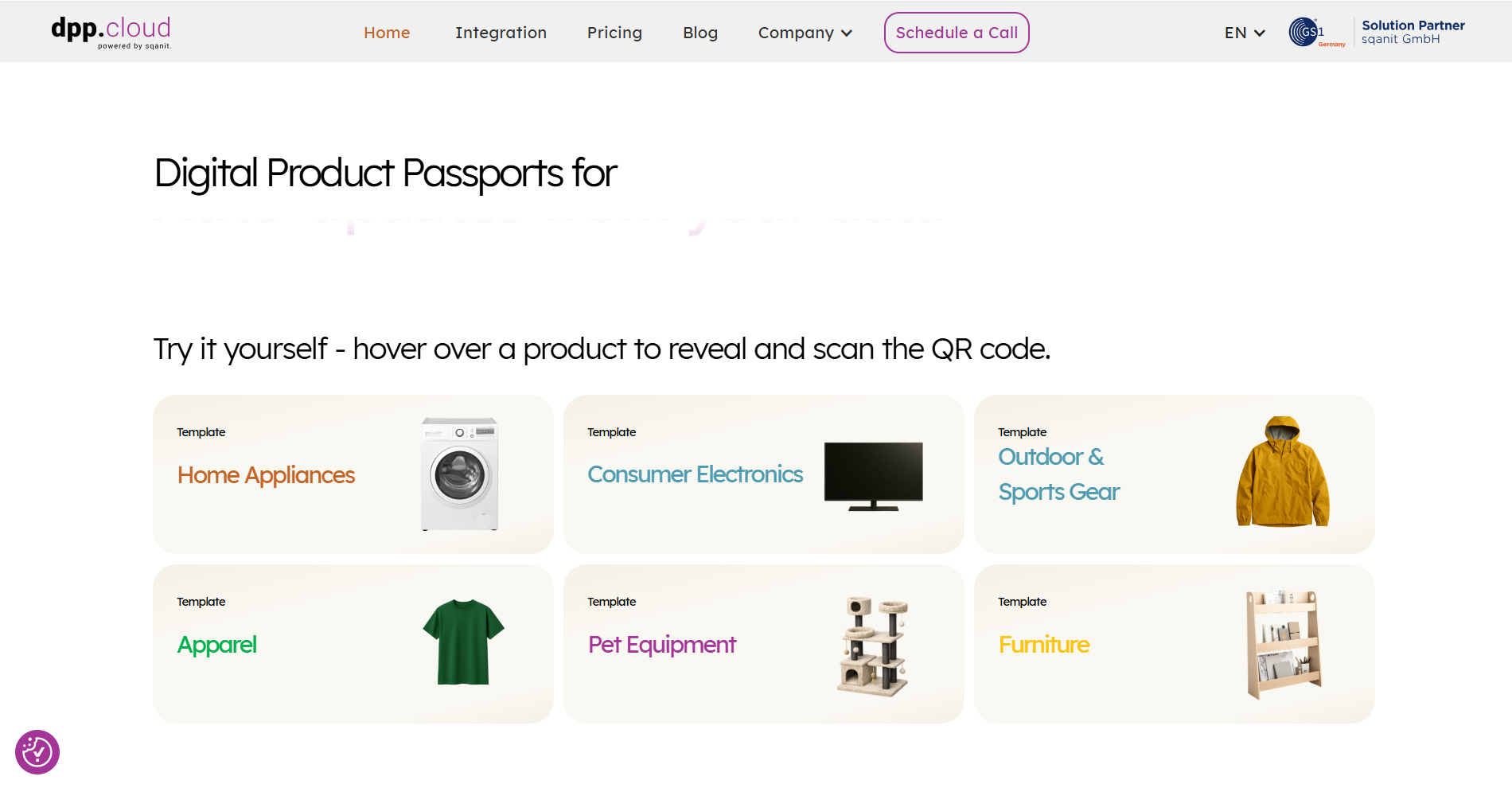
apparel companies.
furniture companies.
electronics and electrical goods manufacturers.
home appliance manufacturers.
outdoor and sports gear companies.
machinery and equipment manufacturers.
companies preparing for EU DPP requirements.
companies needing QR-based service and support experiences.
Publicly referenced customer or ecosystem names on the site include Henry Schein, Stryker, Akeneo, GS1 Germany, VDMA and others shown as logos or references. The About page states that MedTech companies including Henry Schein and Stryker use sqanit to manage installed base and service documentation at scale.
Typical use cases include:
creating Digital Product Passports.
generating QR-linked product pages.
importing product data from PIM or ERP.
automatically updating DPP data.
publishing manuals and guides.
enabling AI user manuals.
linking spare parts and webshop pages.
automating service routing.
managing returns and warranty workflows.
tracking product interactions and service cases.
scaling DPPs across 100,000+ products.
preparing pilots in eight weeks.
implementing GS1 Digital Link-based QR resolution.
Closing Insights
dpp.cloud should be understood as a manufacturer-focused Digital Product Passport platform that connects existing product data to QR-based passport pages and turns those pages into active customer touchpoints.
Its value lies in practical implementation. The platform supports pilot-to-scale rollout, transparent pricing, PIM/ERP integration, high-volume data updates, GS1 Digital Link alignment, QR product access, service automation, and aftermarket engagement.