

Available Other Features
Missing Other Features
Pricing
Starting Price
Options
Available Since
Deployment Options
- Web Browser (Cloud - Based)
Good Option For
- Freelancers (1 person company)
- Microbusiness (2-10 people)
- Small Business (11-50 people)
- Medium Business (51-250 people)
- Large Business (250+ people)
Deep dive
Core Features
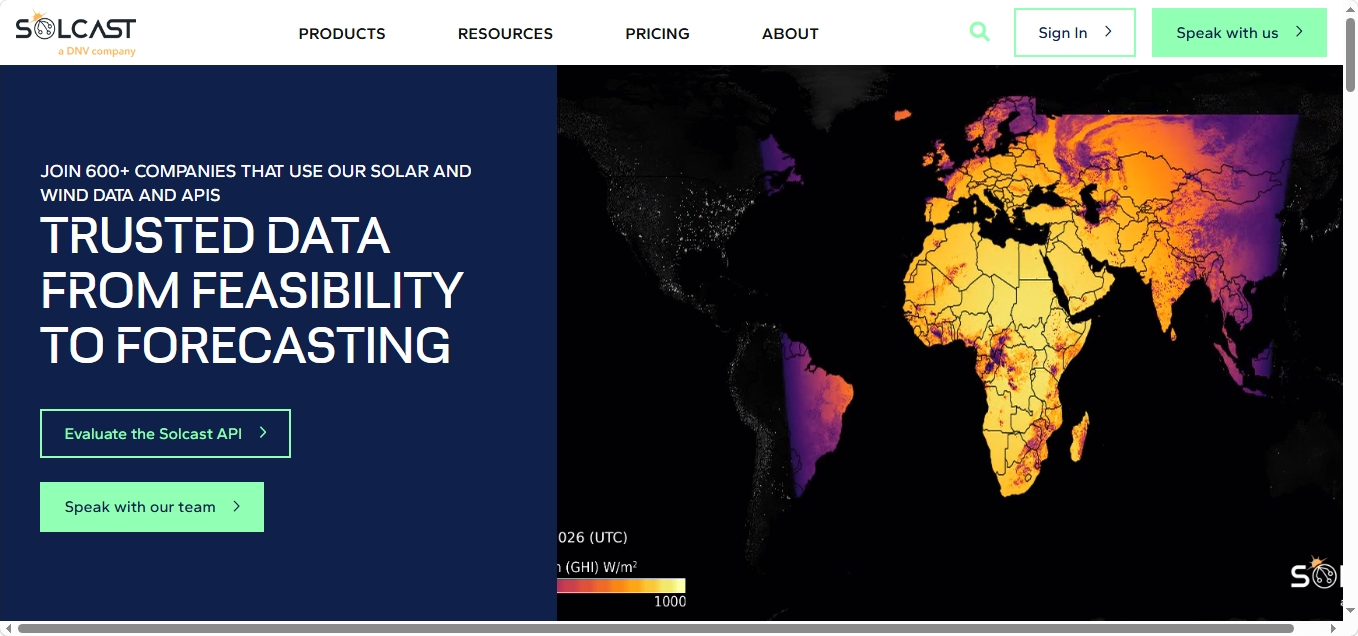
Solcast is delivered primarily through APIs and web downloads, allowing its data to feed directly into customers’ own software and analytical workflows. Its coverage spans long-term resource assessment through operational forecasting.
Historical Solar and Weather Data: Solcast provides historical irradiance and weather time series from 2007 to seven days before the present, with more than 20 parameters relevant to solar applications.
Typical Meteorological Year Data: TMY datasets represent typical long-term weather conditions at a location and are used when modelling the expected performance of proposed renewable-energy projects. Solcast's current TMY calculations use historical inputs through 2025.
Live Weather and Irradiance: Solcast tracks clouds using satellite imagery and produces updated estimates of irradiance, PV power and related conditions. Irradiance and PV-power information is updated every five minutes and downscaled to 90-metre resolution across non-polar continental areas and nearby islands.
Solar Forecasting: Forecasts extend from five minutes to 14 days ahead, helping operators anticipate changes in solar production. Applications include maintenance scheduling, electricity-market bidding, plant dispatch and grid planning.
PV Power Modelling: Users can translate weather and irradiance forecasts into expected electricity generation. Solcast offers Rooftop PV, Advanced PV and Premium PV models for different asset sizes and levels of complexity, with historical, live and forecast PV power available through the API.
API and Data Integration: Solcast's REST API supplies data in formats including JSON and CSV, with additional formats compatible with PVsyst and SAM. A Python SDK supports integration into developers' own applications, while commercial services include bulk requests and service-level agreements.
Closing Insights
Solcast was founded in Australia in 2016 by meteorologists James Luffman and Dr. Nick Engerer, who had experience applying weather information within the electricity sector. DNV acquired Solcast in January 2023, giving the platform access to DNV's wider renewable-energy expertise and digital portfolio. Solcast now says more than 600 companies use its solar and wind data and APIs, with customers operating across areas including renewable generation, energy trading and grid management.
Its value varies substantially by user. A solar developer can use historical data to estimate whether a prospective site has sufficient solar resource; an operating plant can compare actual conditions with expected production; a trader can use forecasts when preparing electricity-market bids; and a grid operator can anticipate how weather-driven generation will affect supply. Solcast therefore spans both project development and day-to-day operation, rather than serving only as a weather-data feed.
Solcast also connects with DNV products such as Solar Resource Compass and SolarFarmer. This wider ecosystem gives prospective users a progression from obtaining renewable-resource data through evaluating sites and forecasting operating assets, while more detailed solar-farm design and energy-yield modelling can be handled in DNV's specialist tools.