


Available Carbon Accounting Features
Missing Carbon Accounting Features
Pricing
Starting Price
Options
Available Since
Deployment Options
- Web Browser (Cloud - Based)
Good Option For
- Small Business (11-50 people)
- Medium Business (51-250 people)
- Large Business (250+ people)
Deep dive
Core Features
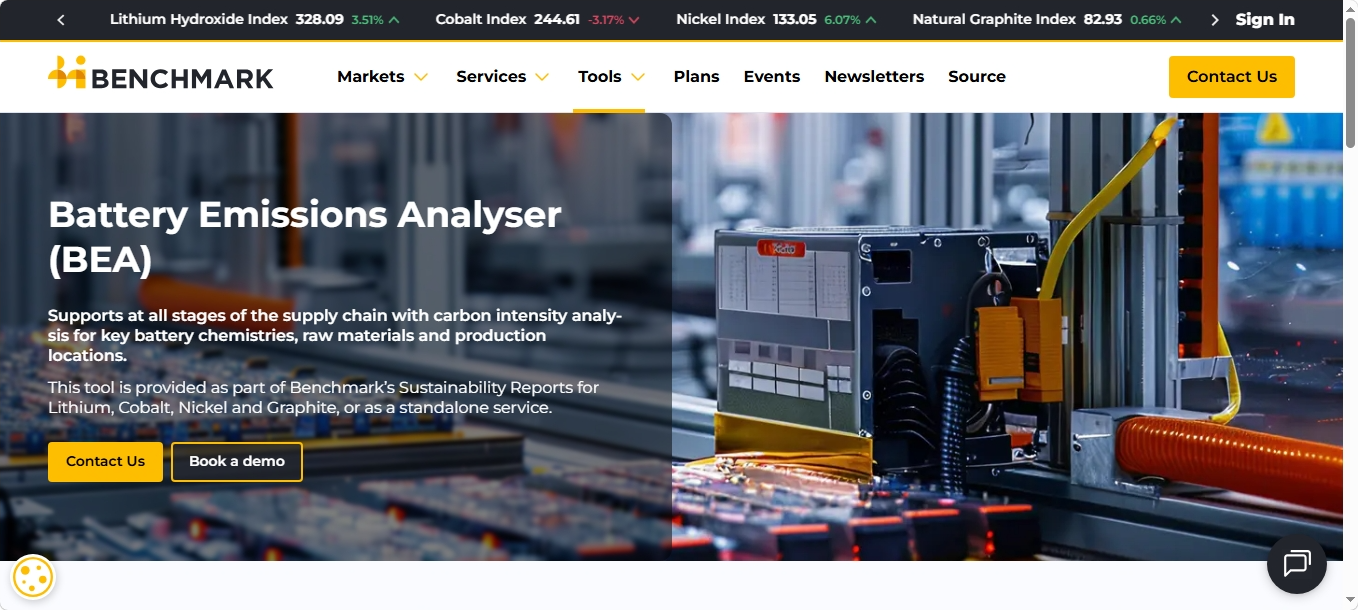
Benchmark’s Battery Emissions Analyser (BEA) is built around a comparative lifecycle assessment framework that evaluates how battery chemistry, manufacturing geography, energy mix, and raw-material sourcing affect carbon intensity. Delivered as an interactive Excel-based model with ongoing analyst support, the platform is designed for scenario testing and supply chain benchmarking rather than static reporting. Some of its main capabilities include:
Battery Chemistry Comparisons – Compares emissions across major cathode chemistries including among others NCM, NCA, LFP, and LMO.
Production Location Analysis – Assesses how regional manufacturing energy mixes and industrial processes influence battery emissions profiles.
Raw Material Sourcing Evaluation – Models how mining origin, refining routes, and feedstock selection affect overall battery carbon intensity.
Component-Level Carbon Breakdown – Provides emissions analysis by production stage and major battery components such as cathodes and anodes.
Scenario Testing Tools – Allows users to model alternative sourcing, chemistry, and manufacturing scenarios to support procurement and investment planning.
Integrated Analyst Support – Subscribers receive monthly data updates and year-round access to Benchmark analysts for customized interpretation and strategy discussions.
Closing Insights
Benchmark’s Battery Emissions Analyser is part of the company’s broader sustainability and supply-chain intelligence offering for battery materials and EV supply chains. The tool reflects growing industry pressure to understand not only battery cost and performance but also embedded emissions throughout EV supply chains.
BEA has been used to examine how battery chemistry, manufacturing location, electricity mix, and raw-material sourcing influence the carbon intensity of lithium-ion batteries. Benchmark’s analysis has highlighted that rising adoption of lithium iron phosphate (LFP) batteries could still create significant emissions challenges when production relies on carbon-intensive electricity grids and upstream processing routes. These findings reflect broader industry concerns about the environmental footprint of EV battery supply chains and the growing importance of lifecycle assessment tools in battery sourcing and procurement decisions.
The BEA platform therefore functions as a decision-support tool for battery and EV supply chains, helping stakeholders compare sourcing pathways and identify emissions hotspots before procurement or investment decisions are made.