

Available Other Features
Missing Other Features
Pricing
Starting Price
Options
Available Since
Deployment Options
- Web Browser (Cloud - Based)
Good Option For
- Freelancers (1 person company)
- Microbusiness (2-10 people)
- Small Business (11-50 people)
- Medium Business (51-250 people)
- Large Business (250+ people)
Deep dive
Core Features
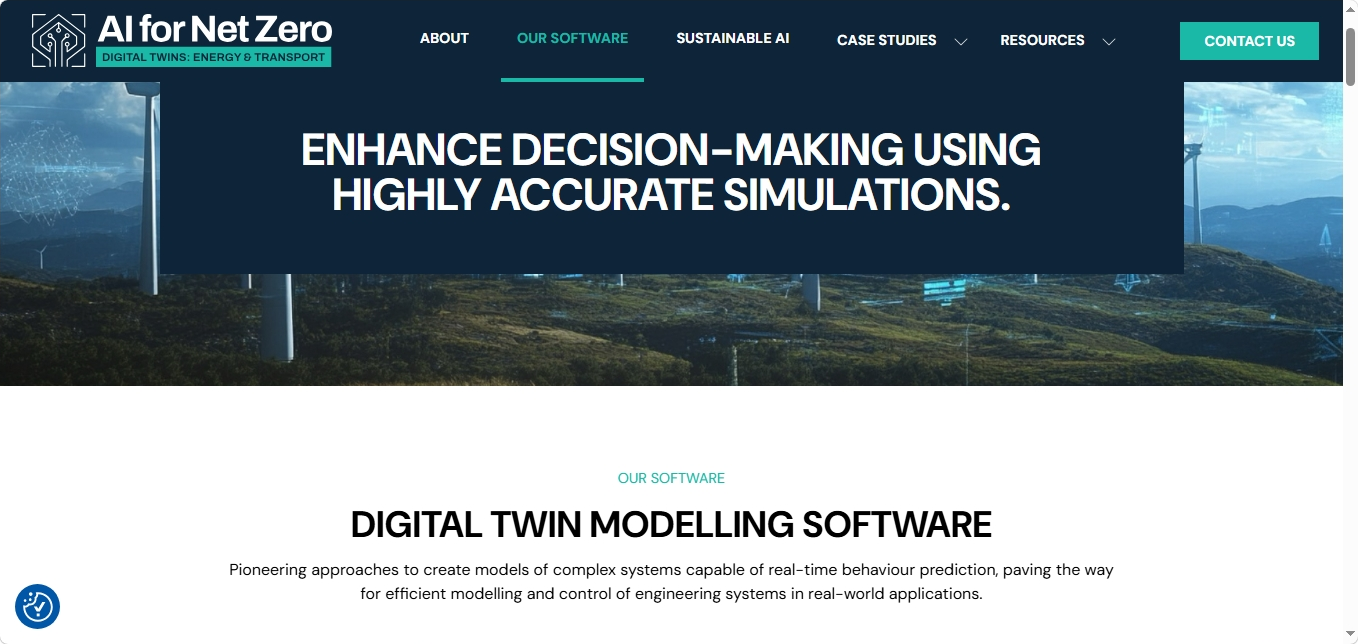
The software centres on real-time digital twins: virtual representations that are dynamically updated using information from their corresponding physical systems. AI for Net Zero emphasizes computational efficiency as well as accuracy, aiming to make sophisticated engineering models fast enough to inform real-world decisions and control.
Real-Time Digital Twin Modelling: Creates virtual models of physical engineering systems that can be continuously updated with real-world data and used to predict their behaviour.
Sensor Data Integration: Combines sensor measurements with physical models using scientific machine learning and data assimilation techniques, helping models respond to changing real-world conditions.
Predictive Analytics: Uses digital replicas to monitor and analyse system behaviour in real time, providing predictions that can support faster engineering decisions.
AI-Based Optimization & Control: Develops adaptive digital twins capable of determining more efficient operating conditions and ultimately controlling engineering systems toward safe and optimal operation.
Computationally Efficient Modelling: Uses low-order digital twins and energy efficient AI approaches designed to require less computing power while retaining accuracy and robustness to sensor noise.
Engineering Scenario Testing: Digital twins provide a virtual environment for testing ideas and operational changes, reducing reliance on expensive physical prototypes and experiments.
Closing Insights
AI for Net Zero is a UKRI/EPSRC-funded research programme, and its digital twin software is being developed to enable real-time modelling, prediction and optimization of complex energy and transport systems. The software is being demonstrated through three principal engineering applications. For wind farms, adaptive wake steering is being investigated to increase power generation. In road transport, active aerodynamic optimization aims to reduce vehicle drag and, in turn, energy consumption and emissions. Its hydrogen work uses digital twins to improve the safety, reliability and operational efficiency of hydrogen systems. Organizations interested in applying the technology to efficiency and optimization problems are invited to contact the project team. Collaboration may be particularly relevant for engineering systems where real-time prediction and control could reduce energy consumption, emissions or operating costs.