


Available Other Features
Missing Other Features
Pricing
Starting Price
Options
- Free
- One-Time Payment
Available Since
Deployment Options
- Web Browser (Cloud - Based)
Good Option For
- Freelancers (1 person company)
- Microbusiness (2-10 people)
- Small Business (11-50 people)
- Medium Business (51-250 people)
- Large Business (250+ people)
Deep dive
Core Features
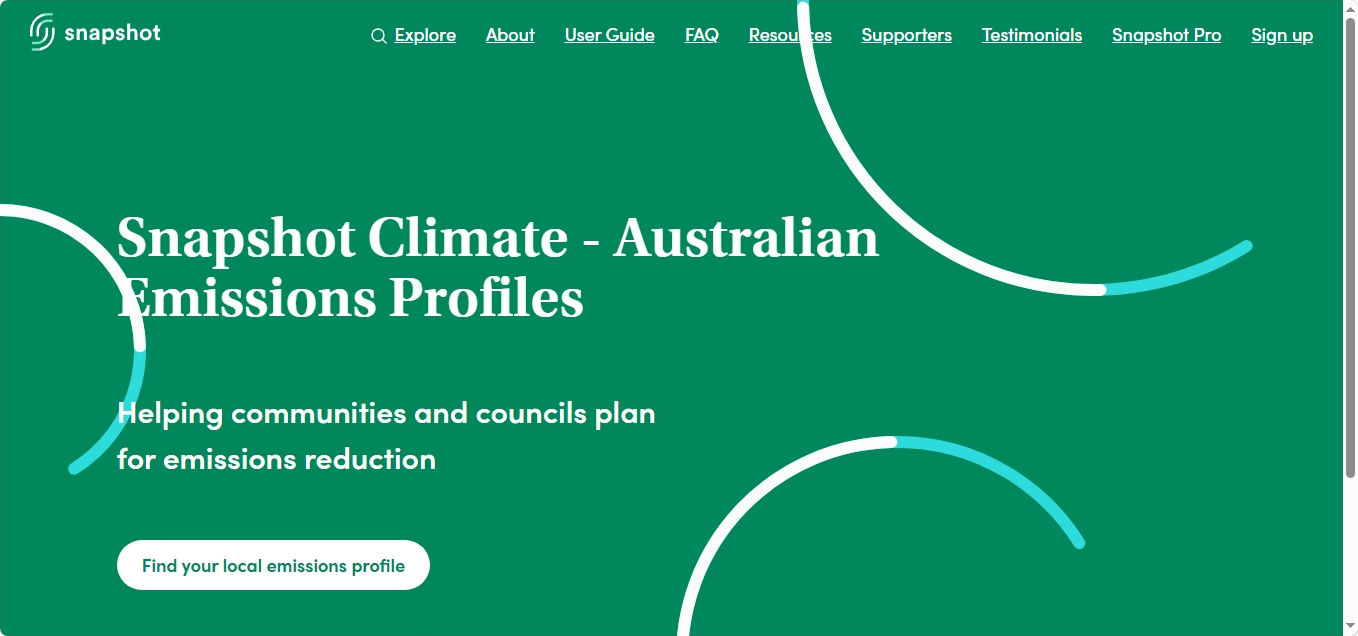
Snapshot applies a common methodology across Australia, allowing local emissions to be examined on a consistent basis. Profiles use locally sourced activity data where available and state or national datasets where necessary, following the Global Protocol for Community-Scale Greenhouse Gas Emission Inventories (GPC). Key features include:
Community Emissions Profiles: Provides profiles for all 537 Australian municipalities, 151 federal electorates and eight states and territories, covering the major sources of emissions within each geographic area.
Sector-Level Analysis: Breaks emissions down across stationary energy, transport, agriculture and land use, waste, fugitive emissions, and industrial processes and product use (IPPU), with further subsector analysis available.
Emissions Hotspot Identification: Helps councils and communities determine which activities contribute most to their footprint, providing a basis for prioritizing measures where reductions could have the greatest impact.
Time-Series Analysis: Users can move between annual profiles and time-series views to examine how overall and subsector emissions have changed. The current platform provides both calendar- and financial-year datasets.
Comparable Local Data: A common calculation framework enables comparison between municipalities and regions. Importantly, all local profiles reconcile with Australia's national emissions total, preventing emissions from simply disappearing between geographic inventories.
Reporting & Data Downloads: Results can be downloaded as CSV data, PDF reports and PNG graphics. Snapshot profiles are also compatible with reporting requirements under the Global Covenant of Mayors (GCoM) and CDP.
Closing Insights
Snapshot emerged from work by Ironbark Sustainability and Beyond Zero Emissions, which had encountered the difficulties councils and communities faced in obtaining affordable and comparable local emissions data. Launched in 2019, it provides a common starting point for identifying whether stationary energy, transport, agriculture, waste or other activities dominate a particular area's footprint. Its methodology follows the GPC and is published in detail, including calculation approaches, data sources and emission factors.
While the core Snapshot profiles are freely accessible, the offering also includes the paid Snapshot Pro service for councils and communities requiring more detailed analysis. Its Key Emitters Profile identifies significant emitters within a region to support engagement with local businesses and industry. Snapshot Pro ranges from a Core package to bespoke datasets and support, with pricing dependent on requirements.
Snapshot has a clear Australian focus, with its methodology specifically designed to produce consistent profiles across Australian municipalities. However, the underlying approach—combining standardized community emissions accounting with geographically allocated national and local datasets—could potentially be relevant elsewhere. Organizations outside Australia interested in a similar system may therefore want to contact Ironbark Sustainability and Beyond Zero Emissions to explore possible collaborations or implementations of the underlying methodology in other countries.