


Available Carbon Accounting Features
Missing Carbon Accounting Features
Pricing
Starting Price
Options
Available Since
Deployment Options
- Web Browser (Cloud - Based)
Good Option For
- Small Business (11-50 people)
- Medium Business (51-250 people)
- Large Business (250+ people)
Deep dive
Core Features
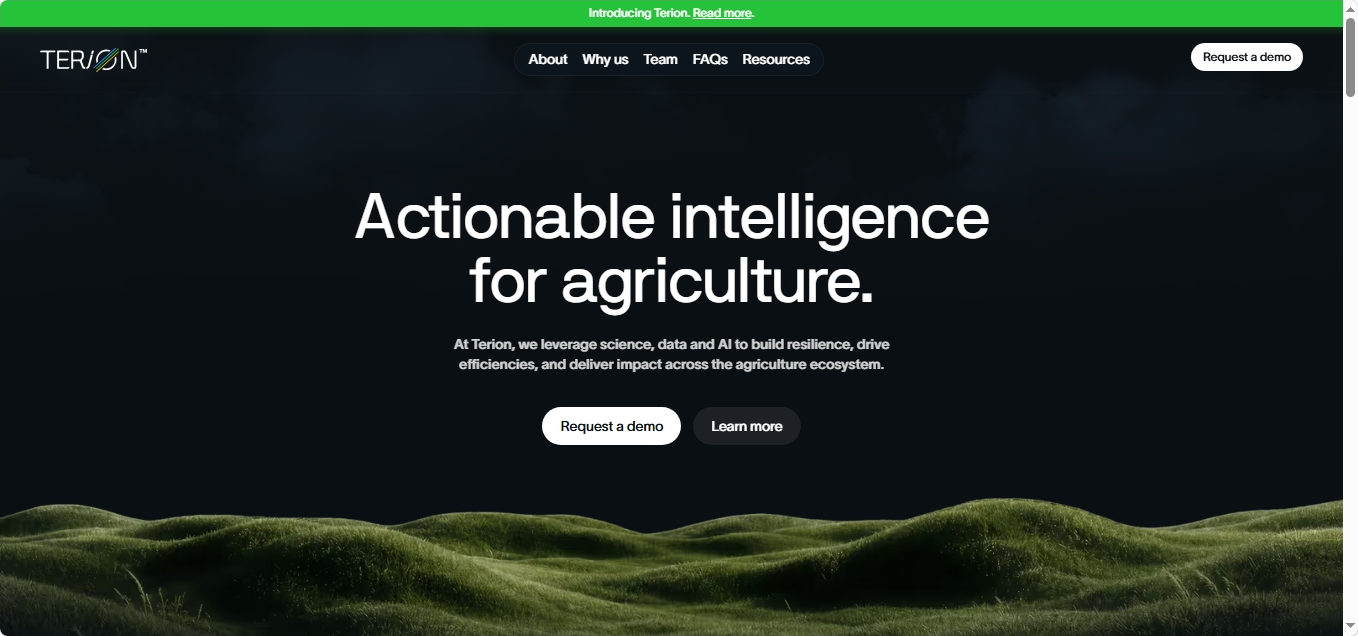
Terion combines proprietary field-level data, remote sensing and process-based agricultural modelling with AI-powered analytics. It uses multiple independently validated process-based models to simulate interactions among crops, soil, weather and management practices. Its key features include:
Agricultural MRV: Terion measures, reports and verifies agricultural outcomes at scale, providing businesses and program operators with evidence for sustainability initiatives, environmental claims and compliance requirements.
Scope 3 Program Management: Businesses can engage growers, deploy agricultural interventions and quantify verified outcomes for Scope 3 initiatives, connecting changes at farm level with corporate supply-chain programs.
Crop and Practice Modelling: Process-based models simulate crop, soil carbon, nitrogen, water and management interactions, allowing different practices and rotations to be evaluated before implementation.
AI-Powered Agricultural Analytics: Terion combines proprietary datasets with AI to generate predictions, recommendations and workflows from large volumes of agricultural information.
Biofuel Traceability and Compliance: The platform connects field-level practices and carbon-intensity information with biofuel supply chains. Terion also supports mass-balance chain-of-custody records.
Farmer Incentive Management: Public and private incentives can be combined within agricultural programs, while Terion supports farmer enrollment and program administration. This links environmental outcomes with financial opportunities for participating growers.
Closing Insights
Terion was formed in June 2026 by Flagship Pioneering through the combination of CIBO Technologies and Indigo Ag's Source business. CIBO contributed scientific modelling, AI and MRV capabilities, while Source brought enterprise integrations and an existing grower network. Terion currently serves customers across North America, Latin America and Europe and and operates from Boston, the U.S. Midwest and Brazil.
Terion’s outlook is closely tied to making agricultural data credible enough for decisions involving sustainability claims, regulation and investment. The company emphasizes its independence from agricultural input and product sales, which it says allows it to provide objective analytics. Its scientific development is also continuing: in September 2026, Terion detailed its use of multi-model ensembles, where multiple independently validated process-based models are run together and their agreement and uncertainty reported. This is intended to provide more defensible estimates while identifying cases where additional ground measurement is warranted.