


Available Carbon Accounting Features
Missing Carbon Accounting Features
Pricing
Starting Price
Options
Available Since
Deployment Options
- Web Browser (Cloud - Based)
Good Option For
- Freelancers (1 person company)
- Microbusiness (2-10 people)
- Small Business (11-50 people)
- Medium Business (51-250 people)
- Large Business (250+ people)
Deep dive
Core Features
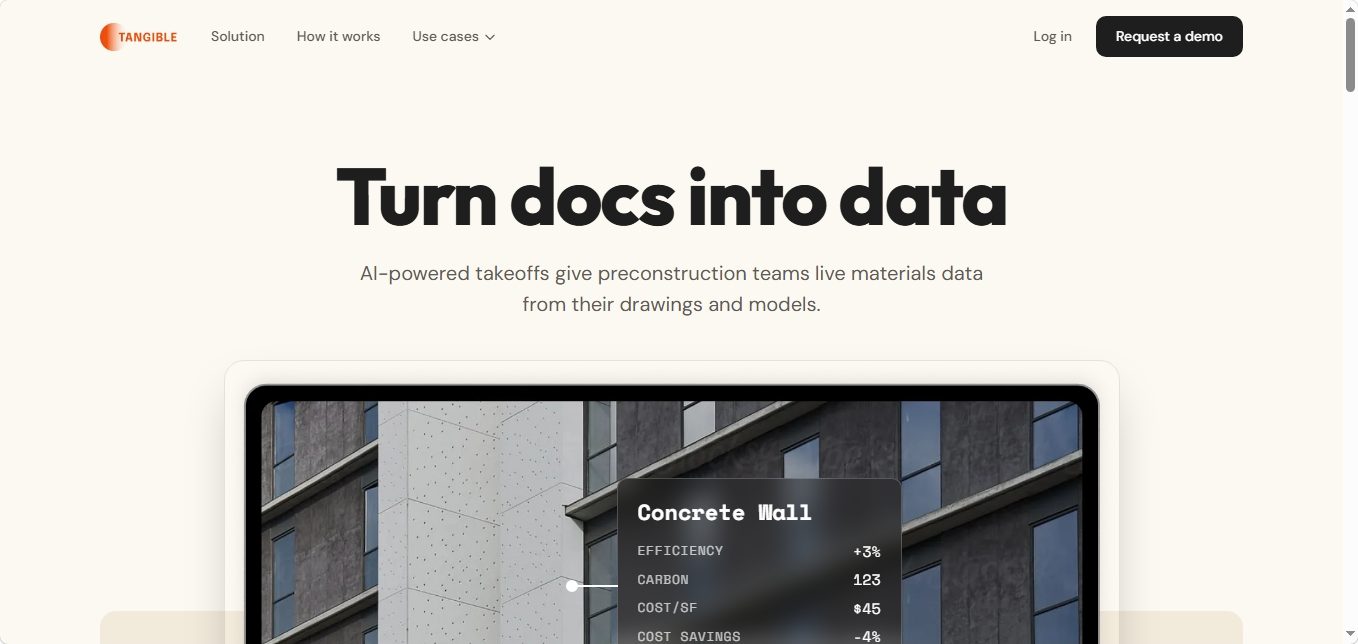
Tangible approaches carbon measurement from the underlying building design rather than from a conventional emissions inventory. Its AI-assisted takeoffs extract material quantities from project documents; those quantities are then connected to EPDs and lifecycle assumptions to produce traceable carbon data. Its key features include:
Design-Based Carbon Calculation: Tangible extracts quantities from Revit models and PDF drawings and maps building elements to standardized assemblies. This provides the material quantities needed to calculate embodied carbon without first constructing a separate quantity spreadsheet.
EPD-Backed Carbon Data: Materials are linked to Environmental Product Declarations sourced through EC3, initially using appropriate industry-wide data where necessary and allowing product-specific EPDs to replace them as specifications become more detailed. Users can also upload their own EPDs or carbon data.
Whole-Life Carbon Assessment: Carbon results can cover upfront embodied carbon (A1–A5), use and replacement stages and end-of-life impacts, as well as operational carbon under B6. Tangible documents its calculation methodology across a 60-year assumed building life.
Design Comparison & Carbon Reduction: Users can preserve versions at different design stages, compare their embodied carbon, swap materials or products and assess the effect before committing to a design. Carbon hotspots can also be identified by assembly or building element.
Carbon Benchmarking: Projects can be compared using carbon intensity and material metrics. Tangible uses CLF Material Baselines for many product categories and regional NRMCA and CRMCA benchmarks for US and Canadian concrete.
Carbon Reporting & Traceability: Carbon values remain linked to the underlying model geometry, drawing information and EPD. Tangible provides 18 predefined reporting scopes, including CALGreen, GRESB, ILFI and the Toronto Green Standard, and supports XLSX exports for reporting and further analysis.
Closing Insights
Founded in 2021 by Anneli Tostar and Nicole Granath, Tangible is particularly relevant where conventional carbon accounting tools stop: at the point where teams need to understand which physical materials are creating a building's emissions and what can still be changed about them. Tangible identifies customers including construction and development company Skanska, logistics real-estate developer and operator Prologis, and general contractor Hensel Phelps, illustrating its applicability across building development, ownership and construction workflows.