

Available Carbon Accounting Features
Missing Carbon Accounting Features
Pricing
Starting Price
Options
- Monthly Subscription
Available Since
Deployment Options
- Web Browser (Cloud - Based)
Good Option For
- Small Business (11-50 people)
- Medium Business (51-250 people)
- Large Business (250+ people)
Deep dive
Core Features
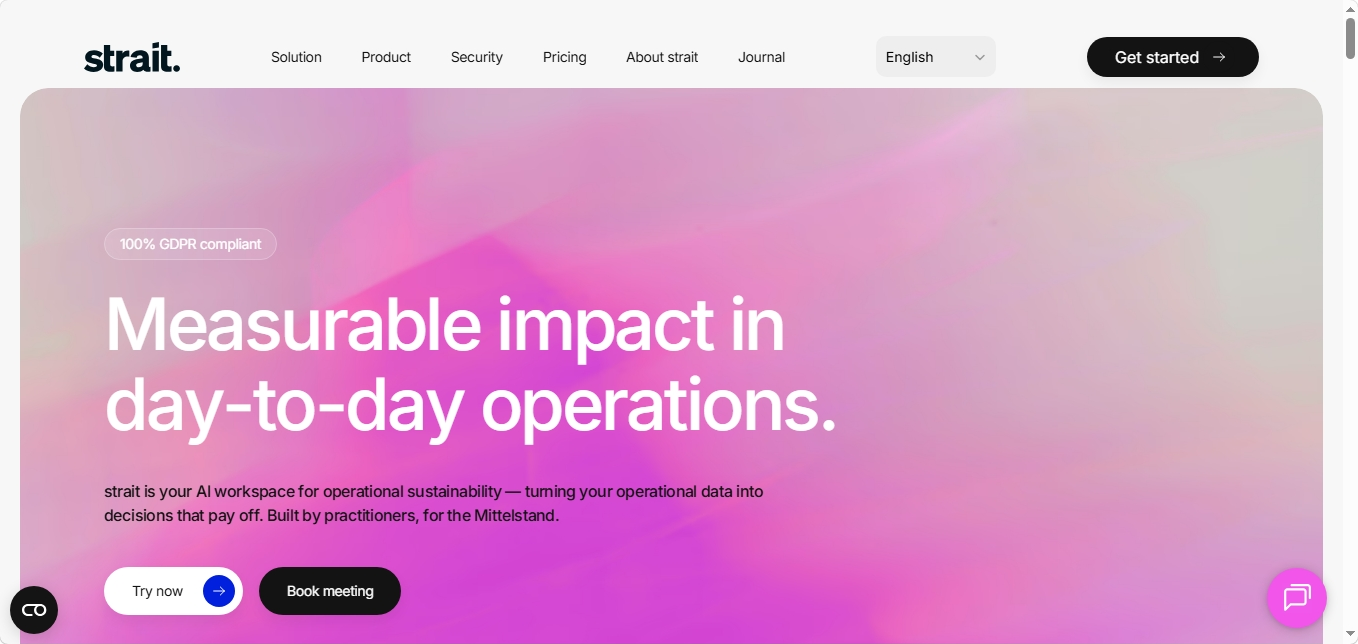
In the strait platform, existing information from invoices, Excel files, meters, ERP systems and operational processes can be combined with sensor data where additional measurement is needed. Its AI then helps analyse this information and translate findings into actions and reporting outputs. Its main features are:
Carbon Accounting: Generates greenhouse gas inventories covering Scopes 1, 2 and 3 from the operational data maintained within the platform, with figures remaining traceable to their underlying sources.
AI-Powered Analysis: strait's AI identifies anomalies, peak loads, hotspots and missing data and can answer questions based on a company's own information through its conversational workspace.
IoT & Real-Time Monitoring: Existing meters and smart meters can be connected, while strait offers non-invasive sensors for missing measurement points. Consumption data can then be captured automatically and monitored in real time.
Location Intelligence: Companies can compare sites, identify patterns and anomalies, and determine where energy consumption, emissions and operating costs offer the greatest opportunities for improvement.
Measures & ROI: Potential improvements are assessed using factors including expected savings, implementation effort, CO₂ impact and payback period, with responsibilities and implementation progress tracked in the platform.
Automated Sustainability Reporting: The Reporting Agent uses existing data to generate greenhouse gas inventories, VSME reports, EcoVadis responses and customer questionnaires, maintaining an audit trail back to source information.
Closing Insights
strait was founded in Nuremberg in 2024 to address what its team saw as a gap between sustainability strategy, reporting and everyday operations. Its approach reflects that origin: instead of replacing existing infrastructure, strait connects systems, files, meters and sensors and uses the resulting data for both operational improvements and sustainability evidence. A published customer example is Holzmanufaktur Decker, where identifying a specific operational issue produced potential savings of more than €3,500 annually. While the platform is developed in Germany and targets small and mid-sized German businesses, but its combination of Scope 1–3 accounting, EcoVadis support and operational sustainability management could also be relevant to SMEs elsewhere, subject to their reporting requirements.