

Available Carbon Accounting Features
Missing Carbon Accounting Features
Pricing
Starting Price
Options
Available Since
Deployment Options
- Web Browser (Cloud - Based)
Good Option For
- Small Business (11-50 people)
- Medium Business (51-250 people)
- Large Business (250+ people)
Deep dive
Core Features
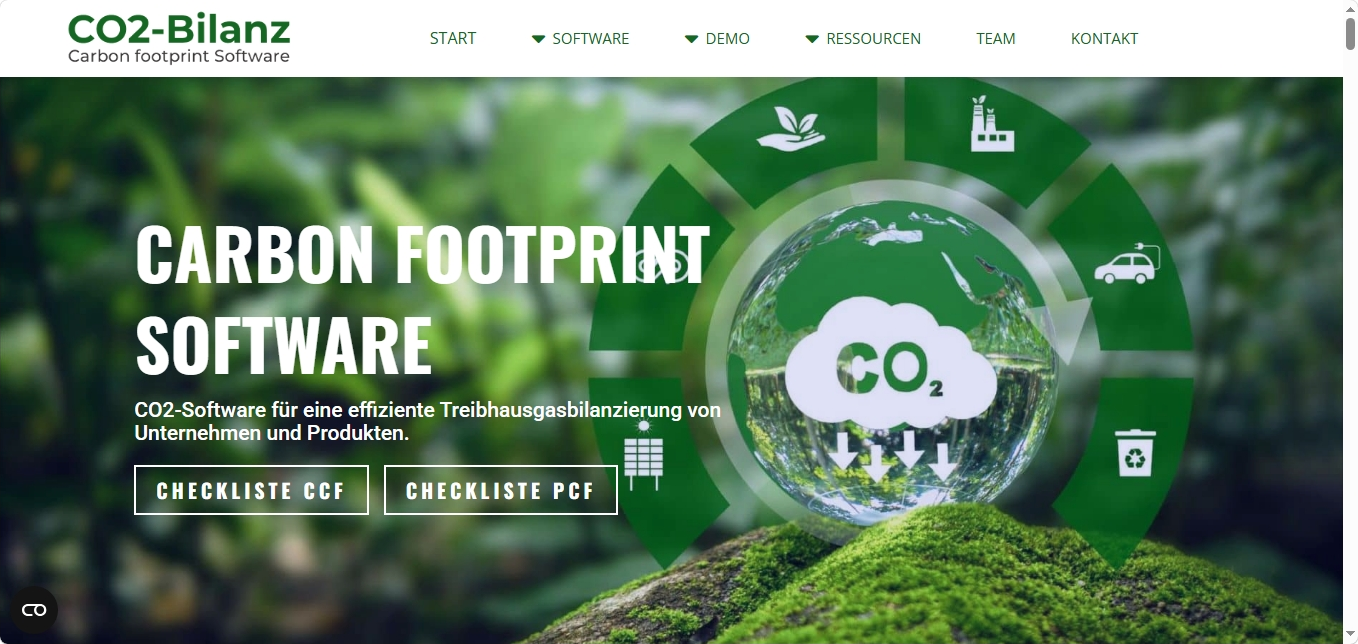
CO2-Bilanz Climate Software primarily follows an activity-based approach, converting information such as energy use, fuels, materials and transport into emissions using environmental factors. Users can define organizational boundaries and structures, add their own categories and factors, and select updated releases of underlying datasets. Its main features include:
Corporate Carbon Footprint: Calculates emissions across Scopes 1, 2 and 3, with flexible organizational structures covering sites, buildings, fleets, projects and events.
Product Carbon Footprint: Supports product-level greenhouse gas accounting under ISO 14067, incorporating materials, energy, production processes, transport and upstream emissions.
Emissions Factor Database: Provides factors for materials, processes, transport and infrastructure, including access to more than 18,000 ecoinvent entries; users can also add proprietary factors and select updated database releases.
Data Integration: Supports data exchange through Excel, CSV and API, alongside customizable standard interfaces, automatic unit and currency conversions and plausibility checks.
Reduction Planning: Enables multi-year comparisons, identification of major emissions sources, planning of reduction measures and visualization of an emissions reduction pathway.
Environmental Footprinting: Beyond carbon, the Product Environmental Footprint functionality assesses additional impacts involving emissions to air, soil and water, resource consumption, waste and noise.
Closing Insights
CO2-Bilanz Climate Software is offered by sanss GmbH, a Fellbach-based German software provider. According to the company, its climate software solutions have been used for 20 years and that, together with a partner network involving more than 400 employees, it serves over 3,000 customers from the industrial and public sectors.
Its combination of CCF and PCF functionality is noteworthy for companies that need corporate emissions and product-level calculations within the same software portfolio. Sector-specific configurations are also available: for example, the healthcare solution includes hundreds of clinical emissions factors, while approximately 100 hospitals currently participate in its anonymized benchmarking platform. Engineering-sector workflows include predefined materials and automated calculation of upstream transport emissions using supplier locations.
Although developed in Germany and oriented toward the German-speaking market, the underlying methodologies have wider applicability. The software supports the GHG Protocol, ISO 14064 and ISO 14067, alongside reporting requirements such as GRI, CDP and CSRD, and other environmental assessments that accommodate requirements across EU countries and Switzerland. This could make it relevant to organizations outside Germany, particularly those seeking internationally standardized CCF and PCF calculations, although prospective users should confirm country-specific coverage.