


Available Energy Management Features
Missing Energy Management Features
Pricing
Starting Price
Options
Available Since
Deployment Options
- Web Browser (Cloud - Based)
Good Option For
Deep dive
Core Features
1) Real-Time Energy Monitoring
SanaLife Energy provides continuous, near real-time monitoring of energy consumption across connected systems. This includes:
live tracking of electricity usage.
monitoring of system-level or building-level consumption.
detection of abnormal usage patterns.
Real-time monitoring enables organizations to respond more quickly to inefficiencies and operational issues.
2) Data Aggregation and Integration
The platform integrates data from:
energy meters.
building systems.
IoT-enabled devices.
This enables the consolidation of multiple data streams into a unified environment, reducing fragmentation and improving data consistency.
However, integration depth may vary depending on implementation and available infrastructure.
3) Energy Data Analytics and Insight Generation
SanaLife Energy includes analytical capabilities that allow users to:
analyse historical energy consumption.
identify trends and seasonal variations.
detect inefficiencies or anomalies.
understand operational energy behaviour.
These analytics support informed decision-making but do not extend into automated optimization.
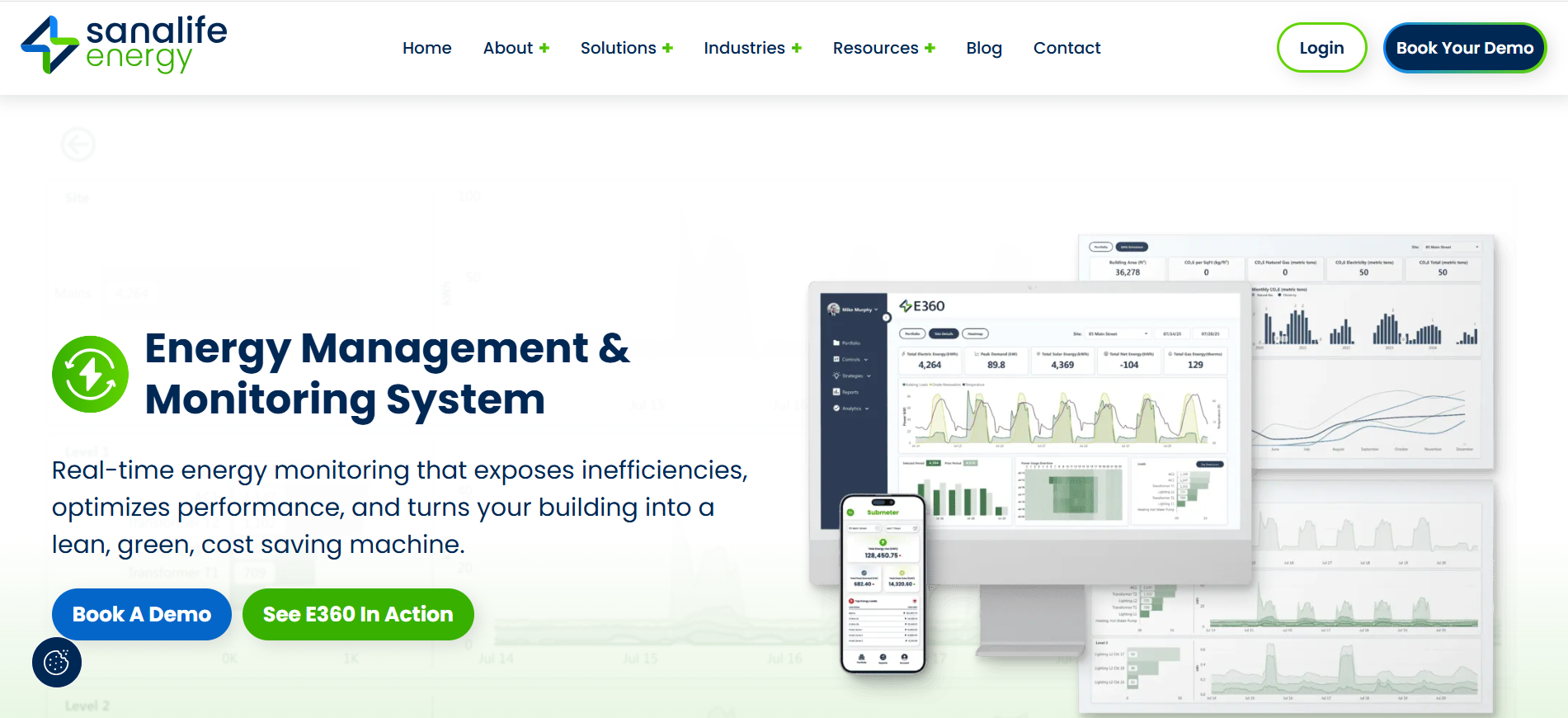
4) Dashboards and Vizualisation
The platform provides configurable dashboards designed to:
present energy data in an accessible format.
visualise key performance indicators.
support both operational monitoring and reporting.
Dashboards play a central role in enabling non-technical users to interpret energy data effectively.
5) Alerts and Notifications
The system generates alerts based on:
predefined thresholds.
abnormal consumption patterns.
system events.
These alerts support proactive management by notifying users of potential issues before they escalate.
6) Multi-Site Monitoring and Portfolio Visibility
SanaLife Energy supports monitoring across multiple locations, enabling:
centralised oversight of energy consumption.
comparison across sites.
portfolio-level analysis.
This is particularly relevant for organisations managing distributed assets.
Plans & Pricing
Pricing is not publicly disclosed.
Based on typical market positioning, the platform is likely:
subscription-based (SaaS).
priced according to the number of sites, devices, or data volume.
Integrations
The platform integrates with:
energy meters.
IoT sensors.
building systems.
These integrations enable data ingestion but do not imply control over systems.
In the broader system architecture, SanaLife sits at the energy monitoring and analytics layer (above data acquisition, below optimization/control).
Certifications & Assurance
No ESG certifications or compliance guarantees are indicated.
The platform supports internal monitoring and analysis, not regulatory assurance or certification.
Expert Voices & Reviews
SanaLife Energy appears to operate as a smaller or niche provider in the energy monitoring segment.
Public information is limited, and:
third-party analyst coverage is minimal.
large-scale enterprise benchmarking is not widely available.
This suggests that:
due diligence is important for enterprise deployments.
the platform may be best suited for specific or smaller-scale use cases.
Customers & Use Cases
Typical use cases include:
monitoring energy consumption across buildings.
identifying inefficiencies and abnormal usage.
supporting energy efficiency initiatives.
improving operational visibility.
enabling data-driven energy management.
The platform is particularly useful for organisations at an early to intermediate stage of energy management maturity.
Closing Insights
SanaLife Energy should be positioned as a foundational energy monitoring and analytics platform.
Its value lies in:
providing visibility into energy consumption.
enabling data-driven insights.
supporting efficiency improvements.
However, it does not provide:
automated optimization.
system control.
emissions accounting.
ESG reporting.
It is best understood as a first-layer energy intelligence tool within a broader energy management ecosystem.