


Available Carbon Accounting Features
Missing Carbon Accounting Features
Pricing
Starting Price
Options
Available Since
Deployment Options
- Web Browser (Cloud - Based)
Good Option For
- Small Business (11-50 people)
- Medium Business (51-250 people)
- Large Business (250+ people)
Deep dive
Core Features
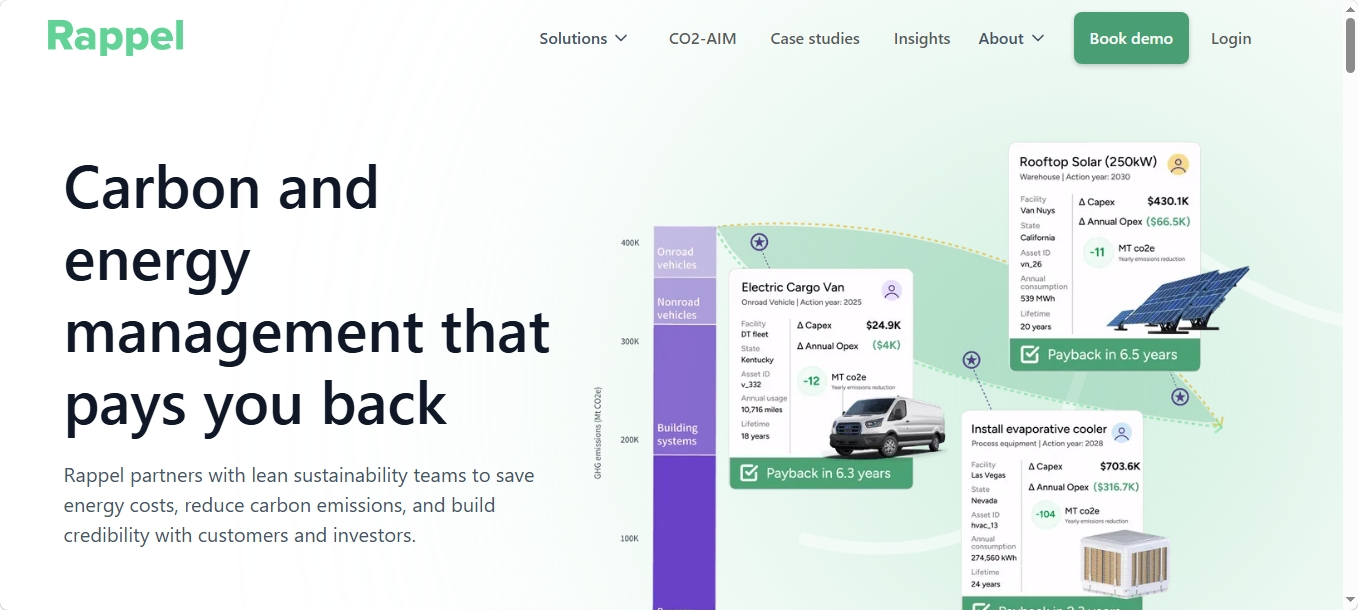
Rappel combines software, carbon analytics, and sustainability expertise to support organizations throughout the decarbonization process. Its modular platform enables businesses to start with greenhouse gas accounting before progressing to energy assessments, climate risk analysis, and investment-focused decarbonization planning.
GHG Emissions Inventory – Calculates carbon emissions using flexible data ingestion, AI-assisted bill reading, automated emissions-factor mapping, and built-in data validation.
Asset-Level Decarbonization Roadmaps – Evaluates emissions reduction measures across energy efficiency, renewable energy, fleet transition, and fuel switching to produce prioritized implementation roadmaps.
Energy Assessments – Creates site-level energy profiles using existing operational data, identifies major energy users, and estimates both emissions reduction and financial savings opportunities.
Climate Risk Assessment – Assesses physical and transition climate risks through scenario analysis and generates disclosure-ready reports aligned with TCFD, CDP, and California SB 261 requirements.
Scenario Optimization – Uses the CO₂-AIM model to compare corporate emissions reduction targets, implementation costs, and financial outcomes through 2050, helping organizations identify the most cost-effective pathways.
Integrated Action Tracking – Translates decarbonization strategies into year-by-year implementation plans with assigned actions, enabling organizations to monitor execution and progress.
Closing Insights
Rappel distinguishes itself by framing carbon management as an operational and financial decision-making tool rather than simply a reporting exercise. Central to this approach is CO₂-AIM, the company's proprietary modelling engine, which combines operational data with more than 60 industry, government, and market datasets to estimate the carbon reduction potential, capital requirements, operational savings, and implementation timing of over 1,500 decarbonization measures. By linking emissions directly to business assets and investment decisions, the platform is designed to help organizations identify projects that deliver both environmental and financial returns.
Rappel reports that its customers typically uncover 10–20% energy cost savings through prioritized operational improvements. Published case studies feature organizations including StandardAero, TemperPack, and The State Group, demonstrating applications across aerospace, manufacturing, and logistics. The company complements the platform with direct access to sustainability experts throughout implementation, making it particularly suited to organizations with limited in-house sustainability resources. Pricing is available on request, with solutions offered as modular packages covering greenhouse gas inventories, energy assessments, decarbonization roadmaps, and climate risk analysis.