

Available Other Features
Missing Other Features
Pricing
Starting Price
Options
- Free Trial
- Annual Subscription
Available Since
Deployment Options
- Web Browser (Cloud - Based)
Good Option For
- Individuals
- Freelancers (1 person company)
- Microbusiness (2-10 people)
- Small Business (11-50 people)
- Medium Business (51-250 people)
- Large Business (250+ people)
Deep dive
Core Features
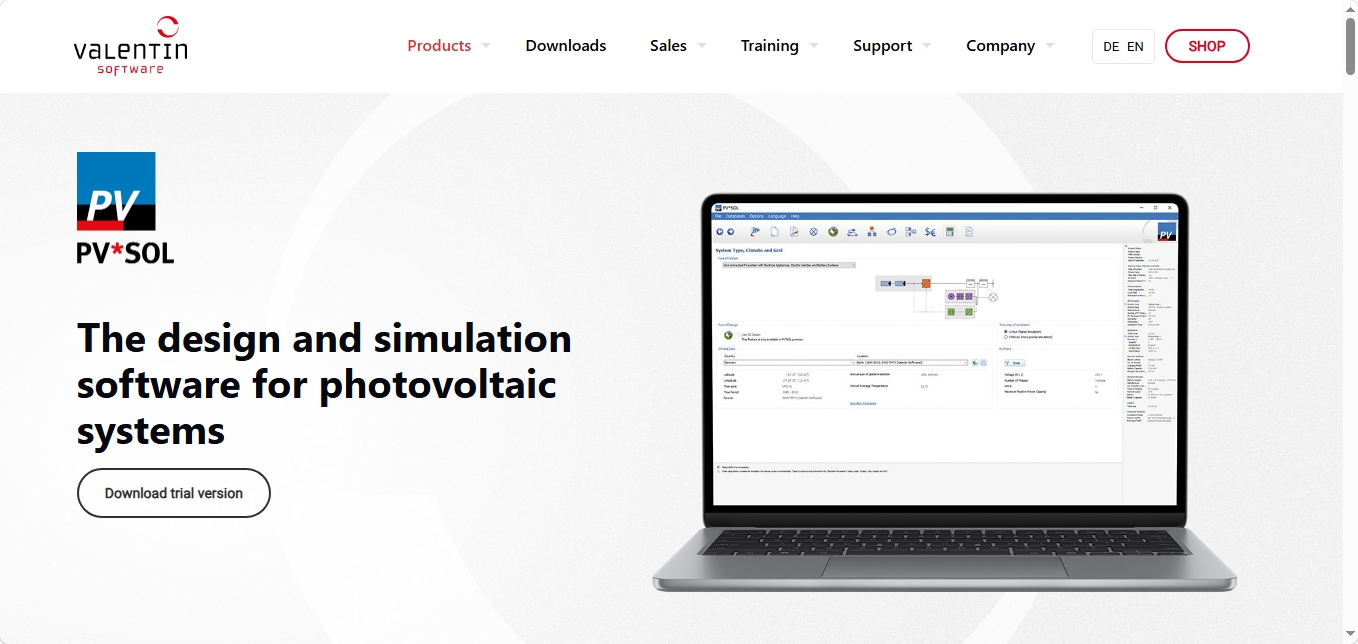
PV*SOL combines time-step simulation with component databases and financial modelling. The software models PV module behaviour using irradiation, temperature, wind, system geometry and manufacturer data, allowing users to investigate expected performance under realistic operating conditions.
PV Yield Simulation: PV*SOL simulates PV generation using worldwide climate data at hourly or one-minute resolution. Calculations account for factors including irradiation, module temperature, reflection and electrical behaviour.
System & Inverter Configuration: Users can configure grid-connected and off-grid installations, with automatic inverter configuration or manual adjustment of strings and MPP trackers. Polystring configurations and power optimizers are also supported.
2D System Planning & Shading: Standard PV*SOL supports roof-area planning without the premium version's 3D environment. Shading losses can be entered as annual percentages or represented through horizon lines, including horizon data imported from PVGIS.
Battery Storage Simulation: PV*SOL models AC- and DC-coupled battery configurations and calculates energy flows between PV generation, electrical loads, batteries and the grid, including charging and discharging behaviour.
Electric Vehicle Modelling: EV charging can be incorporated into the energy simulation. A PV-optimized charging strategy can prioritize available solar electricity while accounting for the vehicle's required energy and availability.
Financial Analysis: Users can model investment costs, operating expenses, subsidies, electricity tariffs and financing. Outputs include internal rate of return, payback period, cash flow and levelized cost of electricity, with P50/P90 yield assumptions available for bankability analysis.
Closing Insights
PV*SOL is developed by Valentin Software, a Berlin-based company specializing in renewable energy planning software. Beyond generation capacity, PV*SOL gives users a more realistic picture of how a proposed system might perform. It considers local climate conditions, the specific solar panels and other equipment being installed, how much electricity the property uses, battery storage and electricity prices. Its extensive product database includes commercially available solar panels, inverters and battery systems, with product information maintained by manufacturers. This allows users to design and test systems using actual equipment rather than relying only on generic assumptions. Prospective users should distinguish PV*SOL from PV*SOL premium when selecting a licence. Both provide the underlying PV simulation and economic-analysis capabilities, but detailed 3D system planning is explicitly reserved for the premium edition.