

Available Other Features
Missing Other Features
Pricing
Starting Price
Options
- Free Trial
Available Since
Deployment Options
- Web Browser (Cloud - Based)
Good Option For
- Individuals
- Freelancers (1 person company)
- Microbusiness (2-10 people)
- Small Business (11-50 people)
- Medium Business (51-250 people)
- Large Business (250+ people)
Deep dive
Core Features
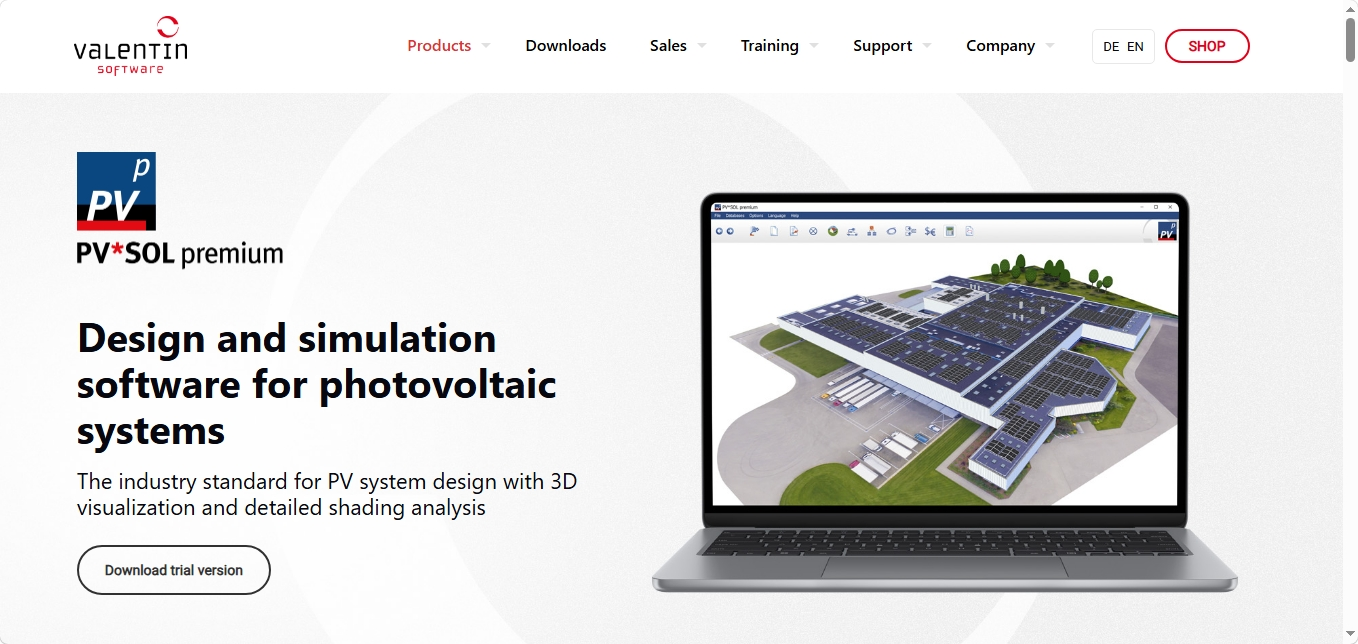
PV*SOL premium combines the simulation capabilities available in PV*SOL with a more detailed spatial design workflow. Its 3D environment is particularly useful for projects where roof shape, nearby buildings, trees, chimneys or other objects can materially affect where modules should be installed and how much electricity they are likely to produce.
3D PV System Design: Users can recreate buildings and surrounding objects, design roof-mounted, roof-integrated and ground-mounted systems, and place up to 7,500 mounted or 10,000 roof-parallel modules within the 3D environment.
Detailed Shading Analysis: The software calculates shading from surrounding 3D objects and can show the resulting reduction in solar radiation for individual modules and points across a PV area, supporting more informed module placement and yield estimates.
Building & Site Modelling: Buildings can be created from floor plans, cadastral maps and map imagery or imported as 3D models. Elevation data and orthophotos from Google Solar API can assist site modelling, while automatically generated Rexplorer LiDAR building models are available for locations in Germany.
PV Yield & Energy Simulation: Worldwide climate data and detailed system modelling are used to estimate generation and energy flows. Projects can incorporate household or commercial electricity use, battery storage, electric vehicles and thermal systems.
Equipment & Electrical Design: Manufacturer-maintained databases contain more than 30,000 PV modules, 9,000 inverters and 16,000 battery systems. PV*SOL premium also supports inverter configuration, module interconnection and customizable circuit diagrams incorporating cables and safety devices.
Financial Analysis & Project Reports: Users can add system costs and electricity tariffs to assess economic performance over 20 years. Simulation and financial results can then be presented in customizable reports, while project data and results can also be exported for further processing.
Closing Insights
PV*SOL premium is developed by Valentin Software, a Berlin company specializing in renewable energy planning and simulation tools. For prospective users choosing between its two PV products, the distinction is straightforward: PV*SOL premium includes the underlying design and simulation functionality of PV*SOL but adds 3D visualization and detailed 3D shading analysis. This makes the premium edition particularly relevant where roof geometry and surrounding objects need to be represented in detail rather than handled through a simpler 2D workflow.
PVSOL premium is also updated frequently. Since PV*SOL premium 2025 Release 1 arrived in November 2024, Valentin Software has issued a steady succession of releases, in some periods roughly monthly, combining new functionality with smaller improvements and bug fixes. The 2026 generation launched in November 2025 and had reached PV*SOL premium 2026 Release 8 by September 2026. Recent additions have included automatically generated 3D building models using Rexplorer LiDAR data in Germany, additional map providers, updated climate datasets and new load profiles.
Prospective users can test PV*SOL premium free for 30 days. A one-year user licence costs €845 plus VAT.